Last updated: June 14, 2026
Quick Answer
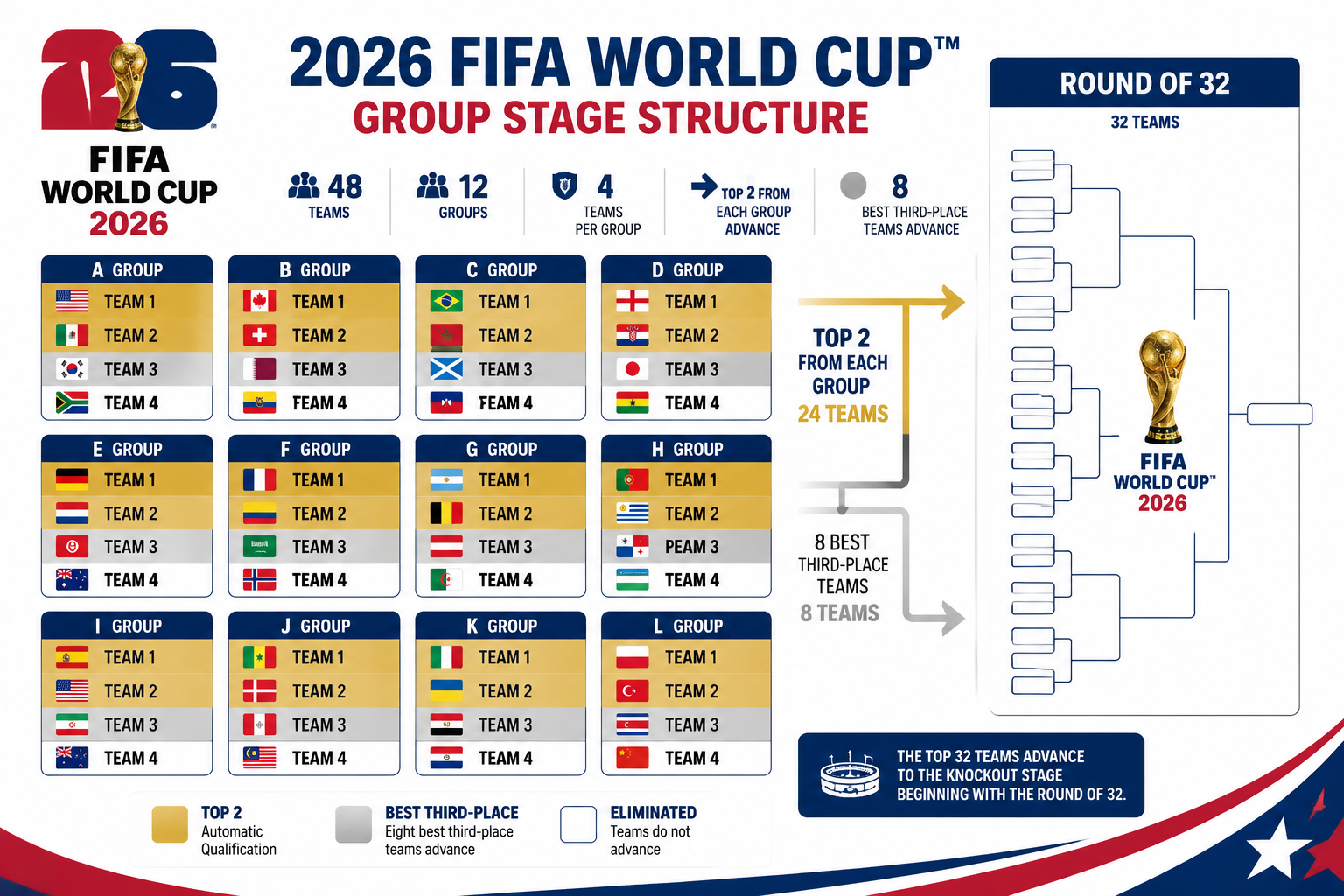
At the 2026 FIFA World Cup, 32 teams advance past the group stage to the knockout rounds. The top two finishers from each of the 12 groups (24 teams) qualify automatically, and the eight best third-placed teams across all groups also go through. [1]
Key Takeaways
- 32 teams advance from the group stage to the Round of 32 at the 2026 World Cup
- The tournament has 12 groups of four teams each, a change from the previous 8-group format
- The top two teams from every group advance automatically (24 teams total)
- The eight best third-placed teams from across all 12 groups also advance
- Points are the primary ranking method: 3 for a win, 1 for a draw, 0 for a loss
- Tiebreakers go in this order: goal difference, goals scored, head-to-head results, fair play points, FIFA rankings
- A team with zero points cannot advance, as at least one win (3 points) is needed to be competitive for a third-place berth
- The men’s and women’s World Cups use different formats and different numbers of advancing teams
- The group stage runs from June 11 to June 27, 2026, with 72 matches played [3]
- After the group stage, the tournament follows a straight knockout format through to the Final on July 19, 2026 [3]
How Many Teams Go Through After the Group Stage in the World Cup
32 teams advance from the group stage to the knockout rounds at the 2026 FIFA World Cup. This is the direct answer, and it applies specifically to the expanded 48-team format introduced for 2026. The route to that number of 32 breaks down clearly: 24 automatic qualifiers (two per group) plus 8 wild-card spots for the best third-placed teams.
This format is brand new. Previous World Cups from 1998 to 2022 used 32 teams in 8 groups, with 16 teams advancing. The jump to 48 teams across 12 groups changes the math significantly and gives more nations a genuine shot at the knockout stage.
For a full breakdown of every group and how seedings were decided, see the World Cup 2026 Groups: Teams, Seeds and How It Works guide.
How Many Teams Qualify From Each Group in the World Cup
Two teams qualify automatically from each group. With 12 groups in the 2026 tournament, that produces 24 automatic qualifiers. The remaining 8 spots go to the best third-placed finishers across all groups. [1]
Here is how the 32 qualifying spots break down:
| Source | Teams |
|---|---|
| Group winners (1st place x 12) | 12 |
| Group runners-up (2nd place x 12) | 12 |
| Best third-placed teams (from 12 groups) | 8 |
| Total advancing | 32 |
The eight best third-placed teams are ranked by points first, then by the standard tiebreaker criteria. Only the results against the first- and second-placed teams in each group count when comparing third-place finishers (results against the fourth-placed team are excluded to ensure fairness across groups). [2]
Do All Groups Send the Same Number of Teams to the Knockout Stage
Not exactly. Every group guarantees two automatic qualifiers. However, only 8 of the 12 third-placed teams advance, meaning 4 groups will see their third-place team eliminated. Whether a third-placed team survives depends entirely on how their points and goal difference compare to third-placed teams in other groups. [1]
This creates a situation where a team finishing third with 6 points (two wins) is almost certain to advance, while a team with 3 points (one win, two losses) may not make the cut depending on results elsewhere.
What Is the Exact Point System in the World Cup Group Stage
The standard FIFA points system applies: 3 points for a win, 1 point for a draw, 0 points for a loss. Each team plays three group stage matches, so the maximum points available is 9. [1]
Common group stage outcomes:
- 9 points (3 wins): Group winner, near-certain top-two finish
- 6 points (2 wins, 1 loss): Strong chance of top two
- 4 points (1 win, 2 draws): Likely top two, sometimes third
- 3 points (1 win, 2 losses): Possible third-place advancement
- 2 points (2 draws, 1 loss): Unlikely to advance
- 1 point (3 draws): Very unlikely to advance
- 0 points (3 losses): Cannot advance
How Do Tiebreakers Work in the World Cup Group Stage
When two or more teams finish level on points, FIFA applies a series of tiebreakers in a set order. The criteria are applied one at a time until the tie is broken. [2]
The tiebreaker order is:
- Goal difference across all group matches
- Goals scored across all group matches
- Head-to-head points between the tied teams
- Head-to-head goal difference between the tied teams
- Head-to-head goals scored between the tied teams
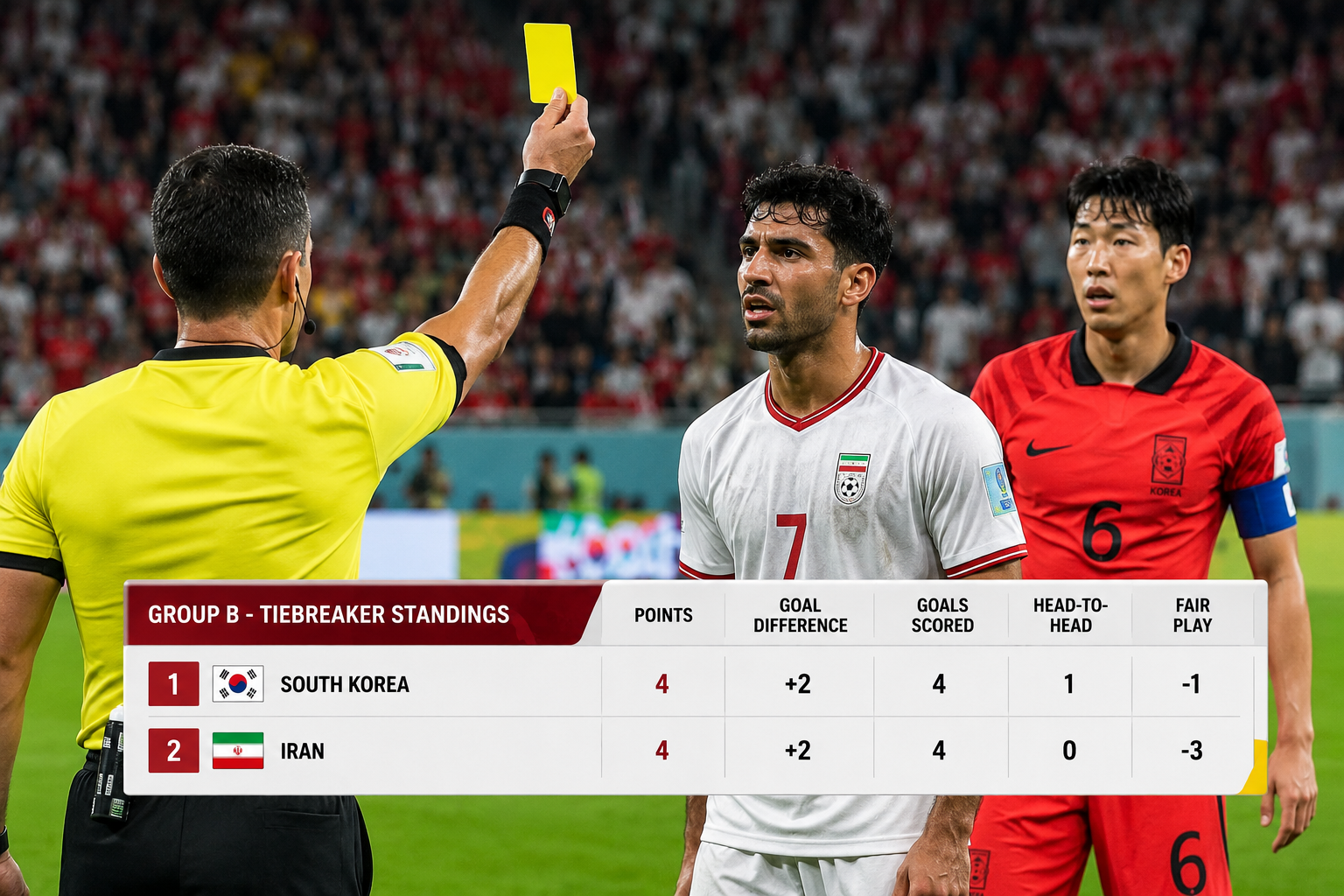
- Fair play points (yellow and red card totals)
- FIFA World Rankings position
Fair play points work as follows: a yellow card is -1 point, a red card from two yellows is -3 points, a direct red card is -3 points, and a yellow card followed by a direct red is -4 points. This system rewards disciplined teams and can be the difference between advancing and going home.
For more detail on how standings are calculated, the World Cup Table: How Group Stage Standings Work in 2026 guide covers every scenario.
What Happens if Teams Are Tied in Points After Group Matches
The tiebreaker sequence above is applied immediately. There is no replay or additional match. If teams are still level after all criteria including FIFA Rankings, lots are drawn, though this is extremely rare in practice. [2]
A common mistake fans make is assuming head-to-head results come first. They do not. Goal difference across all three group games is checked before head-to-head records. This matters because a team could beat a rival head-to-head but still finish below them if the rival has a significantly better overall goal difference.
Can a Team With Zero Points Still Technically Advance
No. A team with zero points from three group games cannot advance. With the third-place route requiring competitive points totals, even 3 points (one win) may not be enough depending on results across all groups. Zero points means three losses, which produces a goal difference that would never rank among the top eight third-placed teams. [1]
The lowest realistic points total for a third-place qualifier is 4 points (one win, one draw, one loss), though in past tournaments 3 points has occasionally been sufficient when results across groups were particularly tight.
How Many Total Teams Make It Past the Group Stage to Knockout Rounds
Exactly 32 teams make it past the group stage at the 2026 World Cup, entering a Round of 32 knockout bracket. [1] From there, the path to the Final works as follows:
- Round of 32: 32 teams, 16 matches
- Round of 16: 16 teams, 8 matches
- Quarter-finals: 8 teams, 4 matches
- Semi-finals: 4 teams, 2 matches
- Third-place play-off: 2 teams, 1 match
- Final: 2 teams, 1 match
The knockout stage begins June 28, 2026, with the Final scheduled for July 19, 2026 at MetLife Stadium in New Jersey. [3] Every knockout match is single elimination, with extra time and penalties used if scores are level after 90 minutes.
For the complete schedule, see the 2026 World Cup Schedule: Dates, Venues, Tickets and Bracket guide.
Are There Different Rules for Advancing in the Men’s vs Women’s World Cup
Yes, the formats differ. The men’s 2026 World Cup uses 48 teams across 12 groups, with 32 advancing. The FIFA Women’s World Cup currently uses 32 teams across 8 groups of four, with 16 teams advancing (the top two from each group). [1]
The Women’s World Cup expanded from 24 to 32 teams starting with the 2023 edition. There is no third-place wild-card route in the women’s format; only the top two from each group advance.
Which Teams Have the Best Chance of Advancing in 2026
Historically, teams from UEFA (Europe) and CONMEBOL (South America) dominate the knockout stages. In every World Cup since 1930, the winner has come from one of these two confederations.
Strong 2026 contenders based on FIFA rankings and recent form include France, England, Brazil, Argentina, Spain, and Germany. For a deeper look at favorites and dark horses, the World Cup Predictions 2026: Top Favorites and Dark Horses guide breaks down the odds.
Host nations (USA, Canada, Mexico) receive automatic qualification and will be playing in front of home crowds, which historically provides a measurable advantage in group stage results.
How Many Teams From Each Confederation Typically Advance
UEFA typically sends the most teams through to the knockout stage, given their large allocation of spots. At the 2026 World Cup, confederation allocations are approximately:
| Confederation | Teams Allocated | Typical Knockout Qualifiers |
|---|---|---|
| UEFA (Europe) | 16 | 12-14 |
| CONMEBOL (South America) | 6 | 5-6 |
| CAF (Africa) | 9 | 4-6 |
| AFC (Asia) | 8 | 3-5 |
| CONCACAF (N/C America) | 6 + 3 hosts | 4-6 |
| OFC (Oceania) | 1 | 0-1 |
These are estimates based on historical patterns and the new 48-team allocation. Actual results vary by tournament.
What Is the Most Common Scenario for Group Stage Elimination
The most common elimination scenario is finishing third or fourth with 3 points or fewer. A team that loses two of three group games almost always goes home, unless results elsewhere are unusually tight.
Fourth-placed teams are always eliminated, regardless of points. Even a fourth-place team with 6 points (two wins) cannot advance, because only the top two plus best third-placed teams go through.
The most painful scenario for fans: finishing third with 4 points but missing out because eight other third-placed teams also had 4 or more points. This is a genuine risk in the expanded 12-group format and something fans of smaller nations should watch closely.
For fans following specific nations, check out the World Cup Groups: How They Work for England, Scotland and Ireland guide for group-specific analysis.
FAQ
How many teams are in the 2026 World Cup group stage? 48 teams compete in the group stage, split across 12 groups of four teams each. [1]
How many teams advance from the group stage total? 32 teams advance: 24 automatic qualifiers (top two from each group) plus the 8 best third-placed teams. [1]
What happens to teams that finish fourth in their group? They are eliminated immediately, regardless of their points total. Fourth place is always the end of the road.
Do all third-placed teams advance? No. Only the 8 best third-placed teams from across all 12 groups advance. The other 4 third-placed teams are eliminated.
How are the best third-placed teams decided? By points first, then goal difference, then goals scored, then fair play points. Results against the fourth-placed team in each group are excluded from the comparison. [2]
What is the minimum points needed to advance from the group stage? There is no fixed minimum, but in practice 4 points gives a strong chance for a third-place qualifier. Six points almost always guarantees advancement as a top-two finisher.
Can a team advance with just one win? Yes, if they finish in the top two of their group with 3 points plus favorable draws, or if they accumulate enough points as a third-place finisher. It is unlikely but possible.
Does goal difference matter more than head-to-head? Yes. Overall goal difference across all three group matches is checked before head-to-head results in the FIFA tiebreaker order. [2]
When does the group stage end in 2026? The group stage runs from June 11 to June 27, 2026. The knockout stage begins June 28. [3]
Is the 2026 format the same as previous World Cups? No. Previous tournaments (1998-2022) used 32 teams in 8 groups, with 16 teams advancing. The 2026 format is the first to use 48 teams, 12 groups, and a Round of 32. [1]
What happens if teams are still tied after all tiebreakers? Lots are drawn by FIFA. This is extremely rare and has not occurred in recent major tournaments.
Do host nations get any advantage in the group stage? Host nations qualify automatically but receive no points advantage. They play under the same rules as every other team.
Conclusion
The answer to how many teams go through after the group stage in the World Cup is 32, made up of 24 automatic group qualifiers and 8 best third-placed teams across 12 groups. This expanded format, introduced for 2026, gives more nations a route into the knockout rounds while keeping the competition intense enough that no team can afford to coast.
Actionable next steps for fans:
- Track your team’s group carefully using the points and tiebreaker rules outlined above
- Pay attention to goal difference from the first match, as it often decides tight group finishes
- Watch results in other groups if your team is on course for third place, because the wild-card race can shift dramatically on the final matchday
- Check the World Cup Football 2026: Dates, Cities, Teams and Fan Guide for fixture dates, broadcast details, and stadium information
- Follow the World Cup Predictions 2026 guide to stay across which teams are favored to advance deep into the tournament
The group stage is where World Cup dreams are made and broken. Knowing exactly how the qualification rules work gives every fan a sharper way to follow the action.
References
[1] What is the format for the FIFA World Cup 2026 tournament – https://gpcustomersupportfwc2026.tickets.fifa.com/hc/en-gb/articles/28784798873117-10-What-is-the-format-for-the-FIFA-World-Cup-2026-tournament
[2] Every World Cup 2026 Group Stage Tiebreaker: What Happens If Teams Finish With The Same Points – https://www.fourfourtwo.com/competition/every-world-cup-2026-group-stage-tiebreaker-what-happens-if-teams-finish-with-the-same-points
[3] How To Watch The FIFA World Cup – https://www.kiplinger.com/personal-finance/family-savings/how-to-watch-the-fifa-world-cup
[4] FIFA World Cup 2026: Dates, Fixtures, Stadiums, Tickets And Everything You Need To Know – https://www.fourfourtwo.com/features/fifa-world-cup-2026-dates-fixtures-stadiums-tickets-and-everything-you-need-to-know
[6] What To Know About Soccer Rules For The World Cup – https://www.axios.com/2026/06/09/what-to-know-about-soccer-rules-for-the-world-cup