
Last updated: May 21, 2026
Quick Answer: Based on data models, betting markets, and expert analysis, Spain, France, and England sit at the top of most World Cup predictions 2026 lists, with Spain currently holding the narrowest edge according to Opta’s supercomputer [2]. Brazil and Argentina remain serious threats, but no single team has a dominant probability — making this one of the most open tournaments in recent memory.
Key Takeaways
- Spain is the current favorite according to Opta’s supercomputer model, but the margin over France and England is slim [2]
- France, Brazil, and Argentina are all within realistic striking distance of the title
- Dark horse teams like Portugal, Germany, and the USMNT (as co-hosts) are worth watching
- Betting markets broadly align with AI models, though France edges slightly higher in crowd-sourced prediction platforms [8]
- AI and machine learning tools are now central to how analysts and bookmakers build forecasts
- Common forecasting mistakes include over-weighting recent form and ignoring tournament-specific factors like travel and group draw luck
- Key players like Kylian Mbappé, Pedri, Jude Bellingham, and Vinícius Jr. could individually shift outcomes
- Regional rankings and qualifying performance matter, but they’re imperfect predictors of tournament success
- No model is consistently accurate — historically, supercomputer predictions have a mixed track record in knockout football
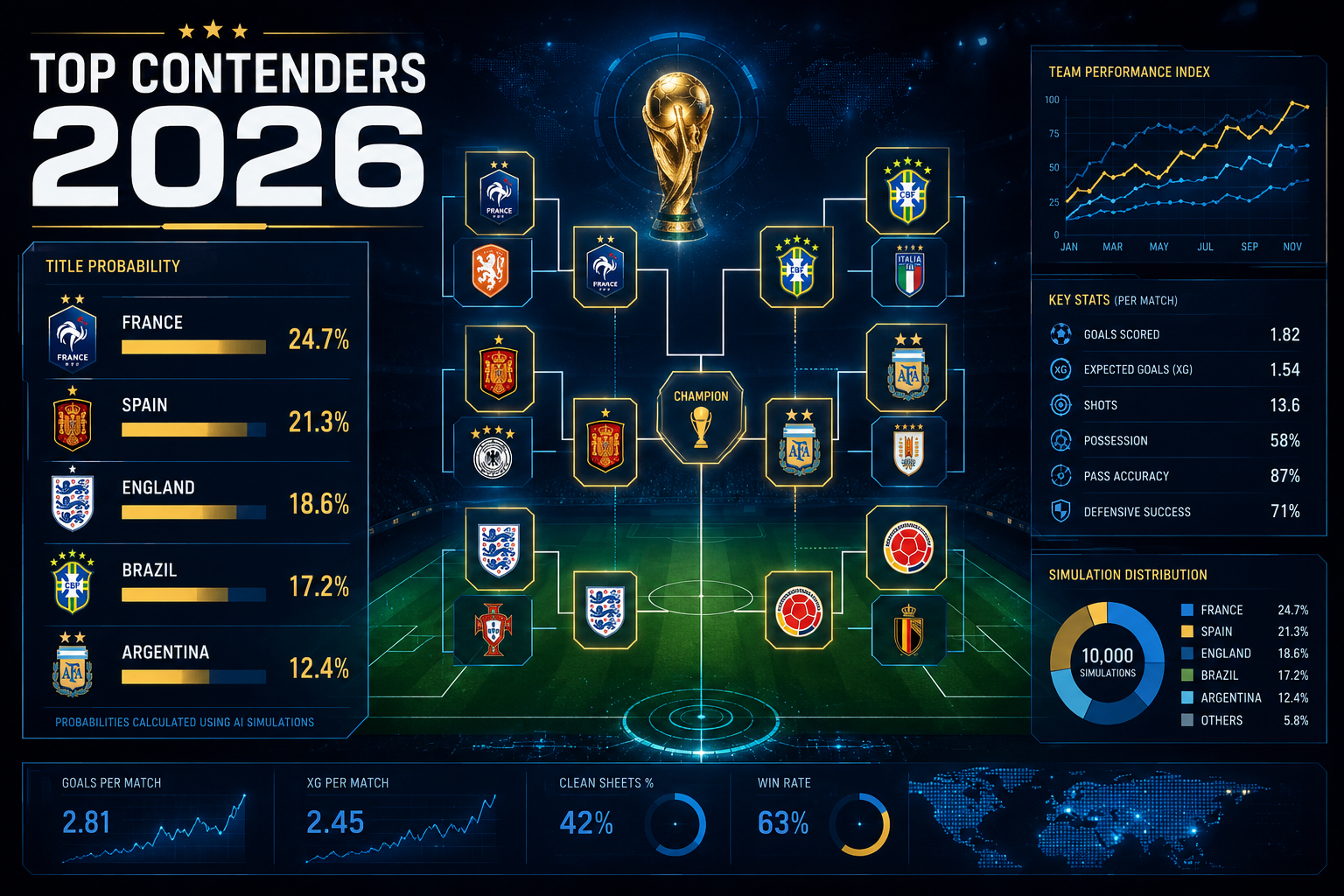
Who Are the Top Teams Predicted to Win the 2026 World Cup?
Spain, France, and England form the top tier of favorites in nearly every credible World Cup prediction model for 2026. Opta’s supercomputer currently names Spain as the single most likely champion [2], while CBS Sports’ expert analysis points to France as their pick to lift the trophy [1].
Here’s a snapshot of the leading contenders based on aggregated model and expert data:
| Team | Model Tier | Key Strength |
|---|---|---|
| 🇪🇸 Spain | Top favorite | Tactical depth, squad balance |
| 🇫🇷 France | Co-favorite | Individual quality, Mbappé |
| 🏴 England | Top 3 | Attacking talent, Bellingham |
| 🇧🇷 Brazil | Strong contender | Vinícius Jr., depth |
| 🇦🇷 Argentina | Defending champion | Experience, Messi legacy |
| 🇩🇪 Germany | Dark horse tier | Rebuilt squad, home continent |
Choose Spain if you trust statistical models. Choose France if you lean toward individual match-winners. Choose England if you believe this is finally their year (again).
ESPN’s roster predictions also flag Germany and Portugal as squads capable of deep runs, depending on how the bracket falls [10].
Which Players Might Be Game Changers in 2026?
A handful of elite players have the ability to carry their teams through knockout rounds almost single-handedly. In 2026, these are the names most analysts point to as potential tournament-defining performers.
Top players to watch:
- Kylian Mbappé (France) — Still in his peak years, and France’s entire attacking system runs through him [1]
- Pedri (Spain) — The midfield engine behind Spain’s possession-based dominance
- Jude Bellingham (England) — Combines goals, creativity, and leadership at just 22
- Vinícius Jr. (Brazil) — One of the most dangerous wide forwards in world football
- Lionel Messi (Argentina) — Likely his final World Cup; motivation will be sky-high [1]
- Cristiano Ronaldo (Portugal) — Same story; legacy-driven performances can be unpredictable
“A single player in form during a knockout run can override almost any statistical model. That’s what makes tournament football so hard to predict.”
The wildcard factor: host nation players often overperform due to crowd support. USMNT players competing on home soil could surprise a few higher-ranked opponents [3].
Which Countries Are Considered Dark Horse Candidates?
Dark horse teams in 2026 are those with realistic upset potential despite sitting outside the top five in most prediction models. Portugal, Germany, the USMNT, and Morocco all qualify.
- Portugal — Deep squad, Ronaldo’s motivation, and a new generation of talent
- Germany — Rebuilt after years of underperformance; dangerous on their day
- USMNT — Co-hosts with a young, improving squad and massive crowd advantage [3]
- Morocco — Proved in 2022 that African football can compete at the highest level
- Netherlands — Inconsistent but capable of beating anyone on a good day
Edge case: Host nation advantage is real but hard to quantify. The USMNT’s ceiling is genuinely unclear — they could exit in the group stage or reach the quarterfinals.
How Accurate Are Current World Cup Predictions?
Honestly, not as accurate as the confidence behind them suggests. Supercomputer models and expert picks both struggle with the unpredictability of knockout football, where a single red card or missed penalty can end a tournament run.
Historically, pre-tournament favorites do win more often than not — but upsets are common enough that treating any prediction as reliable is a mistake. Germany’s group stage exit in 2018 and Argentina’s in the same tournament are reminders that top-ranked teams regularly flame out early.
What prediction models do well:
- Identifying which teams have the best squad depth
- Estimating group stage outcomes with reasonable accuracy
- Flagging which teams are genuinely weak vs. overseeded
What they struggle with:
- Knockout round variance (one-off games)
- Injury impact during the tournament
- Tactical adjustments between rounds
Is AI Being Used to Predict 2026 World Cup Results?
Yes, and it’s more sophisticated than ever. Opta’s supercomputer — one of the most cited tools in football analytics — runs thousands of simulations to generate win probabilities for each team [2]. Football-Espana also reported on AI-generated 2026 World Cup predictions using large-scale match data [4].
These models typically pull from:
- Historical match results (often 10+ years of data)
- Current FIFA rankings and Elo ratings
- Player availability and injury reports
- Head-to-head records in major tournaments
- Tactical and formation data
Are machine learning models better than human experts? For large-sample predictions (like group stage outcomes), models tend to outperform gut-feel punditry. For knockout rounds, the gap narrows significantly because variance dominates. The honest answer is that a hybrid approach — model output plus human context — tends to be most reliable.

How Do Betting Odds Compare to Expert Predictions for World Cup 2026?
Betting markets and expert models largely agree on the top tier but diverge on mid-table teams. Polymarket’s crowd-sourced prediction platform shows France and Spain trading near the top, broadly consistent with Opta’s model output [8].
Where they differ:
- Betting markets price in public sentiment, which can inflate odds for popular teams like Brazil and Argentina beyond what pure data supports
- Expert models tend to be colder about sentiment and focus on squad metrics
- Crowd prediction platforms like Polymarket aggregate thousands of individual forecasts, which can sometimes outperform both
Quick rule: If a team’s betting odds are significantly shorter than their model probability suggests, that’s often a sign of public bias rather than genuine analytical edge.
What Are Common Mistakes in World Cup Forecasting?
The biggest mistake is treating pre-tournament form as a reliable signal. Teams often peak-and-trough across a season, and a team in poor club form can still arrive at a World Cup with a fully motivated, rested squad.
Other frequent forecasting errors:
- Over-relying on FIFA rankings — Rankings reflect recent results but miss tactical evolution
- Ignoring the draw — Group placement and bracket path matter enormously
- Underweighting goalkeeping — A hot goalkeeper can carry a team through multiple knockout rounds
- Assuming favorites always advance — In a 48-team tournament, the bracket is longer and upsets compound
- Forgetting fatigue — Teams with longer club seasons arrive less fresh
How Do Regional Rankings Impact World Cup Predictions?
Regional performance in qualifying gives useful but imperfect signals. A team that dominated CONMEBOL qualifying (like Brazil or Argentina) arrives with confidence and match sharpness. But European qualifying is so competitive that even strong teams drop points regularly, making it a noisier signal.
What regional data tells us:
- Consistent qualifying dominance suggests squad depth
- Teams that scraped through qualifying often have defensive fragility
- CONCACAF qualifying (relevant for the USMNT and Mexico) is a poor predictor of World Cup performance due to the quality gap between regions
FAQ
Q: Who is the current favorite to win the 2026 World Cup? Spain is the top pick according to Opta’s supercomputer model, but France and England are within a very narrow margin [2].
Q: Will Messi play in the 2026 World Cup? Messi has indicated this could be his final World Cup. CBS Sports’ predictions include him as a key factor for Argentina [1].
Q: How many teams are in the 2026 World Cup? The 2026 tournament expands to 48 teams, up from 32, making the group stage longer and increasing the number of potential upsets.
Q: Are AI World Cup predictions reliable? They’re useful for identifying probabilities, not guarantees. Models run thousands of simulations and give percentage likelihoods, not certainties [4].
Q: Which host nation has the best chance of advancing? The USMNT is considered the most competitive of the three host nations (USA, Canada, Mexico) and has a realistic shot at the knockout rounds [3].
Q: How much do professional prediction models cost? Most publicly available models (like Opta’s supercomputer outputs or ESPN’s predictions) are free to read. Proprietary models used by betting firms and clubs are not publicly priced.
Q: What’s the biggest upset risk in 2026? Argentina or Brazil exiting in the group stage is always a possibility — both have done it before. The expanded 48-team format creates more tricky group matchups.
Q: Where can I run my own World Cup bracket predictions? The Telegraph has a free interactive 2026 World Cup predictor and simulator [9]. RotoWire also has a full bracket breakdown [3].
Q: Is France really a favorite or just a popular pick? France has genuine statistical backing — not just public popularity. Their squad depth and Mbappé’s quality make them a legitimate top-three pick in most models [1][2].
Conclusion
The World Cup predictions 2026 landscape is unusually open. Spain holds a narrow model-based edge, France has the star power to win it outright, and England, Brazil, and Argentina are all legitimate contenders. Dark horses like Portugal, Germany, and the USMNT add real unpredictability to a 48-team field that’s bigger and more chaotic than any previous tournament.
Actionable next steps for football fans:
- Follow Opta’s simulation updates as the tournament progresses — probabilities shift fast after each result [2]
- Use the Telegraph’s free predictor tool to build your own bracket [9]
- Watch Polymarket for real-time crowd sentiment on who people actually believe will win [8]
- Don’t lock in a single prediction — keep a shortlist of two or three realistic winners and adjust as the group stage unfolds
The best World Cup prediction is the one that stays flexible. Enjoy the chaos.
References
[1] 2026 FIFA World Cup Predictions: Picking Every Game — https://www.cbssports.com/soccer/news/2026-fifa-world-cup-predictions-picking-every-game-usmnt-messi-ronaldo-france-champions/
[2] Supercomputer Predicts 2026 World Cup Winner — https://www.si.com/soccer/supercomputer-predicts-2026-world-cup-winner
[3] 2026 World Cup Bracket Breakdown: Predicting Every Round — https://www.rotowire.com/soccer/article/2026-world-cup-bracket-breakdown-predicting-every-round-from-group-stage-to-final-112883
[4] World Cup 2026 Predictions AI — https://www.football-espana.net/2026/04/13/world-cup-2026-predictions-ai
[8] 2026 FIFA World Cup Predictions — https://polymarket.com/predictions/2026-fifa-world-cup
[9] FIFA World Cup 2026 Predictor Simulator — https://www.telegraph.co.uk/football/fifa-world-cup-2026-predictor-simulator/
[10] 2026 World Cup Rosters Predictions: Starting XIs — https://www.espn.com/soccer/story/_/id/48677243/2026-world-cup-rosters-predictions-starting-xis-usa-france-mexico-england-spain-germany-brazil-argentina