Last updated: May 22, 2026
Quick Answer: World Cup groups are the first stage of the tournament, where 48 teams (at the 2026 FIFA World Cup) are split into 12 groups of four. Each team plays the other three teams in their group, and the top two teams from each group advance to the knockout rounds. Points, goal difference, and head-to-head results determine who goes through.
Key Takeaways
- The 2026 FIFA World Cup expanded to 48 teams, meaning 12 groups of four teams each.
- Every team plays three group stage matches — one against each other team in their group.
- A win earns 3 points, a draw earns 1 point, and a loss earns 0 points.
- The top two teams from each group advance; at the 2026 World Cup, the eight best third-place teams also progress.
- Tiebreakers go in this order: goal difference, goals scored, head-to-head result, then fair play points.
- England have historically been strong in the group stage but have struggled in knockouts.
- Scotland have had limited World Cup group stage appearances, with their last being France 1998.
- The Republic of Ireland’s last World Cup was 2002; Northern Ireland last appeared in 1986.
- The “Group of Death” is an unofficial term for the toughest group in any given tournament.
- Goal difference can be the difference between glory and going home — every goal matters.
How Do World Cup Groups Actually Work?
World Cup groups divide all qualified teams into smaller pools where every team plays each other once. The group stage runs first, before any knockout football begins.
At the 2026 FIFA World Cup hosted across the USA, Canada, and Mexico, the format works like this:
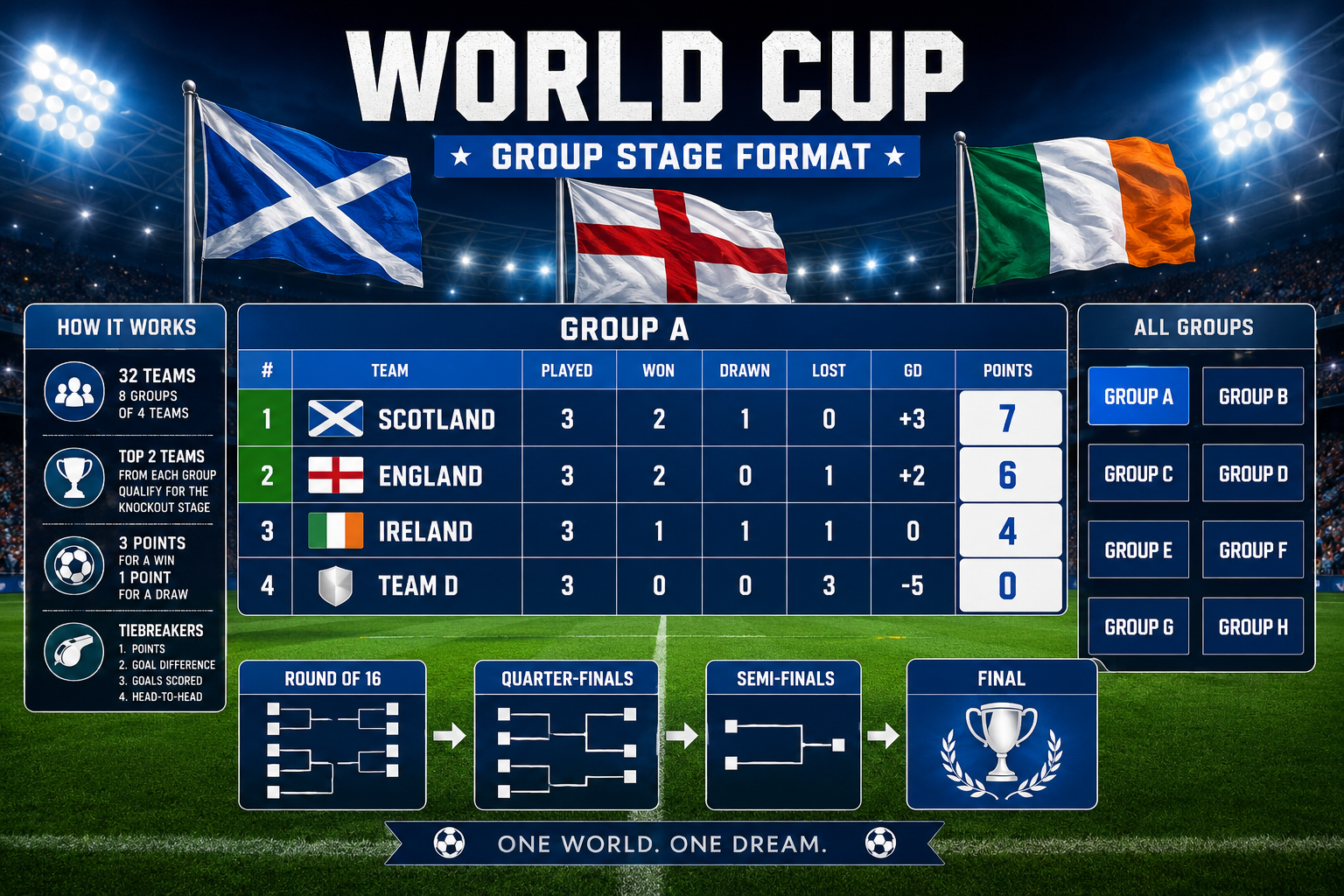
- 48 teams split into 12 groups of four
- Each team plays 3 matches in the group stage
- Points are awarded: 3 for a win, 1 for a draw, 0 for a loss
- At the end of the group stage, teams are ranked by points within their group
- The top two from each group automatically advance
- Additionally, the eight best third-place finishers across all 12 groups also qualify for the Round of 32
This expansion from 32 to 48 teams changed the math significantly. More groups means more drama, more upsets, and more nations getting a shot at the biggest stage in football.
How Many Teams Advance From Each World Cup Group?
At the 2026 World Cup, two teams per group automatically advance, plus the eight best third-place teams. That means 32 teams total progress to the knockout rounds.
Here’s a simple breakdown:
| Finish in Group | Outcome |
|---|---|
| 1st place | Advances to Round of 32 ✅ |
| 2nd place | Advances to Round of 32 ✅ |
| 3rd place (best 8) | Advances to Round of 32 ✅ |
| 3rd place (other 4) | Eliminated ❌ |
| 4th place | Eliminated ❌ |
So finishing third isn’t automatically fatal — but it’s a nervous wait to see if your points total is good enough compared to the other third-place teams across all 12 groups.
How Many Points Do You Get for a Win vs. a Draw?
- Win = 3 points
- Draw = 1 point each
- Loss = 0 points
A team that wins all three group games finishes on 9 points — the maximum. In practice, 6 points (two wins, one loss) is usually enough to advance. Four points (one win, one draw, one loss) is often borderline, and three points or fewer usually means going home.
Common mistake: Fans sometimes assume a draw is “safe.” In a tough group, a draw can cost a team dearly if other results go against them.
What Happens if Teams Tie on Points in a Group?
Tiebreakers in World Cup groups follow a specific order set by FIFA. When two or more teams finish level on points, the ranking is decided by:
- Goal difference (goals scored minus goals conceded across all group games)
- Goals scored (total goals across all group games)
- Head-to-head points (result of the match between the tied teams)
- Head-to-head goal difference
- Head-to-head goals scored
- Fair play points (yellow and red card totals)
- FIFA ranking (as a last resort)
“In 2018, Japan advanced over Senegal on fair play points after both teams finished level on points, goal difference, and goals scored — the first time that tiebreaker had ever been used at a World Cup.”
This is why every yellow card, every goal, and every minute of football in the group stage genuinely matters.
How Do Goal Differentials Impact Group Standings?
Goal difference is the first tiebreaker after points, so it carries enormous weight. A team that wins 3-0 is in a much better position than one that scrapes a 1-0 win if points end up level.
For teams like Scotland or Ireland, who historically compete in tough qualifying groups, goal difference is often what separates heartbreak from history. Running up the score against weaker opponents isn’t just gamesmanship — it’s smart tournament strategy.
Edge case: At the 1994 World Cup, Belgium were eliminated despite having the same points and goal difference as the Netherlands, losing out on goals scored. It’s rare, but it happens.
Which Group Is Considered the Hardest This Tournament?
The “Group of Death” is an unofficial label given to the toughest World Cup group — usually one containing three or more top-ranked nations who would normally expect to advance from any other group.
At the 2026 World Cup, the draw placed several elite nations in close proximity. Groups featuring teams like Brazil, France, Argentina, Spain, Germany, or England alongside strong mid-tier sides tend to generate the most pre-tournament buzz.
How to spot a Group of Death:
- Three or more teams ranked in the global top 15
- At least one major tournament winner in recent history
- No obvious “easy” fixture for any team in the group
For England fans, landing in a softer group is always the hope — but the team’s history shows results don’t always match expectations regardless of group difficulty.
Can Two Teams From the Same Country Both Advance?
No — and also yes, depending on how you look at it. Two clubs from the same country don’t enter the World Cup; national teams do. But two nations from the same region can absolutely both advance.
For British and Irish fans, the relevant scenario is whether England, Scotland, and the Republic of Ireland (or Northern Ireland) could all qualify for the same World Cup and potentially land in the same group. FIFA’s seeding and pot system is specifically designed to prevent teams from the same confederation (UEFA, in this case) from being in the same group — with some exceptions when there are more UEFA teams than groups.
So England and Scotland cannot be drawn into the same World Cup group under current FIFA rules. They’d only meet in the knockout rounds.
What’s the Difference Between the Group Stage and Knockout Rounds?
The group stage and knockout rounds are completely different formats:
| Feature | Group Stage | Knockout Rounds |
|---|---|---|
| Format | Round-robin (play everyone once) | Single elimination |
| Result of a loss | Points deduction, possible elimination | Immediate elimination |
| Draws allowed? | Yes, 1 point each | No — extra time and penalties |
| Teams involved | All 48 | 32 down to 1 |
The group stage rewards consistency. The knockout rounds reward peak performance on a single day. Many great teams have cruised through World Cup groups only to fall apart in the Round of 16 or quarterfinals.
Scotland, England, and Ireland in World Cup Groups: A Quick History
These three nations have very different World Cup group stage histories.
England have qualified for most World Cups and tend to navigate the group stage comfortably — though 2014 (Group D with Italy, Uruguay, and Costa Rica) was a painful exception, with early elimination.
Scotland have qualified for eight World Cups but have never made it past the group stage. Their record is one of the most heartbreaking in football — eliminated on goal difference in 1974, 1978, and 1982. Their last appearance was France 1998.
Republic of Ireland reached the knockout rounds in 1990 (famously beating Romania on penalties) and 2002. They haven’t qualified since.
Northern Ireland last appeared at a World Cup in 1986, where they were eliminated in the group stage.
For all four nations, the group stage has been both the ceiling and the dream.
Which Countries Have the Best Group Stage Record Historically?
Brazil, Germany, and Argentina have the strongest all-time group stage records, having qualified for virtually every World Cup and consistently advancing. Spain and France also boast strong records in the modern era.
Among smaller nations, Uruguay punches well above its weight, and South Korea made a remarkable run to the semifinals in 2002 after navigating a tough group.
For context, England’s group stage record is solid — they’ve been eliminated at that stage only a handful of times. Scotland’s record, while full of near-misses, remains the most famous tale of group stage heartbreak in British football history.
Most Common Group Stage Elimination Scenarios
Teams get knocked out of World Cup groups in a few predictable ways:
- Losing two or more matches — almost always fatal
- Drawing too many games — three draws gives you 3 points, which is rarely enough
- Poor goal difference — winning and drawing but by narrow margins while conceding heavily
- Losing the head-to-head — when points are level, that direct result comes back to haunt you
- Late drama in the final group game — results elsewhere change the picture in real time
The final matchday of each group is played simultaneously to prevent collusion, which regularly produces chaotic, dramatic finishes.
FAQ
Q: How many teams are in each World Cup group in 2026? Four teams per group. With 48 teams total, there are 12 groups of four at the 2026 FIFA World Cup.
Q: How many games does each team play in the group stage? Three games — one against each of the other three teams in their group.
Q: What is the minimum points needed to guarantee advancement? There’s no guaranteed number, but 6 points (two wins) almost always advances a team. Seven or more points guarantees first place in most groups.
Q: Has Scotland ever advanced from a World Cup group stage? No. Scotland have reached eight World Cups but have never progressed beyond the group stage.
Q: Can England and Scotland be in the same World Cup group? No. FIFA rules prevent teams from the same confederation (UEFA) from being drawn into the same group, with limited exceptions.
Q: What happens if all four teams in a group finish level on points? FIFA applies tiebreakers in sequence: goal difference, goals scored, head-to-head results, fair play points, and finally FIFA ranking.
Q: When did Ireland last play in a World Cup group stage? The Republic of Ireland last appeared at a World Cup in 2002 in South Korea and Japan.
Q: What is a “Group of Death”? An unofficial term for a World Cup group containing multiple elite teams who would normally expect to advance, making it statistically likely that at least one major nation gets eliminated early.
Q: Does finishing first in a group give you an easier path in the knockouts? Generally yes — first-place finishers are often drawn against second-place finishers from other groups, which can influence the bracket. But at the 2026 World Cup’s expanded format, the draw mechanics are more complex.
Q: How are teams seeded for the World Cup group draw? FIFA uses its official world rankings at a set cutoff date to create seeding pots. The top-ranked teams (Pot 1) are kept apart so they don’t face each other in the group stage.
Conclusion
World Cup groups are where tournaments are won and lost before the knockout rounds even begin. Understanding how points work, how tiebreakers are applied, and what goal difference really means can completely change how you watch those three group stage matches.
For fans of England, the group stage is usually a formality — but history has shown it’s never truly guaranteed. For Scotland supporters, the group stage has been the heartbreaking ceiling for decades, and qualifying again would already feel like a triumph. For Republic of Ireland and Northern Ireland fans, just getting back to a World Cup group is the dream right now.
Actionable next steps for fans:
- Follow the official FIFA website for live group stage standings and updated tiebreaker scenarios during the tournament.
- Pay attention to the simultaneous final matchday in each group — that’s where the real drama happens.
- Track goal difference from game one — a single goal can change everything.
- Check FIFA’s world rankings before the draw to understand seeding pots and likely group compositions.
Every group game counts. Every goal counts. And for the nations that make it there, every moment is worth it. ⚽
Meta Title: World Cup Groups: How They Work for England, Scotland & Ireland
Meta Description: Learn how World Cup groups work in 2026, including points, tiebreakers, goal difference, and what the group stage means for England, Scotland, and Ireland fans.
Tags: World Cup groups, FIFA World Cup 2026, England World Cup, Scotland World Cup, Ireland World Cup, group stage football, World Cup tiebreakers, Group of Death, World Cup points system, football tournament format, UEFA World Cup qualifying, World Cup group draw