Last updated: May 31, 2026
Quick Answer: The 2026 FIFA World Cup runs from June 11 to July 19, 2026, hosted across 16 cities in the United States, Canada, and Mexico. The World Cup schedule spans 104 matches across a newly expanded 48-team format, making it the largest tournament in the competition’s history. Fans can track fixtures, group stage results, and knockout rounds through FIFA’s official website and major sports apps.
Key Takeaways
- The 2026 World Cup is hosted jointly by the USA, Canada, and Mexico across 16 cities and 16 stadiums.
- The tournament runs from June 11 to July 19, 2026, with the final held at MetLife Stadium in New Jersey.
- For the first time, 48 teams compete, organized into 12 groups of four teams each.
- Match times vary by time zone; fans in Europe will see many games broadcast in afternoon and evening slots.
- Ticket prices range from roughly $100 for group stage matches to over $1,000 for knockout and final tickets.
- Official tickets are sold exclusively through FIFA’s ticketing portal; third-party resellers carry significant fraud risk.
- The knockout bracket begins with a Round of 32, followed by the Round of 16, quarterfinals, semifinals, and the final.
- Penalty shootouts decide tied knockout matches after 90 minutes of regular time and 30 minutes of extra time.
- Travel packages from FIFA-authorized tour operators bundle tickets, accommodation, and transport.
- Brazil, France, England, and Argentina are widely considered among the strongest title contenders heading into the tournament.
When and Where Is the 2026 World Cup Happening?
The 2026 FIFA World Cup takes place from June 11 to July 19, 2026, across three host nations: the United States, Canada, and Mexico. It is the first World Cup ever hosted by three countries simultaneously.
The 16 host cities include New York/New Jersey, Los Angeles, Dallas, San Francisco Bay Area, Seattle, Kansas City, Atlanta, Boston, Miami, Philadelphia, Houston, Guadalajara, Mexico City, Monterrey, Toronto, and Vancouver. The final match is scheduled for MetLife Stadium in East Rutherford, New Jersey, on July 19, 2026.
Key tournament milestones:
- Group stage: June 11 to June 27, 2026
- Round of 32: June 29 to July 3, 2026
- Round of 16: July 5 to July 8, 2026
- Quarterfinals: July 10 to July 12, 2026
- Semifinals: July 15 to July 16, 2026
- Third-place playoff: July 18, 2026
- Final: July 19, 2026
How Does the World Cup Tournament Bracket Work?
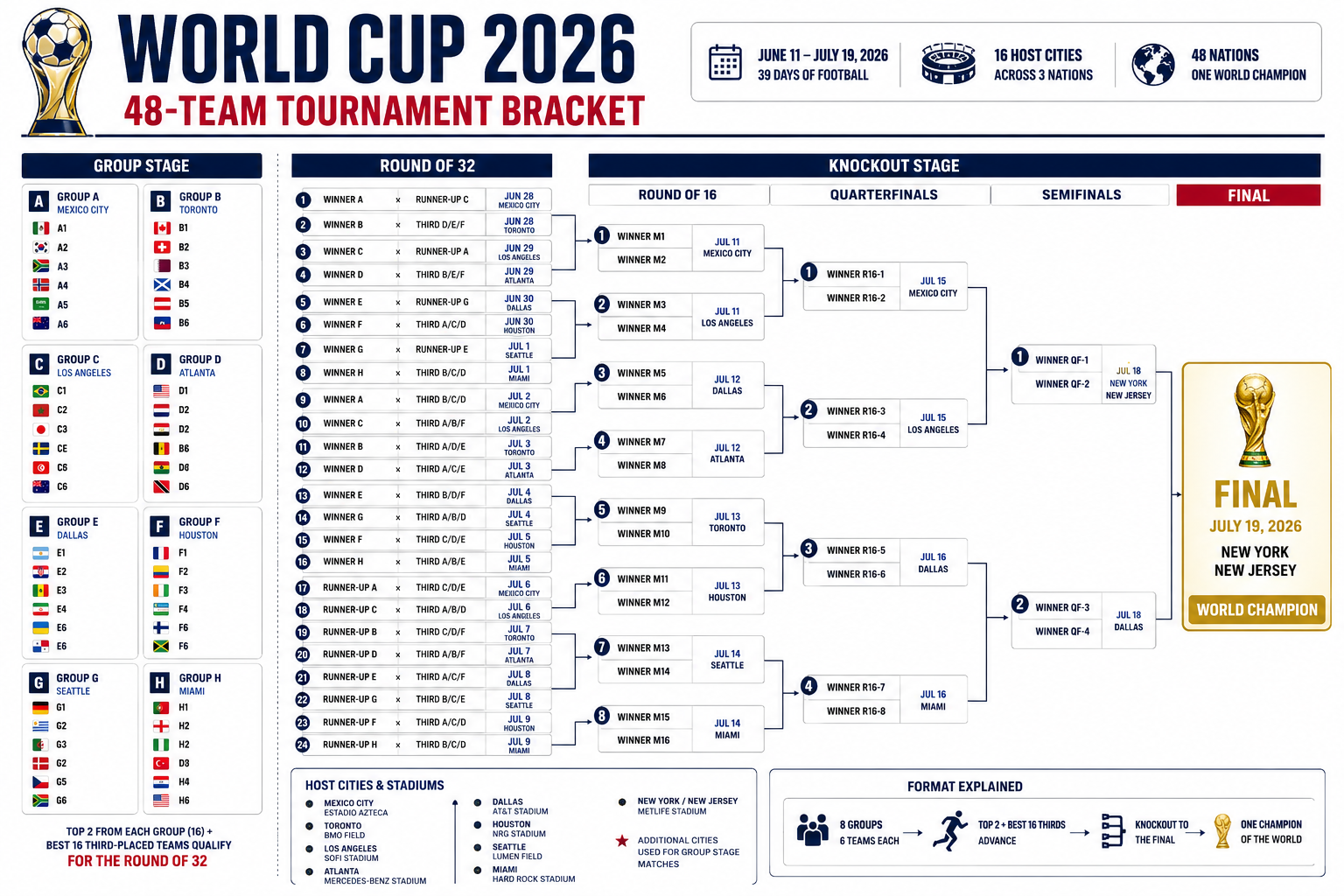
The 2026 World Cup uses a 48-team format for the first time, replacing the previous 32-team structure used since 1998. Teams are divided into 12 groups of four, with the top two from each group plus the eight best third-place finishers advancing to the Round of 32.
From the Round of 32 onward, the tournament is single-elimination. One loss and a team goes home. This bracket structure rewards consistency across the group stage while keeping every knockout match high-stakes.
How progression works:
- Group stage: Each team plays three matches; points determine standings (3 for a win, 1 for a draw, 0 for a loss).
- The top two teams per group qualify automatically.
- The eight best third-place teams across all 12 groups also advance.
- The Round of 32 bracket is pre-drawn based on group finishing positions.
- Winners advance through each round until the final.
Common mistake: Many fans assume third-place teams are randomly seeded. In fact, FIFA uses a specific ranking system based on points, goal difference, and goals scored to determine which eight third-place teams qualify and how they slot into the bracket.
What Are the Group Stage Matchups This Year?
The official group stage draw for the 2026 World Cup took place in December 2025, placing all 48 qualified teams into 12 groups labeled A through L. Each group contains four teams, and all group matches are scheduled across the 16 host stadiums.
Because the full fixture list is publicly available on FIFA.com, fans can search by group, team, date, or venue to build a personal match itinerary. Notable group stage storylines include several high-profile rivalries and first-time World Cup participants from Africa and Asia.
Choose this approach if: You want to plan travel around a specific team. Filter the World Cup schedule by nation on the FIFA app to see all three group stage dates, times, and locations for that team in one view.
What Time Zone Are the Matches Being Played In?
Matches are played across multiple North American time zones, from Eastern (ET) to Pacific (PT). FIFA publishes all match times in local stadium time as well as UTC, making it easier for international viewers to convert.
For fans in Europe, most group stage matches will kick off between 6:00 PM and midnight local time, depending on location. South American viewers will find many matches falling in afternoon slots.
Quick time zone reference:
| Stadium City | Time Zone | UTC Offset |
|---|---|---|
| New York/NJ | Eastern (ET) | UTC-4 |
| Dallas | Central (CT) | UTC-5 |
| Los Angeles | Pacific (PT) | UTC-7 |
| Toronto | Eastern (ET) | UTC-4 |
| Mexico City | Central (CT) | UTC-5 |
| Vancouver | Pacific (PT) | UTC-7 |
How Do I Buy Tickets for World Cup Matches?
Official World Cup tickets are sold exclusively through FIFA’s official ticketing website (FIFA.com/tickets). There is no authorized secondary marketplace. FIFA uses a ballot system for high-demand matches, meaning fans apply during sales windows and are selected randomly if demand exceeds supply.
Step-by-step ticket buying process:
- Create a free FIFA account at FIFA.com.
- Register during the announced ticket application window.
- Select match categories and the number of tickets needed.
- Submit your application before the window closes.
- Wait for FIFA’s ballot result notification by email.
- If successful, complete payment within the deadline provided.
How much do World Cup tickets cost? Prices for the 2026 tournament start at approximately $100 for Category 3 group stage seats and rise to $300 or more for Category 1 group stage seats. Knockout round tickets are significantly higher, with semifinal and final tickets exceeding $1,000 for premium categories. Prices are set by FIFA and published officially before each sales phase.
Edge case: Fans who miss the ballot can check FIFA’s official resale portal, which opens closer to the tournament. Buying from unofficial resellers risks receiving invalid or counterfeit tickets with no recourse.
Which Teams Are Most Likely to Win the 2026 World Cup?
Brazil, France, England, and defending champion Argentina are consistently rated among the top contenders by major football analysts and betting markets heading into the 2026 tournament. Germany and Spain are also considered strong candidates based on recent qualifying form and squad depth.
No single team is a certainty. The expanded 48-team format and the physical demands of playing more matches in North American summer heat add variables that can upset even the strongest squads.
Factors analysts weigh:
- Squad depth across all positions
- Recent tournament form (Nations League, qualifiers)
- Experience of key players at major tournaments
- Coaching tactical flexibility
Can I Watch World Cup Games for Free Online?
In many countries, broadcast rights determine whether free-to-air viewing is available. In the United States, Fox Sports and Telemundo hold broadcast rights for the 2026 World Cup, with some matches available on free-to-air Fox channels. In the UK, ITV and BBC typically share rights, offering free streaming through their respective apps.
Fans should check their country’s official rights holder before the tournament begins. Streaming through unofficial or unlicensed platforms carries legal risk and often delivers poor quality.
Are There Travel Packages for World Cup Fans?
FIFA authorizes a limited number of official hospitality and travel operators to sell bundled World Cup packages. These packages typically include match tickets, hotel accommodation near the venue, airport transfers, and sometimes stadium tours or fan events.
FIFA’s official hospitality partner for 2026 is MATCH Hospitality, which has handled packages for multiple previous World Cups. Independent travel agencies also offer fan travel packages, but these do not include guaranteed match tickets unless they source them through official channels.
What to look for in a travel package:
- Confirmation that match tickets are sourced through FIFA’s official allocation
- Refund policy if matches are rescheduled
- Accommodation proximity to the stadium (transport logistics matter significantly in large host cities)
Common tourist mistake: Booking non-refundable flights and hotels before securing tickets. Always confirm ticket allocation before committing to travel costs.
What Happens If a Game Goes to Penalty Shootouts?
In knockout rounds, if a match is level after 90 minutes of regular time, the game proceeds to 30 minutes of extra time (two 15-minute halves). If the score remains tied after extra time, a penalty shootout decides the winner.
Each team nominates five players to take penalties alternately. If still level after five each, the shootout continues in sudden death. The team scoring more penalties advances. Penalty shootouts do not apply during the group stage; draws in group matches simply stand.
Which Stadiums Will Host the Biggest Matches?
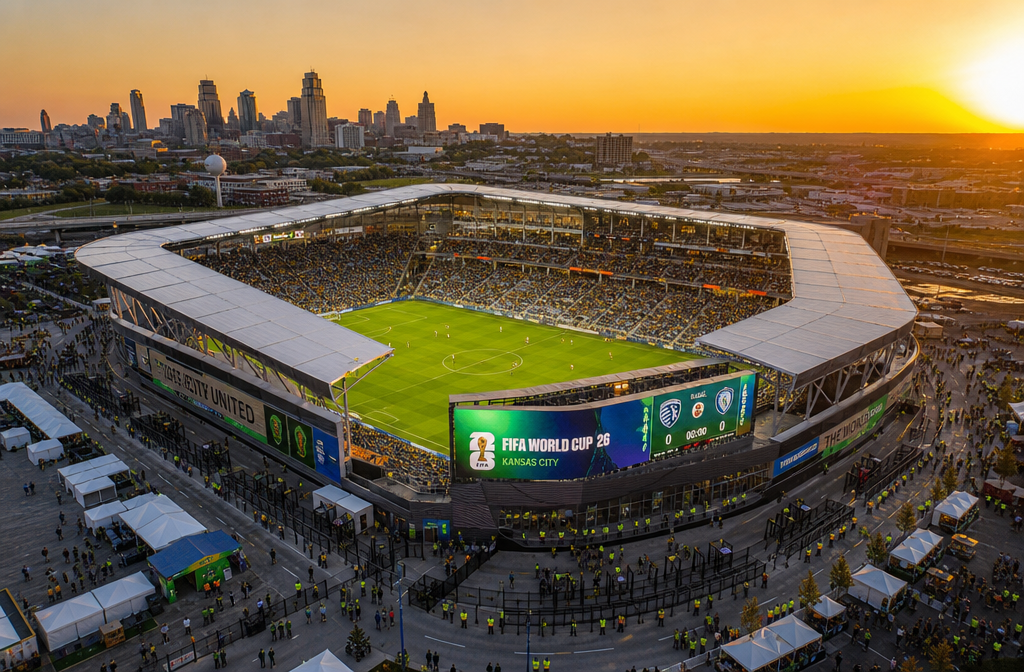
MetLife Stadium in New Jersey hosts the final, making it the marquee venue of the entire World Cup schedule. AT&T Stadium in Dallas and SoFi Stadium in Los Angeles are also expected to host multiple high-profile knockout matches given their capacity and infrastructure.
Stadiums confirmed for knockout rounds include:
- MetLife Stadium, New Jersey (capacity: approx. 82,500)
- AT&T Stadium, Dallas (capacity: approx. 80,000)
- SoFi Stadium, Los Angeles (capacity: approx. 70,000)
- Estadio Azteca, Mexico City (historic venue, capacity: approx. 87,000)
Is the World Cup Safe for International Travelers?
The 2026 World Cup host cities are major metropolitan areas with established international tourism infrastructure. The U.S., Canada, and Mexico all have dedicated security frameworks for large sporting events, and FIFA works closely with local law enforcement to manage stadium security.
Travelers should follow standard international travel precautions: register with their home country’s embassy, purchase travel insurance, keep copies of documents, and stay aware of local advisories. Mexico City and Monterrey venues may carry different risk profiles than U.S. and Canadian cities; travelers should check their government’s official travel advisory pages before booking.
FAQ
When does the 2026 World Cup start? The 2026 FIFA World Cup opens on June 11, 2026, with the group stage beginning across multiple host cities in the USA, Canada, and Mexico.
How many teams are in the 2026 World Cup? 48 teams compete in 2026, up from the previous 32-team format. Teams are split into 12 groups of four.
Where is the World Cup final being held? The final takes place at MetLife Stadium in East Rutherford, New Jersey, on July 19, 2026.
How do I find the full World Cup schedule? The complete fixture list is available on FIFA.com and through official sports apps including the FIFA app, ESPN, and BBC Sport.
Can I attend multiple matches in different cities? Yes, but plan travel carefully. Host cities are spread across three countries and multiple time zones, so back-to-back matches in different cities require significant logistics.
What happens if a group stage match ends in a draw? Draws stand in the group stage. Both teams receive one point each, and the standings are updated accordingly.
How long does a World Cup match last? A standard match is 90 minutes plus injury time. Knockout matches can extend to 120 minutes of extra time and, if needed, a penalty shootout.
Are children’s tickets cheaper? FIFA typically offers reduced pricing for children under a certain age threshold. Check the official FIFA ticketing portal for the specific age cutoff and pricing tiers for 2026.
What is the best way to follow the World Cup schedule in real time? The FIFA official app provides live scores, schedule updates, and push notifications for match results and schedule changes.
Do I need a visa to attend matches in all three host countries? Visa requirements vary by nationality. Fans attending matches in the USA, Canada, and Mexico may need separate visas for each country depending on their passport. Check each country’s official immigration website well in advance.
Conclusion
The 2026 FIFA World Cup is the most expansive tournament in the competition’s history, and keeping track of the World Cup schedule is essential for fans planning to attend, travel, or simply follow their team from home. Start by bookmarking FIFA.com for the official fixture list and ticketing portal. If travel is part of the plan, secure tickets through official channels before committing to flights and hotels. Set up alerts on the FIFA app to catch schedule updates, time zone conversions, and knockout bracket progressions as they happen. For those watching from abroad, confirm your country’s official broadcast rights holder now so streaming access is ready when the opening match kicks off on June 11, 2026.
References
- FIFA Official Website. 2026 FIFA World Cup Host Cities and Venues. FIFA.com. (2024). https://www.fifa.com/worldcup
- MATCH Hospitality. Official FIFA World Cup Hospitality Packages. matchhospitality.com. (2024). https://www.matchhospitality.com
- U.S. Soccer Federation. 2026 FIFA World Cup United States Venues. ussoccer.com. (2024). https://www.ussoccer.com