Last updated: May 31, 2026
Quick Answer
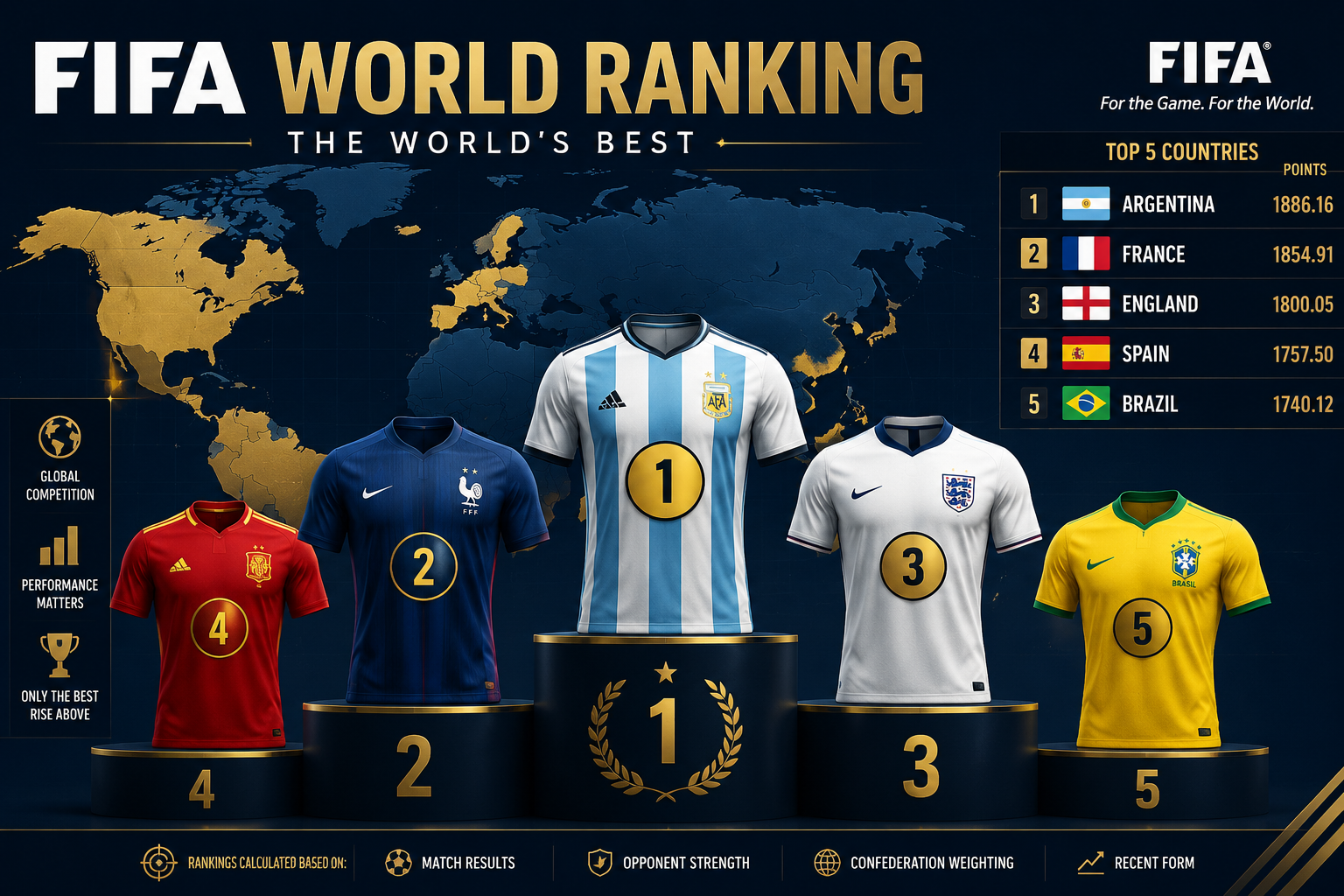
As of 2026, Argentina holds the top spot in the FIFA World Rankings, followed closely by France, England, Spain, and Brazil. These five nations, along with Portugal, Belgium, the Netherlands, Germany, and Italy, make up the top 10 FIFA ranked football countries and represent the gold standard of international football. Rankings shift monthly based on competitive results, so the order changes — but these nations rarely drop far from the summit.
Key Takeaways
- Argentina currently leads the FIFA World Rankings in 2026, building on their 2022 World Cup triumph
- France, England, Spain, and Brazil consistently occupy the top five positions
- FIFA rankings are calculated using a points-based formula that weighs match results, opponent strength, and tournament importance
- European nations dominate the top 10, with only Argentina and Brazil representing South America
- Brazil has won the FIFA World Cup five times — more than any other nation
- Youth development programs in France, Germany, and Spain are widely regarded as the most structured in world football
- Top international players in these nations earn salaries ranging from modest national team fees to multi-million-pound club contracts
- The 2026 FIFA World Cup is a major driver of ranking movement, with qualification results shifting positions significantly
How Do Countries Get Ranked in FIFA?
FIFA uses a points-based system to rank national teams. Every competitive match earns or costs a team points depending on the result, the strength of the opponent, and the importance of the competition.
The key factors in the formula are:
- Match result: Win, draw, or loss
- Opponent strength: Beating a higher-ranked team earns more points
- Tournament weight: World Cup matches carry more weight than friendly games
- Confederation strength: The strength of the opponent’s confederation also factors in
FIFA updates the rankings after every international window. A single tournament run, like a World Cup or Copa America campaign, can move a team dramatically up or down the table. For fans following the 2026 FIFA World Cup, these ranking shifts are part of the drama.
The Top 10 FIFA Ranked Football Countries in 2026
The top 10 FIFA ranked football countries in 2026 are a mix of South American giants and European powerhouses. Here is a snapshot of the current standings:
| Rank | Country | Confederation | World Cup Wins |
|---|---|---|---|
| 1 | Argentina | CONMEBOL | 3 |
| 2 | France | UEFA | 2 |
| 3 | England | UEFA | 1 |
| 4 | Spain | UEFA | 1 |
| 5 | Brazil | CONMEBOL | 5 |
| 6 | Portugal | UEFA | 0 |
| 7 | Belgium | UEFA | 0 |
| 8 | Netherlands | UEFA | 0 |
| 9 | Germany | UEFA | 4 |
| 10 | Italy | UEFA | 4 |
Note: Rankings reflect approximate 2026 standings and may shift following tournament results.
What Makes Brazil So Good at Football?
Brazil’s football dominance comes from a combination of cultural obsession, street football tradition, and a vast talent pool. No country has won more World Cups — five in total — and Brazilian players have shaped the sport’s identity for decades.
Several factors explain Brazil’s consistent excellence:
- Street football culture: Known as “futsal” and “pelada,” informal football is played from an early age across every region of the country, building technical skill naturally
- Sheer population size: Brazil has over 200 million people, meaning the talent pool is enormous
- Club investment: Brazilian clubs like Flamengo and Palmeiro invest heavily in youth academies
- National pride: Football is genuinely the national sport, with participation rates among the highest in the world
Brazil’s style — fluid, technical, and expressive — is partly a product of these grassroots conditions. Even when the national team underperforms, the pipeline of talent rarely dries up.
How Does Argentina’s Football Team Compare to Brazil?
Argentina and Brazil are the two greatest rivals in South American football, and both consistently rank inside the top 10 FIFA ranked football countries. In 2026, Argentina edges Brazil in the rankings, largely due to their 2022 World Cup victory and continued strong performances under Lionel Scaloni.
Key comparison points:
- World Cup wins: Brazil leads with 5; Argentina has 3
- Recent form: Argentina has been the more consistent side since 2021, winning Copa America and the World Cup
- Playing style: Brazil tends toward technical, attacking football; Argentina blends tactical discipline with individual brilliance
- Star power: Both nations have produced generational talents, from Pelé and Ronaldo for Brazil to Maradona and Messi for Argentina
The rivalry remains one of football’s greatest storylines, and both nations are strong contenders heading into the 2026 World Cup.
Which European Country Has the Most World Cup Wins?
Germany and Italy share the record among European nations with four World Cup wins each. Germany won in 1954, 1974, 1990, and 2014. Italy won in 1934, 1938, 1982, and 2006. France follows with two titles (1998 and 2018), while Spain and England have one each.
“Europe dominates the FIFA top 10 by numbers, but South America holds the edge in total World Cup trophies when Brazil’s five titles are included.”
Why Are Some Countries Better at Football Than Others?
National football success is not random. Countries that consistently rank in the top 10 FIFA ranked football countries share several structural advantages.
The main factors include:
- Youth development infrastructure: Countries like France, Germany, and Spain have national academies and mandatory youth training standards for professional clubs
- Domestic league quality: Strong leagues (Premier League, La Liga, Bundesliga, Serie A, Ligue 1) expose players to high-level competition weekly
- Football culture and participation rates: Countries where football is the primary sport see higher participation, which increases the talent pool
- Coaching standards: Top nations invest in coaching education at every level, from grassroots to elite
- Financial resources: Wealthier football associations can fund better facilities, scouting networks, and support staff
Countries that lack one or more of these elements — even those with talented individuals — rarely sustain top 10 status over time.
Which FIFA Top 10 Country Has the Best Youth Development Program?
France is widely considered to have the most effective youth development system in world football. The Clairefontaine academy, established in 1988, has produced players including Thierry Henry, Nicolas Anelka, and a generation of current stars. Germany’s DFB academy network and Spain’s La Masia (FC Barcelona’s youth system) are also globally respected.
Top youth development programs by country:
- France: Clairefontaine national academy; mandatory youth structures at Ligue 1 clubs
- Germany: DFB talent program with regional centres across the country
- Spain: La Masia and Real Madrid’s Castilla system; strong regional federation academies
- Netherlands: Ajax’s famous youth model, which has influenced academies worldwide
- Brazil: Club-based academies at Flamengo, Santos, and Palmeiras
The key difference between France and others is the national coordination — every elite club feeds into a centrally monitored system, making talent identification more consistent.
Are There Any Upcoming Football Talents in These Top Ranked Countries?
Yes, every top 10 FIFA ranked country has a strong pipeline of emerging talent heading into 2026 and beyond.
Notable young players to watch:
- France: Warren Zaire-Emery (Paris Saint-Germain) and Mathys Tel (Bayern Munich) are among the most exciting teenagers in European football
- England: Kobbie Mainoo (Manchester United) and Levi Colwill (Chelsea) are pushing for regular senior caps
- Spain: Lamine Yamal (FC Barcelona) has already broken into the senior squad at a remarkable age
- Germany: Florian Wirtz (Bayer Leverkusen) is considered one of the best young midfielders in the world
- Brazil: Endrick (Real Madrid) and Estevao Willian are generating enormous buzz
These players represent the next wave of talent for nations that are already at the top of the game.
What Training Techniques Do Top FIFA Ranked Countries Use?
Top FIFA ranked countries use a blend of physical conditioning, tactical periodization, and technical drills that are more structured than lower-ranked nations.
Common training approaches include:
- Rondo drills: Small-sided possession exercises used heavily by Spain and France to build quick passing and movement
- Positional play (juego de posicion): A Spanish concept that organizes players by zones rather than fixed positions
- High-intensity interval training (HIIT): Used across Germany and England to build the physical capacity for pressing football
- Video analysis: All top 10 nations use detailed match analysis software to prepare tactically for opponents
- Mental conditioning: Sports psychology is now a standard part of national team preparation in France, England, and Germany
The gap between top 10 nations and lower-ranked teams is as much about training quality and consistency as it is about raw talent.
Average Salary of Players in Top 10 FIFA Countries
Player salaries vary enormously depending on whether the discussion is about club contracts or national team appearance fees. National team match fees are generally modest compared to club wages.
- Club salaries: Top players in England’s Premier League earn between £100,000 and £400,000 per week at elite clubs. La Liga and Bundesliga players earn somewhat less on average, though top earners are comparable
- National team fees: Most top 10 nations pay appearance fees in the range of £1,000 to £15,000 per match, which is a small fraction of club earnings
- Brazil and Argentina: Club wages are lower domestically, but top players exported to Europe earn Premier League or La Liga-level wages
The financial gap between playing for a top club and playing for a national team is significant. National team football is driven by pride and ranking points, not wages.
Is It Expensive to Play Professional Football in Top Ranked Countries?
Breaking into professional football in a top 10 FIFA ranked country is not primarily about money — it is about access and talent identification. Most elite academies in France, Germany, Spain, and England are free for selected players, with clubs covering accommodation, education, and training costs.
However, there are indirect costs:
- Relocation: Families often move to be near academy facilities
- Private coaching: Some families invest in private training before a child is scouted
- Equipment and travel: Grassroots football costs can add up before a player reaches elite level
For players who are selected into national academy systems, the financial burden is low. The bigger barrier is geographic — players in rural areas or lower-income regions may not be seen by scouts as easily as those in major cities.
How Do National Football Rankings Impact Player Recruitment?
A country’s FIFA ranking directly influences how clubs and national federations approach player recruitment. Higher-ranked nations attract more scouting attention from top European clubs, and players from those countries command higher transfer fees on average.
Specific impacts include:
- Transfer market value: Players from Argentina, France, England, and Brazil are often valued higher because their national team pedigree is recognized globally
- Visa and work permit rules: In England, players from higher-ranked nations find it easier to obtain work permits under Football Association rules
- International exposure: Players from top 10 nations play in high-profile tournaments more regularly, which increases their visibility to club scouts
For fans curious about how this plays out at the biggest stage, the 2026 World Cup groups show exactly how rankings determine seeding and draw positions.
Which FIFA Top 10 Country Is Best for Football Scholarships?
The United States is not in the FIFA top 10, but for football scholarships specifically, England, Germany, and Spain offer the most structured pathways for young players seeking funded development.
- England: The Premier League’s Elite Player Performance Plan (EPPP) funds academy players at Category 1 and 2 clubs with full scholarships from age 9
- Germany: The DFB’s talent centres are state-funded, making them effectively free for selected players
- Spain: La Liga clubs offer full scholarships within their academy systems, and the Spanish federation runs funded regional programmes
- France: The INF Clairefontaine scholarship programme is government-backed and highly competitive
For players from outside Europe, the 2026 FIFA World Cup spotlight on top nations has increased interest in these scholarship pathways from football families worldwide.
Common Mistakes Young Footballers Make in Top National Teams
Young players who break into top 10 FIFA ranked national squads often struggle with the step up in intensity and expectation. The most common mistakes are not technical — they are mental and tactical.
- Trying to do too much: Young players often overplay, attempting to impress rather than executing their role simply
- Ignoring defensive responsibilities: Club managers tolerate this more than international coaches, who demand full tactical discipline
- Poor positioning in transition: International football moves faster than most domestic leagues; players who are slow to transition defensively get exposed quickly
- Underestimating opponents: Even lower-ranked nations can cause upsets at major tournaments
- Neglecting recovery: International windows are intense, with matches close together; players who do not manage their bodies often pick up injuries
Coaches at this level have little patience for repeated errors. Young players who thrive are those who listen, adapt quickly, and keep things simple.
FAQ
Which country is currently ranked number one by FIFA in 2026? Argentina holds the top FIFA ranking in 2026, a position they have largely maintained since winning the 2022 World Cup in Qatar.
How often does FIFA update the world rankings? FIFA updates the rankings after every international match window, which typically occurs six to eight times per year.
Has England ever been ranked number one by FIFA? Yes. England reached the top of the FIFA rankings in 2012 under Fabio Capello, though they have not held that position since.
Why does Belgium rank so highly despite never winning a major tournament? Belgium’s ranking reflects consistent strong results in competitive matches against high-ranked opponents. Their “golden generation” accumulated significant ranking points through deep tournament runs, including reaching the World Cup semi-finals in 2018.
Can a country’s ranking drop quickly after one bad tournament? Yes. A poor World Cup or continental championship can cost a nation hundreds of ranking points, especially if they lose to lower-ranked opponents in early rounds.
Is the FIFA ranking the same as being the best team in the world? Not always. Rankings reflect accumulated results over time, not current form. A team can be ranked highly based on past results while going through a transitional period.
Which country has the most players playing in the top five European leagues? Brazil consistently has the most players exported to top European leagues, followed by France and Argentina.
Do friendly matches affect FIFA rankings? Yes, but they carry significantly less weight than competitive matches. A friendly win against a top-ranked opponent earns far fewer points than a World Cup qualifier result.
Which top 10 FIFA nation has the youngest squad on average in 2026? France and England have invested heavily in youth, and both nations field squads with a notably young average age compared to Italy and Germany.
What happens to a country’s ranking if they don’t play for several months? Rankings decay slightly over time if a team is inactive, though FIFA applies this gradually to avoid punishing nations with limited fixture schedules.
Conclusion
The top 10 FIFA ranked football countries in 2026 represent the peak of the global game, built on decades of investment in youth development, domestic league quality, and football culture. Argentina leads the table, but France, England, Spain, Brazil, and the rest of the group are never far behind.
For football fans, understanding these rankings adds a layer of context to every major tournament. Rankings determine seedings, shape draws, and influence which nations are considered favorites before a ball is kicked.
Actionable next steps for football fans:
- Follow the 2026 FIFA World Cup closely, as results will reshape these rankings significantly
- Check out the World Cup 2026 predictions to see which top 10 nations are tipped to go deep
- Read up on England’s World Cup history and 2026 squad if you want a deeper look at one of the top-ranked nations
- Keep an eye on emerging talents from France, Spain, and Brazil — the next generation of stars is already making noise
The rankings will keep moving. The drama never stops.
body {
font-family: -apple-system, BlinkMacSystemFont, 'Segoe UI', Roboto, sans-serif;
background: #f4f6f9;
padding: 20px;
color: #1a1a2e;
}
.cg-element-wrapper {
max-width: 720px;
margin: 0 auto;
background: #ffffff;
border-radius: 12px;
box-shadow: 0 4px 20px rgba(0,0,0,0.1);
overflow: hidden;
}
.cg-element-header {
background: linear-gradient(135deg, #0d1b4b 0%, #1a3a8f 100%);
color: #ffffff;
padding: 24px 28px;
text-align: center;
}
.cg-element-header h2 {
font-size: 1.4rem;
font-weight: 700;
margin-bottom: 6px;
}
.cg-element-header p {
font-size: 0.9rem;
opacity: 0.85;
}
.cg-element-body {
padding: 24px 28px;
}
.cg-element-filter-label {
font-size: 0.85rem;
font-weight: 600;
color: #555;
margin-bottom: 8px;
text-transform: uppercase;
letter-spacing: 0.05em;
}
.cg-element-filter-row {
display: flex;
flex-wrap: wrap;
gap: 8px;
margin-bottom: 20px;
}
.cg-element-filter-btn {
padding: 7px 16px;
border: 2px solid #1a3a8f;
border-radius: 20px;
background: transparent;
color: #1a3a8f;
font-size: 0.82rem;
font-weight: 600;
cursor: pointer;
transition: all 0.2s ease;
}
.cg-element-filter-btn:hover,
.cg-element-filter-btn.active {
background: #1a3a8f;
color: #ffffff;
}
.cg-element-table {
width: 100%;
border-collapse: collapse;
}
.cg-element-table thead tr {
background: #f0f3fa;
}
.cg-element-table th {
padding: 10px 14px;
text-align: left;
font-size: 0.78rem;
font-weight: 700;
color: #444;
text-transform: uppercase;
letter-spacing: 0.04em;
border-bottom: 2px solid #dde3f0;
}
.cg-element-table td {
padding: 12px 14px;
font-size: 0.88rem;
border-bottom: 1px solid #eef0f6;
vertical-align: middle;
}
.cg-element-table tr:last-child td {
border-bottom: none;
}
.cg-element-table tr:hover td {
background: #f7f9ff;
}
.cg-element-rank-badge {
display: inline-flex;
align-items: center;
justify-content: center;
width: 28px;
height: 28px;
border-radius: 50%;
font-weight: 700;
font-size: 0.82rem;
color: #ffffff;
}
.cg-element-rank-1 { background: #c9a227; }
.cg-element-rank-2 { background: #8e9aaf; }
.cg-element-rank-3 { background: #a0522d; }
.cg-element-rank-other { background: #1a3a8f; }
.cg-element-flag {
font-size: 1.3rem;
margin-right: 6px;
}
.cg-element-country-cell {
display: flex;
align-items: center;
gap: 4px;
}
.cg-element-bar-wrap {
background: #eef0f6;
border-radius: 4px;
height: 10px;
width: 100%;
min-width: 80px;
}
.cg-element-bar-fill {
height: 10px;
border-radius: 4px;
background: linear-gradient(90deg, #1a3a8f, #4a90d9);
transition: width 0.5s ease;
}
.cg-element-hidden {
display: none;
}
.cg-element-footer {
padding: 14px 28px;
background: #f0f3fa;
font-size: 0.75rem;
color: #777;
text-align: center;
border-top: 1px solid #dde3f0;
}
@media (max-width: 520px) {
.cg-element-header h2 { font-size: 1.1rem; }
.cg-element-body { padding: 16px; }
.cg-element-table th, .cg-element-table td { padding: 8px 8px; font-size: 0.78rem; }
}
FIFA Top 10 Country Rankings Explorer 2026
Filter by confederation or sort by World Cup wins, ranking points, or youth rank
Filter by Confederation
<div class="cg-element-filter-label">Sort By</div>
<div class="cg-element-filter-row">
<button class="cg-element-filter-btn active" onclick="sortTable('rank', this)">FIFA Rank</button>
<button class="cg-element-filter-btn" onclick="sortTable('wc', this)">World Cup Wins</button>
<button class="cg-element-filter-btn" onclick="sortTable('youth', this)">Youth Rank</button>
</div>
<table class="cg-element-table" id="cg-ranking-table">
<thead>
<tr>
<th>Rank</th>
<th>Country</th>
<th>Conf.</th>
<th>WC Wins</th>
<th>Youth Rank</th>
<th>Est. Points</th>
</tr>
</thead>
<tbody id="cg-table-body">
</tbody>
</table>
</div>
<div class="cg-element-footer">
Data reflects approximate 2026 FIFA standings. Points are illustrative estimates. Youth rank based on academy reputation and recent U21 performance. Source: FIFA.com
</div>
const cgData = [
{ rank: 1, flag: "AR", country: "Argentina", conf: "CONMEBOL", wc: 3, youth: 4, points: 1870 },
{ rank: 2, flag: "FR", country: "France", conf: "UEFA", wc: 2, youth: 1, points: 1840 },
{ rank: 3, flag: "GB-ENG", country: "England", conf: "UEFA", wc: 1, youth: 3, points: 1810 },
{ rank: 4, flag: "ES", country: "Spain", conf: "UEFA", wc: 1, youth: 2, points: 1795 },
{ rank: 5, flag: "BR", country: "Brazil", conf: "CONMEBOL", wc: 5, youth: 5, points: 1780 },
{ rank: 6, flag: "PT", country: "Portugal", conf: "UEFA", wc: 0, youth: 7, points: 1755 },
{ rank: 7, flag: "BE", country: "Belgium", conf: "UEFA", wc: 0, youth: 8, points: 1730 },
{ rank: 8, flag: "NL", country: "Netherlands", conf: "UEFA", wc: 0, youth: 6, points: 1710 },
{ rank: 9, flag: "DE", country: "Germany", conf: "UEFA", wc: 4, youth: 2, points: 1690 },
{ rank: 10, flag: "IT", country: "Italy", conf: "UEFA", wc: 4, youth: 9, points: 1665 }
];
const flagEmoji = {
"AR": "AR", "FR": "FR", "GB-ENG": "EN", "ES": "ES",
"BR": "BR", "PT": "PT", "BE": "BE", "NL": "NL", "DE": "DE", "IT": "IT"
};
const countryFlags = {
"Argentina": "🇦🇷", "France": "🇫🇷", "England": "🏴",
"Spain": "🇪🇸", "Brazil": "🇧🇷", "Portugal": "🇵🇹",
"Belgium": "🇧🇪", "Netherlands": "🇳🇱", "Germany": "🇩🇪", "Italy": "🇮🇹"
};
const maxPoints = 1870;
let currentFilter = 'all';
let currentSort = 'rank';
function getRankClass(rank) {
if (rank === 1) return 'cg-element-rank-1';
if (rank === 2) return 'cg-element-rank-2';
if (rank === 3) return 'cg-element-rank-3';
return 'cg-element-rank-other';
}
function renderTable() {
let filtered = cgData.filter(d => currentFilter === 'all' || d.conf === currentFilter);
if (currentSort === 'rank') filtered.sort((a, b) => a.rank - b.rank);
else if (currentSort === 'wc') filtered.sort((a, b) => b.wc - a.wc || a.rank - b.rank);
else if (currentSort === 'youth') filtered.sort((a, b) => a.youth - b.youth);
const tbody = document.getElementById('cg-table-body');
tbody.innerHTML = '';
filtered.forEach(d => {
const barWidth = Math.round((d.points / maxPoints) * 100);
const row = document.createElement('tr');
row.innerHTML = `
${d.rank}
${countryFlags[d.country] || ''}
${d.country}
${d.conf}
${d.wc}
${d.youth}
${d.points.toLocaleString()}
`;
tbody.appendChild(row);
});
}
function filterTable(conf, btn) {
currentFilter = conf;
document.querySelectorAll('.cg-element-filter-row:first-of-type .cg-element-filter-btn').forEach(b => b.classList.remove('active'));
btn.classList.add('active');
renderTable();
}
function sortTable(sortKey, btn) {
currentSort = sortKey;
document.querySelectorAll('.cg-element-filter-row:last-of-type .cg-element-filter-btn').forEach(b => b.classList.remove('active'));
btn.classList.add('active');
renderTable();
}
renderTable();