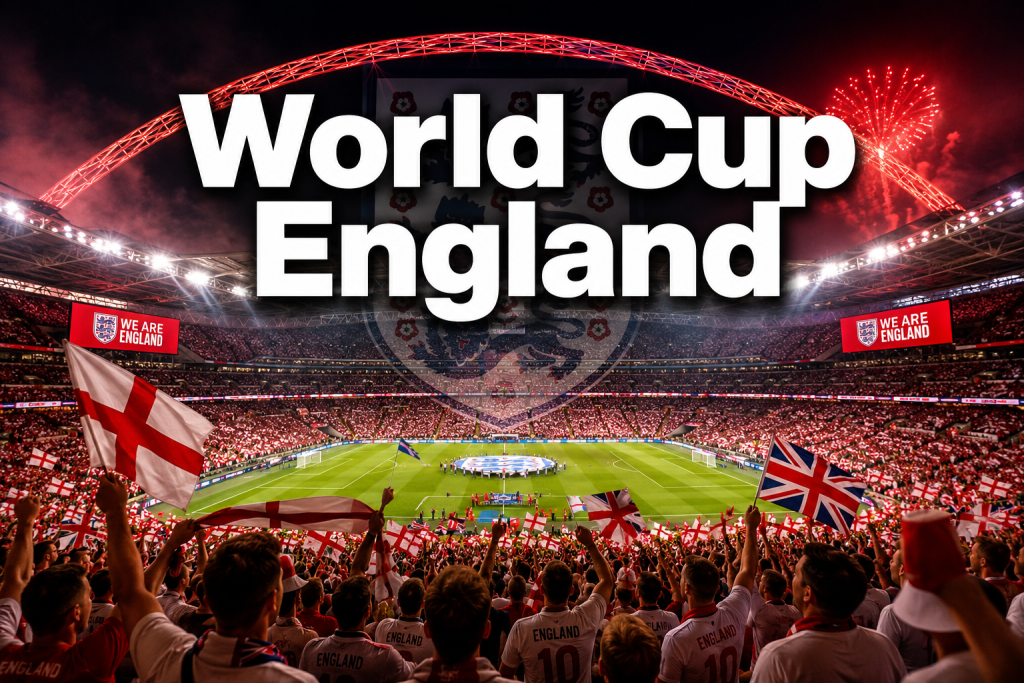
Last updated: May 25, 2026
Quick Answer: England has won the World Cup once, in 1966 on home soil. Since then, the Three Lions have come agonisingly close on several occasions but haven’t lifted the trophy again. In 2026, England are considered genuine contenders with a strong squad, though history and tournament pressure remain real factors fans can’t ignore.
Key Takeaways
- England’s only World Cup win came in 1966, beating West Germany 4–2 in the final at Wembley.
- The Three Lions have reached the semi-finals three times: 1966 (won), 1990, and 2018.
- Harry Kane remains England’s all-time leading scorer and is central to their 2026 campaign.
- England typically lines up in a 4-3-3 or 4-2-3-1 formation under current management.
- Common criticisms include poor penalty shootout records and tactical conservatism in knockout rounds.
- England’s squad in 2026 blends experienced veterans with exciting younger talent.
- Ticket prices for England World Cup games vary widely — expect to pay $150–$800+ USD on the secondary market depending on the round.
- England’s biggest World Cup upsets include losses to the USA in 1950 and Iceland in Euro 2016 (not a World Cup, but a cultural scar nonetheless).
How Many World Cups Has England Won?
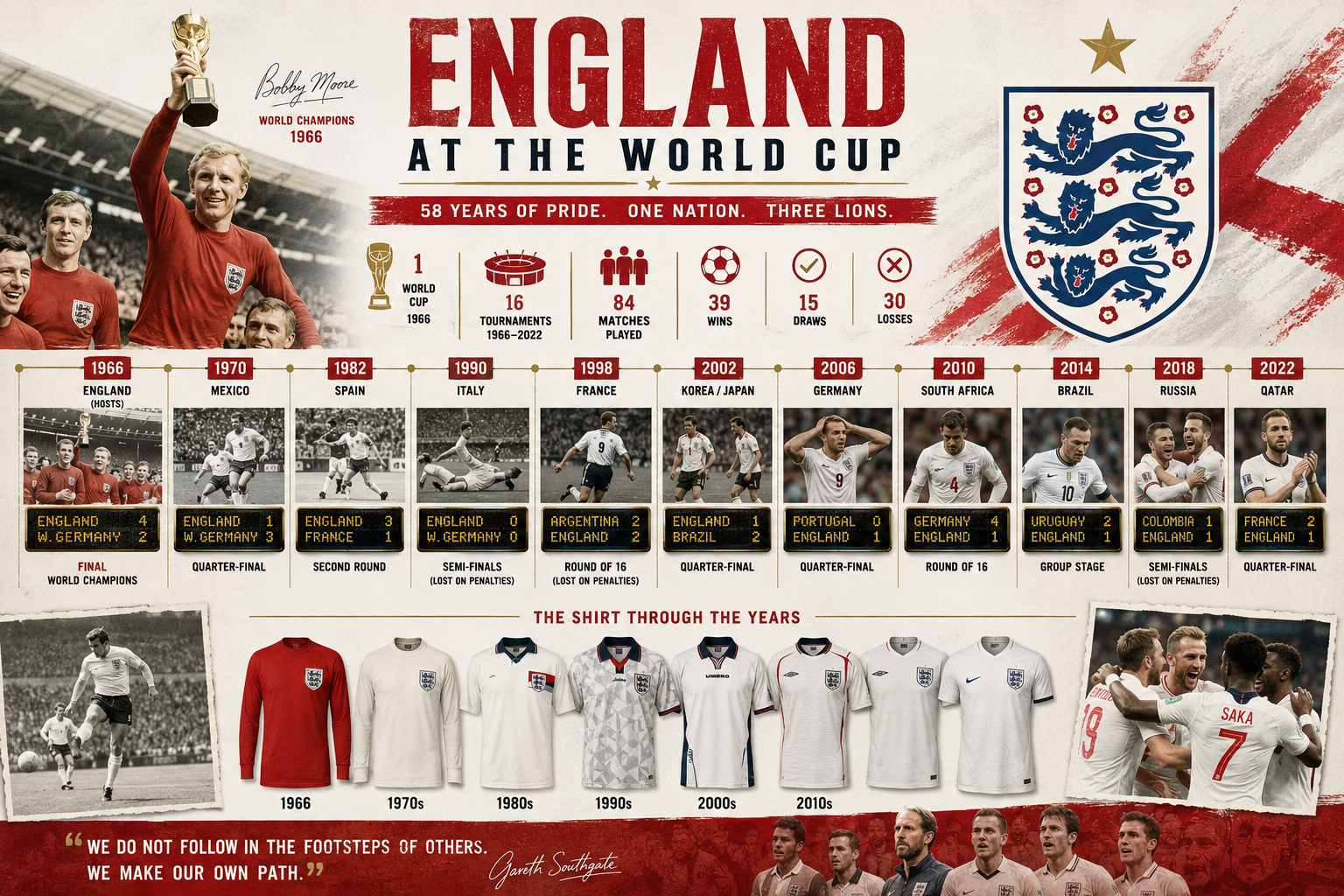
England has won the World Cup exactly once. That came in 1966 when the tournament was held in England, and the national team beat West Germany 4–2 after extra time at Wembley. Geoff Hurst scored a hat-trick — still the only hat-trick in a World Cup final — and Bobby Moore lifted the trophy.
Since 1966, England have:
- Reached the quarter-finals or further six times
- Made the semi-finals in 1990 (lost to West Germany on penalties) and 2018 (lost to Croatia)
- Never won a penalty shootout in a World Cup until 2018 vs Colombia — a long-overdue breakthrough
The 60-year gap since that victory is the central tension of every World Cup England campaign. It’s not that England are a weak nation — they consistently qualify and regularly reach the later rounds. The issue is converting potential into a trophy.
When Is England’s Next World Cup Match?
England’s next World Cup match depends on where the 2026 tournament schedule currently stands. The 2026 FIFA World Cup is co-hosted by the USA, Canada, and Mexico — the first tournament to feature 48 teams, which means more matches and a longer group stage.
England were drawn into their group and are expected to progress through the group stage based on squad quality. For the exact fixture date and time:
- Check FIFA’s official website (fifa.com) for the live schedule
- Use the BBC Sport or Sky Sports apps for UK-localised match times
- Set alerts on Google — searching “England World Cup fixture” pulls up the schedule card instantly
⚽ Quick tip: With 48 teams in 2026, the group stage runs longer than previous tournaments. England could play their first knockout match later than fans are used to, so plan viewing schedules accordingly.
Who Are England’s Best Players at the World Cup?
England’s squad in 2026 features a strong mix of Premier League quality and European club experience. The standout names include:
- Harry Kane — England’s all-time top scorer, playing his club football at Bayern Munich. Clinical in front of goal and a genuine world-class striker.
- Jude Bellingham — The Real Madrid midfielder is arguably England’s most complete player. Creative, energetic, and capable of decisive moments in big games.
- Phil Foden — The Manchester City forward brings creativity and directness in tight spaces.
- Bukayo Saka — Arsenal’s right winger is a consistent performer who offers both goals and assists.
- Trent Alexander-Arnold — His ability to play in midfield or at right back gives England tactical flexibility.
These players represent England’s best chance of going deep in the tournament. When all five are fit and firing, England match up well against any nation in the world.
Is Harry Kane Playing in This World Cup?
Yes, Harry Kane is part of England’s 2026 World Cup squad. Kane has been England’s talisman for years and remains the country’s all-time leading scorer. At Bayern Munich, he’s continued to score at a prolific rate, keeping his form sharp heading into the tournament.
Kane’s importance to World Cup England cannot be overstated. England’s attack is significantly weaker without him, and his ability to hold up play, link with midfield, and finish in tight situations makes him irreplaceable at this level.
Watch for: Kane’s partnership with Bellingham in the final third. When those two connect, England are genuinely dangerous.
What Formation Does England Use in World Cup Matches?
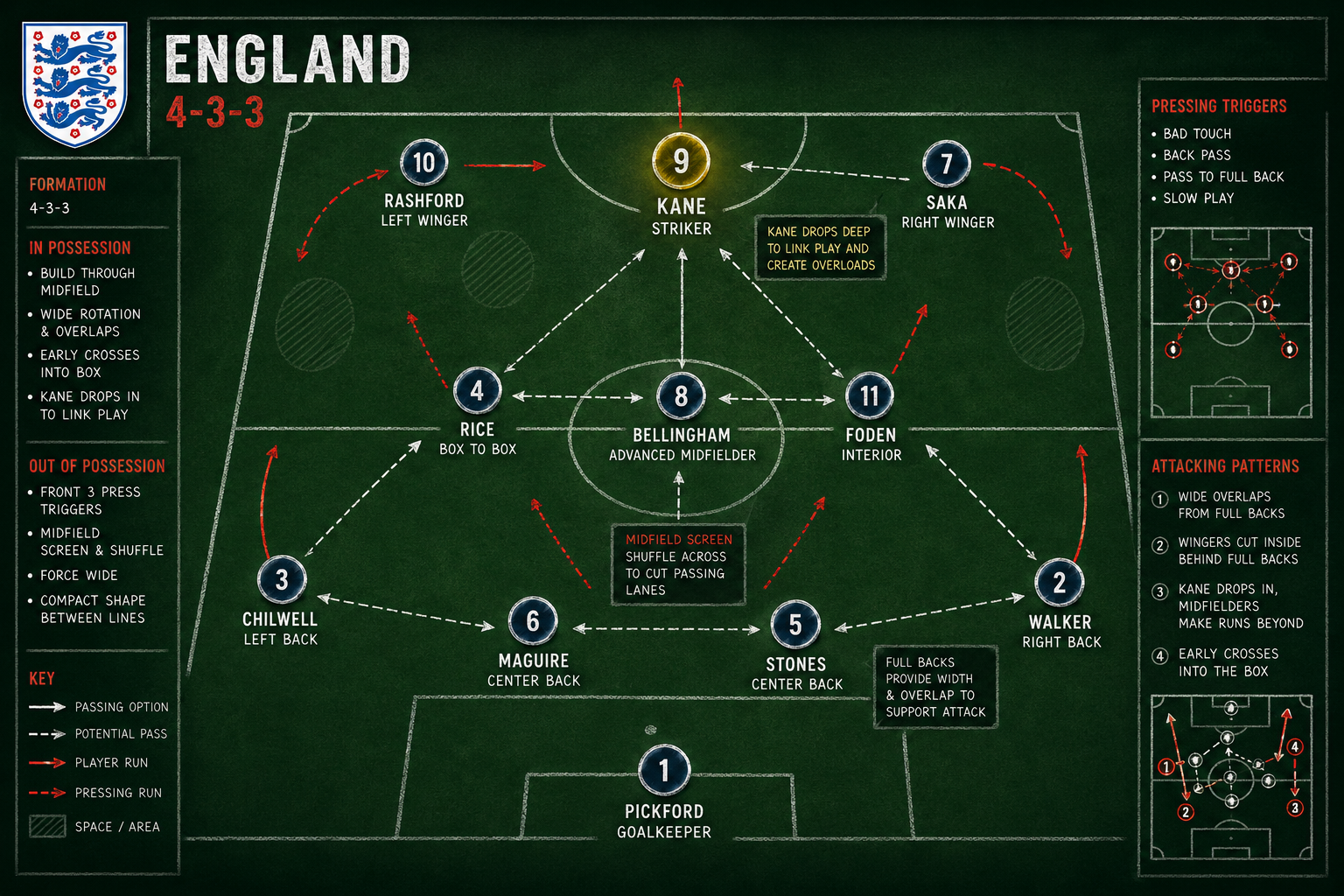
England most commonly uses a 4-3-3 or 4-2-3-1 formation in World Cup football. The exact shape depends on the opponent and the game situation.
- 4-3-3: Allows Bellingham to play as an advanced midfielder while Saka and Foden operate as wide forwards behind Kane.
- 4-2-3-1: Provides more defensive cover in midfield, useful against possession-heavy opponents.
England’s management has also experimented with a 3-4-3 when chasing games or wanting to overload wide areas. Flexibility is a strength of the current setup, though critics argue England sometimes overthink their shape in knockout rounds.
Why Does England Struggle in World Cup Tournaments?
England consistently reaches the knockout rounds but rarely wins the tournament. Several factors explain this pattern:
- Penalty shootout anxiety — England lost six consecutive shootouts before beating Colombia in 2018. The mental burden of that history has been real.
- Tactical conservatism — England managers have historically been criticised for sitting on leads or playing too cautiously against lower-ranked opponents.
- Injury timing — Key players often arrive at tournaments carrying knocks or not at peak fitness.
- Expectation pressure — The English media creates enormous pressure around the squad, which can affect performance in knockout games.
- Opponent adaptability — Top nations like France, Brazil, and Germany have historically adjusted better mid-tournament than England.
Common mistake England makes: Dropping into a low defensive block after scoring first, which invites pressure and allows opponents back into games.
How Does England’s Team Compare to Other Top Nations?
England sit comfortably among the world’s top eight nations but face stiff competition from traditional powerhouses.
| Nation | World Cup Wins | Recent Finals | Key Strength |
|---|---|---|---|
| Brazil | 5 | 2002 | Attacking flair |
| Germany | 4 | 2014 | Tactical discipline |
| France | 2 | 2018, 2022 | Squad depth |
| Argentina | 3 | 2022 | Individual brilliance |
| England | 1 | 1966 | Midfield quality |
| Spain | 1 | 2010 | Possession football |
England’s midfield — particularly Bellingham — is genuinely world-class. The gap between England and the very top nations is smaller than it’s been in decades, but France and Brazil still carry more tournament-winning pedigree in 2026.
What Are England’s Chances of Winning the World Cup in 2026?
England are genuine contenders but not outright favourites. Most pre-tournament assessments place them in a second tier of contenders alongside Germany and Portugal, behind France, Brazil, and Argentina.
Factors working in England’s favour:
- Deep, talented squad with Premier League fitness
- Bellingham and Kane at the peak of their powers
- Experience from the 2018 semi-final and Euro 2020/2024 runs
- Improved penalty shootout mentality
Factors working against them:
- Inconsistency in big knockout games
- Defensive vulnerabilities at set pieces
- Pressure of 60 years without a World Cup
Choose England as your pick if: You believe squad quality and individual brilliance can overcome tournament nerves. It’s not a stretch — it’s a genuine possibility.
How Much Do World Cup Tickets Cost for England Games?
Official FIFA tickets for the 2026 World Cup group stage started at around $80–$150 USD for standard categories. However, England games — especially if they reach the knockout rounds — command significant premiums on the secondary market.
Rough estimates for England matches:
- Group stage: $150–$350 on resale platforms
- Round of 16: $300–$600
- Quarter-final and beyond: $500–$1,500+
Fans travelling from the UK should also budget for flights, accommodation in US/Canadian cities, and local transport. Major host cities include New York, Los Angeles, Dallas, and Toronto — all with significant travel costs from the UK.
What Are the Biggest Upsets in England’s World Cup History?
England’s World Cup journey includes some genuinely shocking defeats:
- 1950 vs USA (1–0): Widely considered one of the biggest upsets in World Cup history. England, as one of the favourites, lost to a part-time American side in the group stage.
- 1958 — Failed to qualify from the group stage: England drew all three group games and went out without winning a match.
- 1970 quarter-final vs West Germany (2–3): England led 2–0 and collapsed, losing in extra time.
- 2010 vs Germany (1–4): A Frank Lampard goal that clearly crossed the line was disallowed. England were then dismantled 4–1 in a humiliating last-16 exit.
These moments are part of the World Cup England story — painful, but they explain why every tournament feels loaded with both hope and dread.
How Can England Improve Their World Cup Performance?
England’s path to winning a World Cup requires specific improvements, not just talent accumulation.
- Penalty preparation: Regular, high-pressure shootout practice in training camps — not just in the week before a game.
- Tactical adaptability: Being willing to change shape mid-game rather than sticking rigidly to the starting plan.
- Squad rotation management: Using the expanded 48-team format to rotate players smartly through the group stage.
- Mental coaching: Investing in sports psychology at squad level to handle the unique pressure of major tournaments.
- Defensive set-piece organisation: England concede too many goals from corners and free kicks at major tournaments.
FAQ
Q: When did England last win the World Cup? England won the World Cup in 1966, beating West Germany 4–2 at Wembley. It remains their only World Cup title.
Q: Has England ever hosted the World Cup? Yes, England hosted the 1966 FIFA World Cup — the same tournament they won. There are no confirmed plans for England to host again in the near future.
Q: How many times has England been in a World Cup final? Once — in 1966. England have reached the semi-finals on two other occasions (1990, 2018) but didn’t make it to the final.
Q: Who is England’s all-time top scorer at the World Cup? Gary Lineker scored 10 World Cup goals across two tournaments (1986, 1990), making him England’s top World Cup scorer historically. Harry Kane is closing in on that record.
Q: Why do England always lose on penalties? England lost six consecutive World Cup and European Championship shootouts between 1990 and 2016. The pattern is partly psychological and partly a result of inadequate preparation. They’ve improved since 2018 but the reputation lingers.
Q: Is the 2026 World Cup bigger than previous tournaments? Yes. The 2026 FIFA World Cup is the first to feature 48 teams, up from 32. This means more matches, a longer group stage, and a new round-of-32 knockout round.
Q: What is England’s FIFA ranking in 2026? England consistently rank inside the top 5 in the FIFA World Rankings. Check fifa.com for the current exact ranking, as it updates monthly.
Q: Can England win the World Cup in 2026? It’s genuinely possible. England have the squad quality to go all the way, but they’ll need to avoid the mental and tactical lapses that have cost them in previous tournaments.
Conclusion
World Cup England is one of football’s most compelling ongoing stories — a nation that invented the game, won it once in glorious fashion, and has spent six decades chasing that feeling again. In 2026, the ingredients are there: a world-class striker in Kane, a generational talent in Bellingham, and a squad deep enough to compete with anyone.
Here’s what to do next:
- Follow the fixture schedule on FIFA.com or BBC Sport so you never miss an England game.
- Watch Bellingham and Kane’s club form leading into the tournament — their fitness is the single biggest indicator of England’s chances.
- Join the conversation — fan forums, social media, and pub debates are all part of the World Cup England experience.
- Temper expectations but stay hopeful — England are contenders, not certainties. Enjoy the ride.
The Three Lions haven’t roared loudest since ’66. But in 2026, the squad and the moment might finally align. 🦁