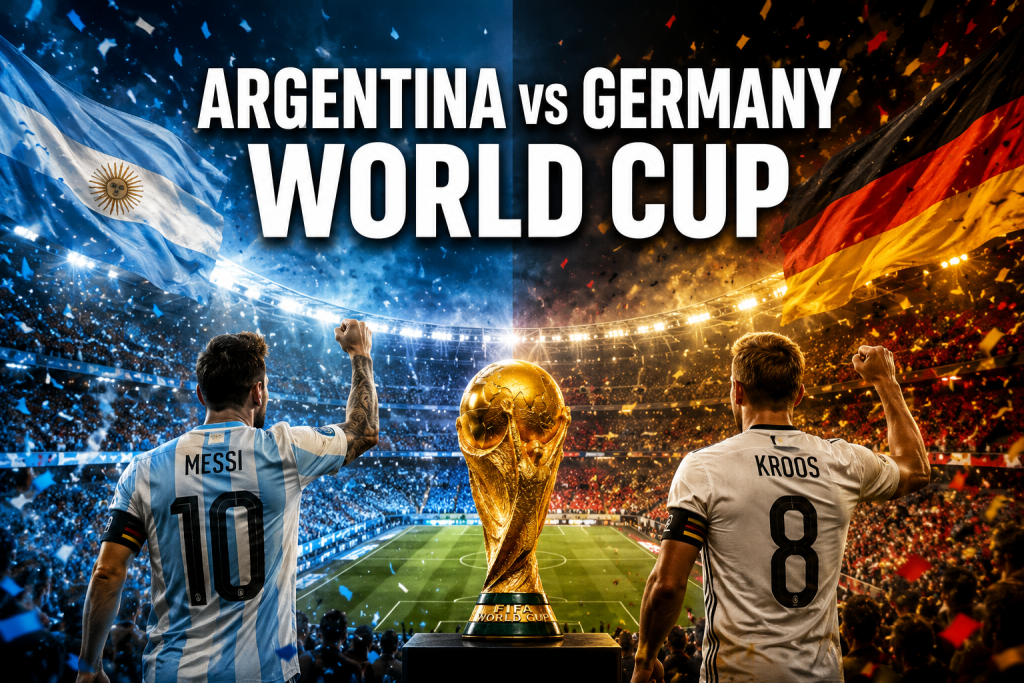
Last updated: June 1, 2026
Quick Answer
Argentina and Germany have met four times in FIFA World Cup finals, making theirs the most repeated final matchup in tournament history. Their encounters span 1986, 1990, 2006 (semifinal), and 2014, with each team winning two of the four final meetings. The most recent clash, the 2014 World Cup final in Brazil, ended 1-0 to Germany thanks to Mario Gotze’s extra-time goal.
Key Takeaways
- Argentina and Germany have faced each other in three World Cup finals (1986, 1990, 2014), each producing a different winner.
- Argentina won the 1986 final 3-2; Germany won the 1990 final 1-0 and the 2014 final 1-0.
- Mario Gotze scored the only goal of the 2014 final in the 113th minute of extra time.
- Diego Maradona was the defining player of the 1986 encounter; Lothar Matthaus dominated the 1990 clash.
- Germany has won four World Cup titles overall; Argentina has won three (1978, 1986, 2022).
- Their tactical contrast, Argentina’s flair against Germany’s structure, has defined each meeting.
- No confirmed fixture between the two sides is scheduled for the 2026 World Cup group stage.
- The rivalry is widely regarded as the most storied in World Cup final history.
How Many Times Have Argentina and Germany Played in World Cup Finals?
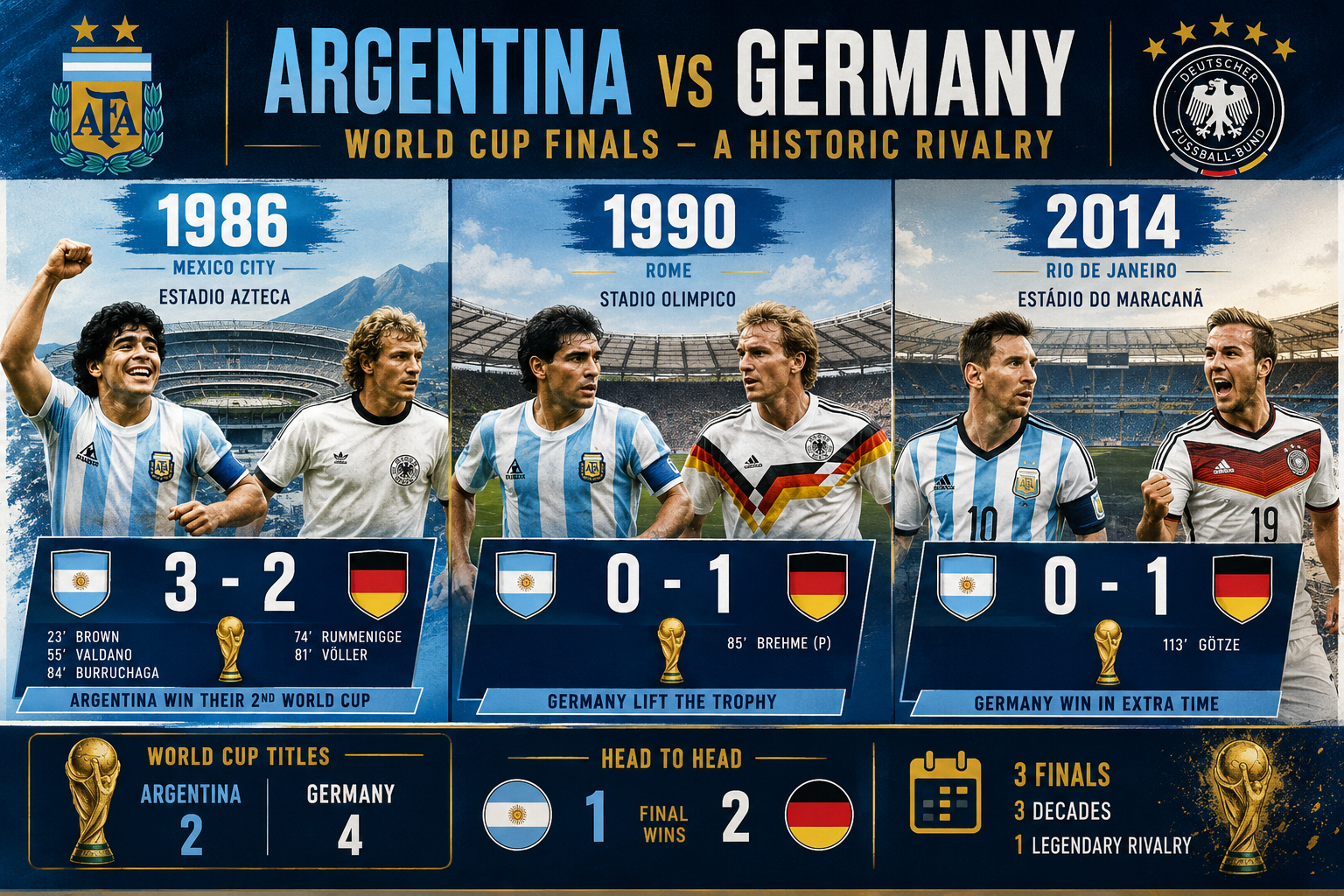
Argentina and Germany have met in three World Cup finals, more than any other pair of nations in tournament history. They played in 1986 (Mexico), 1990 (Italy), and 2014 (Brazil). Each final was decided by a single goal or a narrow margin, which tells you everything about how closely matched these sides have always been.
Head-to-head World Cup final record:
| Year | Host | Score | Winner |
|---|---|---|---|
| 1986 | Mexico | Argentina 3-2 West Germany | Argentina |
| 1990 | Italy | West Germany 1-0 Argentina | West Germany |
| 2014 | Brazil | Germany 1-0 Argentina (AET) | Germany |
Beyond the finals, the two sides also met in the 2006 World Cup quarterfinals in Germany, with the hosts winning on penalties after a 1-1 draw. For a full breakdown of Argentina’s World Cup history, see the complete fan guide to La Albiceleste’s legacy.
Who Won the Most Recent World Cup Match Between These Teams?
Germany won the most recent Argentina vs Germany World Cup encounter, the 2014 FIFA World Cup final, by a score of 1-0 after extra time. The match was played on July 13, 2014, at the Estadio do Maracana in Rio de Janeiro, Brazil.
Mario Gotze came off the bench and scored in the 113th minute, controlling a chest pass from Andre Schurrle and volleying past Sergio Romero. It was a devastating moment for Argentina, who had reached the final largely on the brilliance of Lionel Messi.
What Was the Score in the 2014 World Cup Final?
Germany beat Argentina 1-0 in the 2014 World Cup final, with the decisive goal arriving in extra time. For 90 minutes, neither side could break the deadlock despite Argentina’s Gonzalo Higuain missing a clear chance in the first half.
Key moments from the 2014 final:
- Higuain missed an open goal in the first half for Argentina
- Messi hit the post late in normal time
- Gotze scored in the 113th minute to win it for Germany
- Messi won the Golden Ball award despite being on the losing side, a decision that drew significant controversy
Why Do Argentina and Germany Have Such a Historic Soccer Rivalry?
The Argentina vs Germany World Cup rivalry is historic because it is built on repeated high-stakes encounters at the sport’s biggest stage, not just friendly matches or group games. Three World Cup finals between the same two nations is unprecedented, and each match has carried enormous national pride.
There is also a cultural dimension. Argentina’s football identity is rooted in individual brilliance, improvisation, and passion. Germany’s football identity, particularly through the 1970s to 2010s, was built on collective discipline, physical intensity, and tactical precision. When these two philosophies collide in a final, the tension is almost theatrical.
For broader context on Germany’s World Cup journey, the Germany World Cup history, tactics, and stars guide covers the full picture.
Which Players Were Key in Their Past World Cup Encounters?
Several players defined individual chapters of the Argentina vs Germany World Cup rivalry.
1986 Final:
- Diego Maradona (Argentina): Orchestrated the entire tournament and was the decisive figure in the final, assisting two goals.
- Karl-Heinz Rummenigge (West Germany): Scored in the comeback that briefly made it 2-2 before Argentina sealed it.
1990 Final:
- Lothar Matthaus (West Germany): Dominated midfield throughout the tournament; arguably the best player of that World Cup.
- Andreas Brehme scored the only goal from the penalty spot.
2014 Final:
- Mario Gotze (Germany): Came off the bench to score the winner in extra time.
- Lionel Messi (Argentina): Carried Argentina to the final but could not find a decisive moment when it mattered most.
What Strategies Do Argentina and Germany Typically Use Against Each Other?
In their World Cup meetings, Germany has consistently used a high-pressing, structured defensive shape that limits Argentina’s space for individual creativity. Argentina, meanwhile, has relied on quick transitions and the ability of one or two elite players to create something from nothing.
Common tactical patterns:
- Germany tends to press high and win the ball in Argentina’s half
- Argentina looks to exploit space behind Germany’s defensive line on the counter
- Set pieces have been decisive in multiple encounters
- Germany’s midfield discipline has historically neutralized Argentina’s playmakers
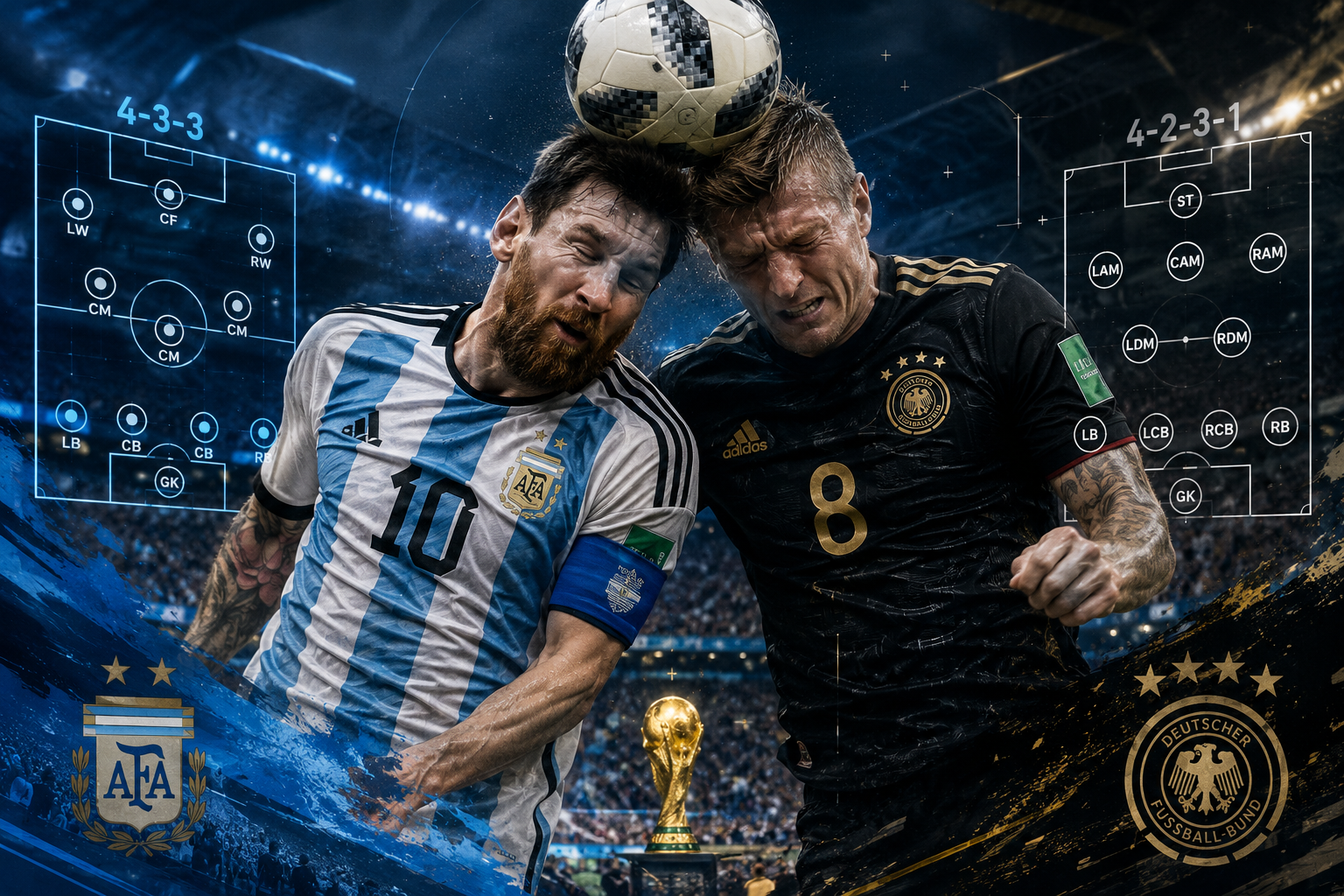
In 2014, Germany’s 4-2-3-1 shape allowed them to control possession while pressing aggressively, which limited Messi’s influence for long stretches. Argentina’s 4-3-3 relied heavily on Messi dropping deep to receive the ball, which Germany’s defensive midfielders tracked closely.
Are There Any Controversial Moments in Their World Cup History?
Yes, the Argentina vs Germany World Cup history contains several moments that still generate debate among football fans.
The most controversial incidents:
- 1990 Final penalty: The match-winning penalty awarded to West Germany in the 1990 final, for a foul on Rudi Voller, remains disputed. Argentine players argued the contact was minimal. The match also saw two Argentine players sent off, which Argentina’s camp felt was influenced by referee bias.
- Messi’s 2014 Golden Ball: FIFA awarded Lionel Messi the Golden Ball as the tournament’s best player despite Argentina losing the final. Many analysts argued Thomas Muller or Manuel Neuer had stronger tournaments.
- 1986 Final comeback: West Germany came back from 2-0 down to make it 2-2 before Jorge Burruchaga scored the winner for Argentina in the 83rd minute, a dramatic swing that some felt Germany should have seen out.
How Do Their National Soccer Styles Differ?
Argentina’s football culture prizes individual expression, technical skill, and attacking flair. Germany’s football culture, historically, prizes collective organization, physical conditioning, and tactical structure. These are not just stereotypes; they reflect genuine differences in how each nation develops and selects players.
Argentina produces forwards and attacking midfielders who are comfortable in tight spaces and capable of moments of individual brilliance. Germany has historically produced disciplined midfielders, physically dominant defenders, and technically sound forwards who function within a system.
By 2026, both nations have evolved. Germany’s post-2014 decline and subsequent rebuild has pushed them toward a more possession-based style. Argentina, energized by their 2022 World Cup win in Qatar, continues to blend Messi-era creativity with younger, more direct forwards. You can track both squads heading into 2026 via the World Cup 2026 groups complete guide.
Which Team Has More World Cup Championships Overall?
Germany has won four World Cup titles (1954, 1974, 1990, 2014). Argentina has won three (1978, 1986, 2022). Germany holds the edge in total championships, though Argentina’s 2022 Qatar triumph closed the gap and re-established them as the reigning world champions heading into the 2026 tournament.
- Germany: 4 titles
- Argentina: 3 titles
Both nations rank among the top five most successful World Cup nations of all time, alongside Brazil (5), Italy (4), and France (2).
What Are Common Mistakes Argentina or Germany Make in Big Tournament Matches?
Both nations have patterns of underperformance in specific scenarios worth noting for fans watching the 2026 tournament.
Argentina’s recurring issues:
- Over-reliance on one player (historically Messi) to create all attacking threat
- Defensive vulnerability on the counter-attack when chasing a game
- Inconsistent penalty shootout performance
Germany’s recurring issues:
- Slow starts to tournaments, particularly in the group stage (they were eliminated in the group stage at the 2018 World Cup in Russia)
- Struggles when their high press is bypassed with direct play
- Difficulty adapting mid-match when their tactical plan is disrupted
For fans following Germany’s 2026 campaign, the 2018 World Cup archives provide useful context on how badly a tournament can go wrong even for a four-time champion.
Who Are the Top Goal Scorers in Their Head-to-Head World Cup Games?
Across all World Cup meetings between Argentina and Germany (including group stages and knockout rounds), goals have been spread across multiple players rather than dominated by one scorer.
Notable goal scorers in Argentina vs Germany World Cup matches:
- Karl-Heinz Rummenigge – scored in the 1986 final
- Rudi Voller – scored in the 1986 final comeback
- Jorge Burruchaga – scored the 1986 final winner for Argentina
- Andreas Brehme – scored the only goal of the 1990 final
- Mario Gotze – scored the only goal of the 2014 final
- Miroslav Klose – scored in the 2006 quarterfinal
No single player has scored more than once across all their World Cup meetings, which underlines how tight and defensively structured these games tend to be.
How Much Do World Cup Tickets Cost for an Argentina Germany Match?
If Argentina and Germany were to meet at the 2026 World Cup (hosted across the United States, Canada, and Mexico), ticket prices would vary significantly based on the round. For the 2026 tournament, FIFA’s official pricing tiers for knockout rounds are expected to range from approximately $150 for category 3 seats in the round of 32, up to $1,100 or more for category 1 seats in the final.
A potential Argentina vs Germany World Cup final rematch in 2026 would be among the most in-demand tickets in sporting history. Secondary market prices for such a match would almost certainly exceed $3,000 per seat based on comparable demand at the 2014 final.
For the latest ticketing and scheduling information, the World Cup Football 2026 ultimate fan guide covers host city details and how to navigate official ticket channels.
Is This a Classic International Soccer Matchup for Fans?
Without question, the Argentina vs Germany World Cup rivalry is the defining final matchup in the sport’s history. No other two nations have met in as many World Cup finals, and the quality of those encounters, three tight, dramatic games decided by a single goal or a narrow margin – has cemented the fixture in football folklore.
For fans who grew up watching Maradona in 1986 or Messi in 2014, these games carry a weight that goes beyond the scoreline. They represent entire eras of football. The prospect of a fourth final meeting in 2026 is one of the most exciting hypotheticals in the sport right now. For more on Argentina’s 2026 ambitions, see the Argentina 2026 World Cup tag page.
FAQ
How many World Cup finals have Argentina and Germany played against each other? Three. They met in the 1986 final (Argentina won 3-2), the 1990 final (West Germany won 1-0), and the 2014 final (Germany won 1-0 after extra time).
Who scored the winning goal in the 2014 World Cup final? Mario Gotze scored in the 113th minute of extra time to give Germany a 1-0 win over Argentina at the Maracana in Rio de Janeiro.
Which country has won more World Cups, Argentina or Germany? Germany has won four World Cups (1954, 1974, 1990, 2014). Argentina has won three (1978, 1986, 2022).
Did Argentina and Germany play at the 2022 World Cup? No. Argentina and Germany were in different groups at the 2022 World Cup in Qatar and did not meet at any stage of the tournament.
Who was the best player in the 1986 Argentina vs Germany World Cup final? Diego Maradona is widely considered the standout player of the 1986 final and the entire tournament. He did not score in the final but created two of Argentina’s three goals.
Why was the 1990 final so controversial? The 1990 final is remembered for the penalty awarded to West Germany for a foul on Rudi Voller, which many considered soft. Two Argentine players were also sent off, and Argentina felt the officiating was biased. Andreas Brehme scored the resulting penalty for the only goal.
Could Argentina and Germany meet at the 2026 World Cup? Yes, it is possible. Both nations are strong favorites to advance deep into the 2026 tournament. A final meeting would require both teams to win their respective halves of the bracket, which is entirely plausible given their squads.
What is the overall head-to-head record between Argentina and Germany at World Cups? Across all World Cup matches (including group stages and knockouts), Germany holds a slight edge, but the three finals are split 1-1-1 across the three meetings.
Did Lionel Messi ever win a World Cup final against Germany? No. Messi played in the 2014 World Cup final against Germany but Argentina lost 1-0 after extra time. Messi won his World Cup title in 2022 against France, not Germany.
Is the Argentina vs Germany World Cup rivalry the greatest in the tournament’s history? Many football historians argue yes, based purely on the number of final meetings and the quality of those matches. Brazil vs Germany and Brazil vs Argentina are also cited, but no other pair has met three times in a final.
Conclusion
The Argentina vs Germany World Cup rivalry stands apart from every other international football matchup because it has been tested repeatedly at the highest possible level. Three finals, three different winners across different eras, and a combined seven World Cup titles between them make this the most compelling fixture in the sport’s history.
For fans heading into the 2026 tournament, here are the actionable steps to make the most of this rivalry:
- Watch the 1986 final if you have not seen it. Maradona’s performance remains the benchmark for individual brilliance in a World Cup final.
- Track both squads through the 2026 group stage using the World Cup 2026 groups guide to understand when a potential rematch could happen.
- Buy tickets early through FIFA’s official channels if you want to attend any late-stage match involving either nation.
- Follow Argentina’s 2026 campaign through the Argentina World Cup history tag and Germany’s through the Germany World Cup titles archive.
- Check the 2026 World Cup predictions for expert analysis on whether a fourth final between these two giants is genuinely on the cards.
The history is extraordinary. The next chapter is still being written.
References
- FIFA Official Match Reports, 1986 World Cup Final (Mexico)
- FIFA Official Match Reports, 1990 World Cup Final (Italy)
- FIFA Official Match Reports, 2014 World Cup Final (Brazil)
- Wilson, Jonathan. Inverting the Pyramid: The History of Football Tactics. Orion Books, 2008.
- FIFA.com, World Cup Historical Records and Statistics, accessed 2024.