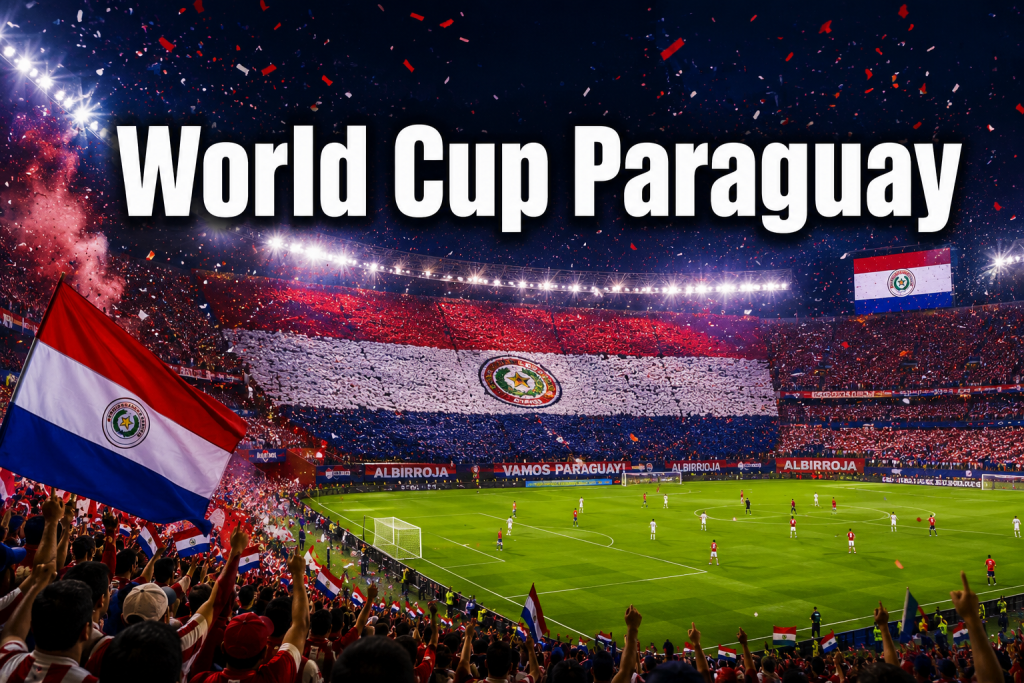
Last updated: May 26, 2026
Quick Answer: Paraguay has qualified for the FIFA World Cup eight times, with their best performance being a quarter-final finish at the 2010 tournament in South Africa. The Albirroja (as the national team is known) has produced world-class players and passionate fan culture, though consistent advancement beyond the round of 16 has proven difficult. As of 2026, Paraguay is working to rebuild and qualify for the next World Cup cycle.
Key Takeaways
- 🇵🇾 Paraguay has appeared in eight FIFA World Cups: 1930, 1950, 1958, 1986, 1998, 2002, 2006, and 2010.
- Their best result was reaching the quarter-finals at the 2010 World Cup in South Africa.
- Legendary goalkeeper José Luis Chilavert remains one of the most iconic Paraguayan players in World Cup history.
- Paraguay consistently punches above its weight in CONMEBOL qualifying, given the country’s relatively small population (around 7 million).
- Defensive organization is Paraguay’s traditional strength; they have historically struggled to convert scoring chances at the highest level.
- The national team has not qualified for a World Cup since 2010, making the next cycle critically important.
- Young prospects like Miguel Almirón (now in his peak years) and emerging academy talents give fans reason for optimism in 2026.
- Paraguayan fans are among the most passionate in South America, traveling in large numbers to support the Albirroja abroad.
When Did Paraguay First Qualify for the World Cup?
Paraguay first qualified for the World Cup in 1930, competing in the inaugural tournament held in Uruguay. They lost both group-stage matches but made history simply by being among the 13 nations that launched the world’s most-watched sporting event.
That debut was significant. Paraguay was one of only four South American nations to participate in 1930, alongside hosts Uruguay, Argentina, and Brazil. They returned for the 1950 tournament in Brazil, then again in 1958, before a long gap until 1986.
How Many Times Has Paraguay Been in the World Cup?
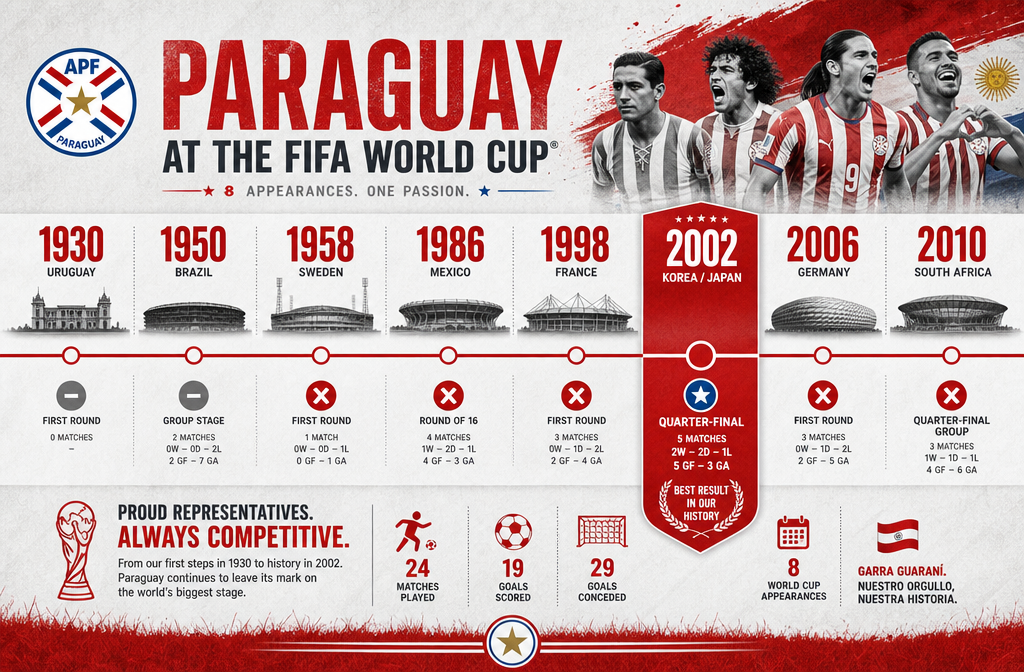
Paraguay has qualified for the FIFA World Cup eight times in total. Here is a full breakdown:
| Year | Host Country | Stage Reached |
|---|---|---|
| 1930 | Uruguay | Group Stage |
| 1950 | Brazil | Group Stage |
| 1958 | Sweden | Group Stage |
| 1986 | Mexico | Round of 16 |
| 1998 | France | Round of 16 |
| 2002 | South Korea/Japan | Round of 16 |
| 2006 | Germany | Group Stage |
| 2010 | South Africa | Quarter-Finals |
Key insight: Paraguay qualified for four consecutive World Cups from 1998 to 2010, their most consistent international period. They have not qualified since 2010, which represents their longest absence from the tournament.
What Years Did Paraguay Do Really Well in the World Cup?
Paraguay’s best World Cup performance came in 2010, when they reached the quarter-finals in South Africa. Their 2002 campaign in South Korea/Japan was also strong, advancing from a group that included Spain, Slovenia, and South Africa before losing to Germany in the round of 16.
2010 highlights:
- Beat Japan 5-3 on penalties in the Round of 16
- Defeated Slovakia 2-0 in the group stage
- Lost to Spain 1-0 in the quarter-final (Spain went on to win the tournament)
The 2010 run is widely considered the high point of World Cup Paraguay history. Reaching the last eight against the eventual champions showed genuine quality.
Best Paraguayan Players Who Played in the World Cup
Several Paraguayan players have left a lasting mark on World Cup history. The most celebrated include:
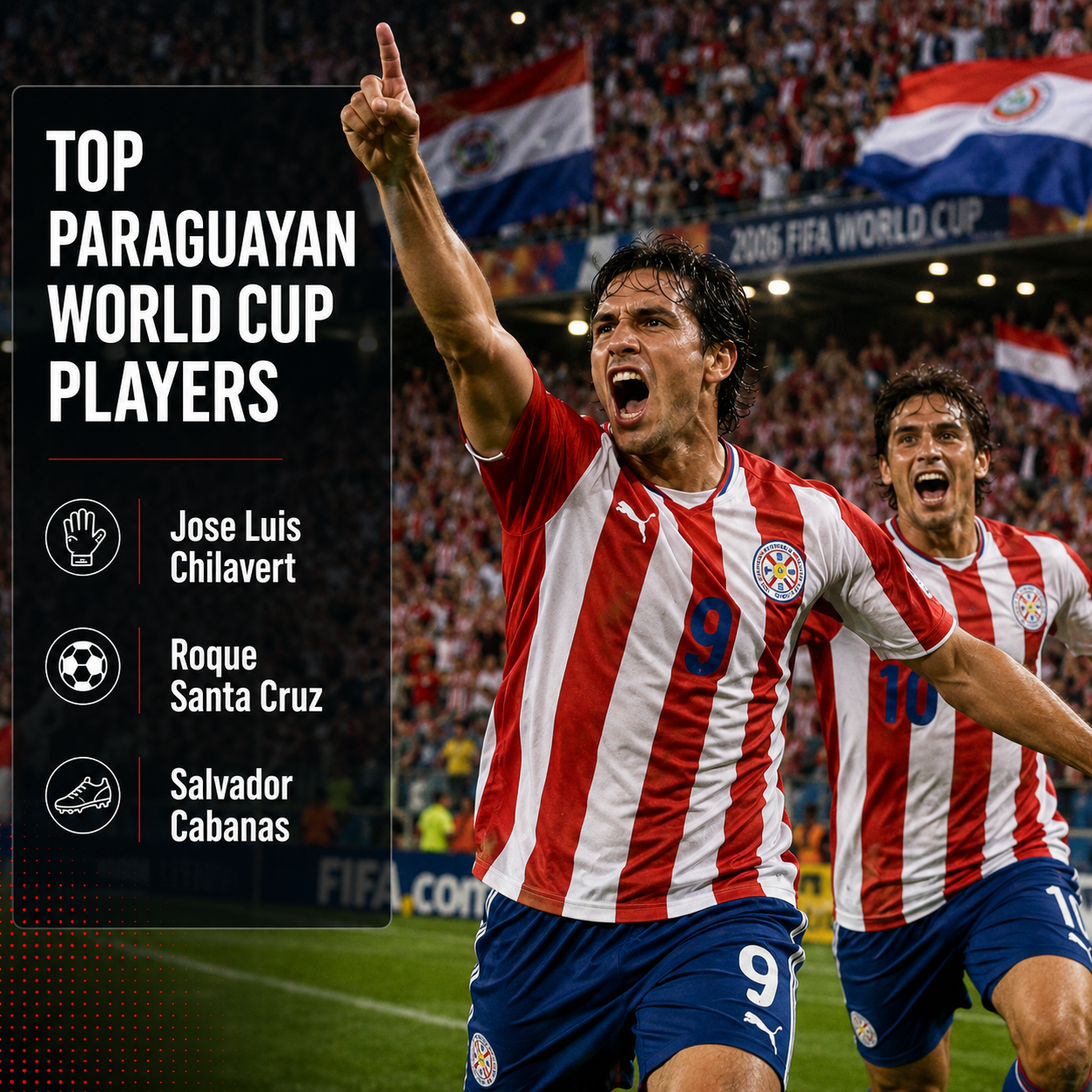
- José Luis Chilavert (1998, 2002): Goalkeeper and set-piece specialist who scored from free kicks and penalties at club level. Widely regarded as one of the greatest goalkeepers of his generation.
- Roque Santa Cruz (2002, 2006, 2010): Striker who played for Bayern Munich and Manchester City. A consistent performer across three World Cup tournaments.
- Salvador Cabañas (2010): Powerful forward whose career was tragically cut short by a shooting incident in 2010, just before the tournament.
- Edgar Benítez (2010): Midfielder who scored key goals during the quarter-final run.
- Nelson Valdez (2006, 2010): Versatile forward who contributed important goals in South Africa.
“Chilavert was not just a goalkeeper — he was an event. Every set piece was a moment of genuine danger.” — common assessment among South American football analysts of the 1990s era.
How Does Paraguay’s World Cup Performance Compare to Other South American Teams?
Paraguay’s record is solid for a nation of its size, but it trails the traditional South American powerhouses significantly. Among CONMEBOL nations, the ranking by World Cup success looks roughly like this:
- Brazil: 5 titles, most appearances
- Argentina: 3 titles
- Uruguay: 2 titles, consistent qualifier
- Colombia: Quarter-finalists in 2014
- Chile: Quarter-finalists multiple times, Copa América winners
- Paraguay: Best finish — quarter-finals (2010)
- Ecuador, Bolivia, Venezuela: Fewer appearances or none
Choose Paraguay as a benchmark if you are comparing mid-tier South American nations. For a country with roughly 7 million people (compared to Brazil’s 215 million), eight World Cup appearances is a legitimate achievement. However, Paraguay has never won a Copa América either, which underlines the ceiling they have historically hit.
Why Doesn’t Paraguay Win More World Cup Matches?
Paraguay’s main limitation at World Cups has been converting defensive solidity into goals. The team has historically been organized and hard to break down, but lacks the clinical finishing that top teams possess.
Common patterns in Paraguay’s World Cup exits:
- Narrow losses to technically superior opponents (Spain in 2010, Germany in 2002)
- Dependence on penalty shootouts rather than open-play dominance
- Limited squad depth compared to larger footballing nations
- Difficulty replacing generational players like Chilavert or Santa Cruz
Common mistakes Paraguay’s national team makes in World Cup tournaments:
- Over-relying on a defensive structure without a clear attacking plan B
- Failing to develop consistent goalscorers at international level
- Inconsistent CONMEBOL qualifying campaigns that disrupt team momentum
What Soccer Positions Do Paraguayan Players Excel In?
Paraguayan football has traditionally produced strong goalkeepers and central defenders. Chilavert defined a generation in goal. Players like Carlos Gamarra and Julio César Cáceres were reliable, physical center-backs who anchored World Cup campaigns.
In midfield, Paraguay has produced hard-working box-to-box players rather than creative playmakers. Miguel Almirón, who plays attacking midfield and wide positions, represents a newer generation that blends creativity with work rate.
Position strengths by era:
- 1990s–2000s: Goalkeepers, center-backs, defensive midfielders
- 2010s–2020s: Wide midfielders, attacking midfielders (Almirón’s profile)
- 2026 outlook: Emerging forwards from youth academies in Asunción
Who Are the Top Paraguayan Soccer Prospects for the Next World Cup?
As of 2026, Paraguay’s national team is in a rebuilding phase. The players most likely to lead the next World Cup qualification push include:
- Miguel Almirón: Still active and influential; his experience in the English Premier League with Newcastle United gives him elite-level match sharpness.
- Julio Enciso: Young attacking midfielder who joined Brighton & Hove Albion; considered one of the most exciting young players in Paraguayan football.
- Antonio Sanabria: Striker with Serie A experience; a consistent goal threat at club level.
- Omar Alderete: Solid center-back who has played in the Bundesliga and La Liga.
Edge case: Paraguay’s qualification for the 2026 World Cup (held in the USA, Canada, and Mexico) was not secured. Their next target is the 2030 tournament, where CONMEBOL will have expanded qualification spots due to the 48-team format.
How Much Money Do Paraguayan National Team Players Earn for World Cup Participation?
FIFA distributes prize money to national federations, not directly to players. For the 2022 World Cup in Qatar, FIFA allocated $440 million USD total (FIFA, 2022). How much individual players receive depends on agreements between the federation and the squad.
Paraguay’s federation, the APF (Asociación Paraguaya de Fútbol), negotiates bonuses internally. Players at European clubs typically earn their primary salaries from club contracts, with national team bonuses being supplemental. Exact figures for Paraguayan player bonuses are not publicly disclosed by the APF.
What is known: CONMEBOL nations that reach the quarter-finals receive significantly larger federation payouts than group-stage exits, which is part of why the 2010 run was financially meaningful for Paraguayan football infrastructure.
Is It Worth Traveling to Paraguay During World Cup Season?
Traveling to Paraguay during a World Cup is a unique experience, even when the tournament is hosted elsewhere. Asunción transforms during major matches, with public screenings, street celebrations, and an electric atmosphere in bars and fan zones.
Worth traveling if:
- You want an authentic South American football culture experience away from tourist crowds
- You are interested in combining the trip with visits to Iguazú Falls or the Jesuit ruins
- You enjoy local fan culture more than stadium access
Less ideal if:
- You want to attend matches in person (requires traveling to the host country)
- You are visiting solely for World Cup tourism without broader interest in Paraguay
Asunción’s fan culture during World Cup matches is genuine and welcoming to visiting football fans. Local bars near the Estadio Defensores del Chaco become lively gathering points.
How Do Paraguayan Fans Support Their National Team During the World Cup?
Paraguayan fans are known for passionate, organized support both at home and abroad. During the 2010 World Cup in South Africa, large contingents of Paraguayan supporters traveled to matches, creating visible red-and-white sections in stadiums.
Fan traditions include:
- Wearing the red-and-white striped Albirroja jersey (the white away kit is also popular)
- Drumming groups (barras) that maintain chants throughout matches
- Public viewing parties in Asunción’s main squares, particularly Plaza de los Héroes
- Social media campaigns coordinated by fan groups ahead of qualifying matches
What Are the Biggest Challenges for Paraguay in International Soccer Tournaments?
Paraguay faces structural challenges that go beyond tactics. The biggest obstacles include:
- Brain drain: Top Paraguayan players move to European leagues early, sometimes limiting their development in a coherent national team system.
- Federation resources: The APF operates with a smaller budget than Brazil, Argentina, or Colombia, affecting youth development infrastructure.
- CONMEBOL competition: South American qualifying is widely considered the hardest in world football. Only 6 of 10 CONMEBOL nations qualify automatically for a 48-team World Cup.
- Coaching continuity: Paraguay has cycled through multiple coaches in recent years, disrupting tactical identity.
- Population size: With roughly 7 million people, the talent pool is smaller than neighboring nations.
FAQ: World Cup Paraguay
Q: How many World Cup goals has Paraguay scored in total? Paraguay has scored goals across all eight World Cup appearances, with their 2010 campaign being their most productive. Exact all-time totals vary by source, but their 2010 run included goals from Vera, Benítez, and Cardozo.
Q: Did Paraguay ever win a World Cup match against a major football nation? Yes. In 2010, Paraguay beat Slovakia 2-0 in the group stage and defeated Japan on penalties in the Round of 16 before losing to Spain.
Q: Who is Paraguay’s all-time top scorer in World Cup history? No single Paraguayan player has dominated World Cup scoring; goals have been spread across multiple players. Roque Santa Cruz is among the most prominent scorers across multiple tournaments.
Q: Why is Paraguay called the Albirroja? “Albirroja” means “white and red” in Spanish, referring to the colors of the Paraguayan national flag and the team’s traditional striped jersey.
Q: Has Paraguay ever hosted a World Cup? No. Paraguay has never hosted a FIFA World Cup. The closest regional tournament hosted in Paraguay was the 1999 Copa América.
Q: Is Miguel Almirón still playing for Paraguay’s national team in 2026? As of 2026, Almirón remains an active and important player for the Paraguayan national team, though his club situation should be confirmed via current sports news sources.
Q: What is Paraguay’s FIFA ranking in 2026? FIFA rankings fluctuate monthly. For the most current ranking, check the official FIFA website directly.
Q: How does Paraguay qualify for the World Cup? Paraguay qualifies through CONMEBOL’s South American qualifying round-robin, where all 10 South American nations play each other home and away. The top teams qualify automatically; a fifth-place finisher enters an intercontinental playoff.
Conclusion
World Cup Paraguay is a story of genuine achievement against structural odds. Eight tournament appearances, a quarter-final in 2010, and a roster of world-class players like Chilavert and Almirón represent a proud footballing tradition for a nation of 7 million people.
Actionable next steps for fans:
- Follow CONMEBOL qualifying updates to track Paraguay’s progress toward the 2030 World Cup.
- Watch Julio Enciso at club level (Brighton) to see the next generation of Paraguayan talent develop.
- If visiting Asunción, check the APF’s official calendar for national team matches at the Estadio Defensores del Chaco.
- Explore Paraguay’s Copa América history alongside their World Cup record for a fuller picture of the Albirroja’s international standing.
Paraguay may not be a perennial World Cup contender, but their history rewards attention. The next qualification campaign will be a defining test of whether this generation can restore the Albirroja to football’s biggest stage.
References
- FIFA. (2022). FIFA World Cup Qatar 2022 Financial Report. FIFA.com. https://www.fifa.com
- FIFA. (2023). Historical World Cup Results and Statistics. FIFA.com. https://www.fifa.com
- CONMEBOL. (2023). South American World Cup Qualifying Format. CONMEBOL.com. https://www.conmebol.com
- Goldblatt, D. (2006). The Ball is Round: A Global History of Football. Viking/Penguin.