
Last updated: May 25, 2026
Quick Answer: Jordan’s national football team has never qualified for the FIFA World Cup, but they came agonizingly close in 2014 and again in 2022, reaching the intercontinental playoffs both times. The “World Cup Jordan” conversation is one of the most exciting in Asian football right now, with the Nashama (the national team’s nickname) steadily improving their regional standing and producing genuine talent capable of competing at the highest level.
Key Takeaways
- 🏆 Jordan has never qualified for the FIFA World Cup as of 2026, but has reached playoff rounds twice
- ⚽ The Jordanian national team is nicknamed “Al-Nashama” (The Nobles)
- 🌍 Jordan competes in the AFC (Asian Football Confederation) qualifying zone
- 🥈 Jordan reached the AFC Asian Cup final in 2023, their best-ever continental result
- 🏟️ Jordan’s main home stadium is the King Abdullah II Stadium in Amman, capacity roughly 13,000 (with larger venues used for big matches)
- 💰 Ticket costs for home World Cup qualifiers typically range from a few Jordanian dinars to around 20 JD (approximately $28 USD) for premium seats
- 🧑🤝🧑 Key rivalries include Saudi Arabia, Iraq, and Palestine in the regional context
- 📉 Infrastructure gaps and limited professional league depth remain the biggest challenges
- 🌱 Youth development programs have expanded significantly in the past decade
- 🎯 Players like Yazan Al-Naimat and Musa Al-Taamari represent the new generation of Jordanian talent
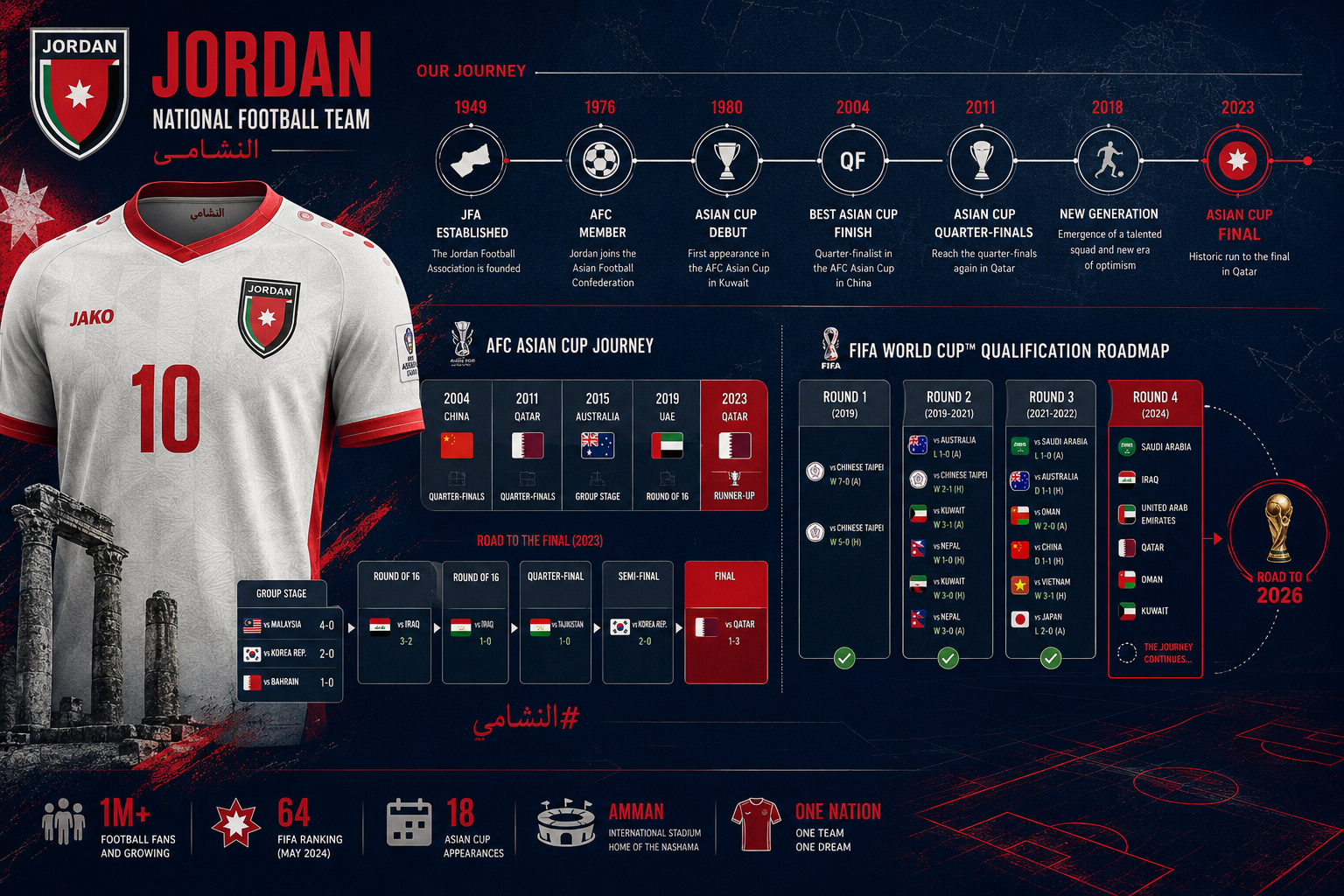
What Exactly Is “World Cup Jordan” and When Did It Happen?
“World Cup Jordan” refers to Jordan’s ongoing campaign to qualify for the FIFA World Cup, a dream that has come close to reality but hasn’t been achieved yet. Jordan has participated in multiple World Cup qualifying campaigns through the AFC, with their closest brushes coming in the 2014 and 2022 cycles.
In the 2014 qualifying campaign, Jordan made history by reaching the intercontinental playoff against Uruguay. They lost 5-0 on aggregate, but just getting there was a massive milestone. Then in the 2022 cycle, they again reached an intercontinental playoff, this time against Australia, losing 2-1 on aggregate. Both moments sparked massive national celebrations just for qualifying to that stage.
In 2026, Jordan is competing in the third round of AFC World Cup qualifying, chasing one of Asia’s expanded slots (Asia now has 8.5 spots in the 48-team World Cup format).
How Does Jordan’s National Soccer Team Perform in World Cup Tournaments?
Jordan has never appeared at a FIFA World Cup finals. However, their qualifying performances show a team trending upward. The Nashama have consistently reached the later stages of AFC qualifying, and their 2023 AFC Asian Cup run (where they finished runners-up) confirmed they can compete with Asia’s best.
Key qualifying milestones:
- 2014 cycle: Reached intercontinental playoff (lost to Uruguay)
- 2018 cycle: Eliminated in the third round
- 2022 cycle: Reached intercontinental playoff (lost to Australia)
- 2026 cycle: Currently competing in the third round (as of 2026)
“Jordan reaching two intercontinental playoffs in a decade shows this isn’t a fluke — it’s a program on the rise.”
Why Hasn’t Jordan Qualified for the FIFA World Cup Yet?
The short answer is competition. Asia’s qualifying is brutal, and Jordan consistently runs into powerhouses like Japan, South Korea, Iran, and Saudi Arabia. The intercontinental playoff format also puts them against established footballing nations from other confederations.
The main structural reasons:
- AFC competition depth: Asia has historically had 4-5 guaranteed spots for 46+ nations competing
- Resource gaps: Jordan’s football budget is smaller than Gulf neighbors
- Late professional league development: The Jordan Pro League only became semi-professional relatively recently
- Population base: Jordan has roughly 10 million people, limiting the talent pool compared to football giants
The expanded 2026 World Cup (48 teams, 8.5 AFC spots) gives Jordan their best-ever shot. It’s not guaranteed, but the odds are better than they’ve ever been.
How Much Does It Cost to Attend World Cup Qualifier Matches in Jordan?
Attending a World Cup qualifier in Jordan is genuinely affordable compared to most international football experiences. Home qualifier tickets typically range from 2 JD to 20 JD (roughly $3 to $28 USD), depending on the seat category and the opponent’s profile.
Rough ticket price breakdown (estimates based on typical Jordan FA pricing):
| Category | Price (JD) | Price (USD approx.) |
|---|---|---|
| General standing | 2–5 JD | $3–7 |
| Standard seated | 5–10 JD | $7–14 |
| Premium/VIP seated | 10–20 JD | $14–28 |
Away fans attending matches in Jordan also find costs manageable. Flights into Amman’s Queen Alia International Airport connect easily from across the Middle East and Europe. Hotels in Amman range from budget options under $40/night to mid-range at $80–120/night.
Practical tip: Buy tickets through the Jordan Football Association’s official channels or authorized local vendors. Scalpers exist but prices rarely inflate dramatically for qualifier matches.
What Are the Biggest Challenges for Jordan’s Soccer Team Internationally?
Jordan faces a mix of structural and competitive challenges that make World Cup qualification difficult. The biggest ones aren’t just about talent — they’re about systems.
- Funding: The Jordan FA operates with a fraction of the budget available to Gulf nations like Saudi Arabia or UAE
- Domestic league quality: The Jordan Pro League doesn’t consistently produce players ready for top international competition
- Player drain: Many of Jordan’s best players move abroad early, sometimes disrupting team chemistry
- Fixture scheduling: Jordan’s home ground options are limited, and some qualifiers are played at neutral venues
- Psychological pressure: Reaching playoff rounds and losing has created a “nearly men” narrative that can weigh on squads
Common mistake in international competition: Jordanian teams have historically struggled to maintain intensity across 90 minutes against top Asian sides, often conceding late goals that cost crucial points.
Which Jordanian Soccer Players Are Most Likely to Make a National Impact?
Jordan’s most exciting current players combine technical quality with experience in competitive leagues. Musa Al-Taamari is arguably the standout name — a creative winger who plays at a high level and was central to Jordan’s 2023 Asian Cup run. Yazan Al-Naimat is another forward with pace and finishing ability who’s drawn attention from clubs outside Jordan.
Players to watch in 2026:
- Musa Al-Taamari — creative midfielder/winger, Jordan’s most technically gifted player
- Yazan Al-Naimat — striker with pace and international experience
- Baha’ Faisal — experienced goalkeeper who provides stability
- Nour Mansour — midfield engine with strong work rate
Players who compete in stronger leagues (Europe, Gulf, or top Asian leagues) tend to perform better for the national team. This is why Jordan’s coaching staff actively monitors the diaspora — players with Jordanian heritage playing in European leagues can be eligible and add significant quality.
How Does Jordan’s Soccer Infrastructure Compare to Other Middle Eastern Countries?
Jordan’s football infrastructure is developing but lags behind Gulf states. Saudi Arabia, UAE, and Qatar have invested billions in stadiums, academies, and professional leagues. Jordan’s investment is more modest but growing.
Honest comparison:
| Country | Top Stadium Capacity | Pro League Status | World Cup Appearances |
|---|---|---|---|
| Saudi Arabia | 68,000+ | Fully professional | 6 |
| UAE | 45,000+ | Fully professional | 0 |
| Qatar | 80,000+ | Fully professional | 1 (host) |
| Jordan | ~25,000 (largest venue) | Semi-professional | 0 |
| Iraq | 65,000+ | Professional | 1 |
Jordan’s advantage is a passionate fan base and a team culture that punches above its weight. The 2023 Asian Cup final appearance was achieved without the financial firepower of Gulf rivals.
What Youth Soccer Programs Exist in Jordan to Develop Future Talent?
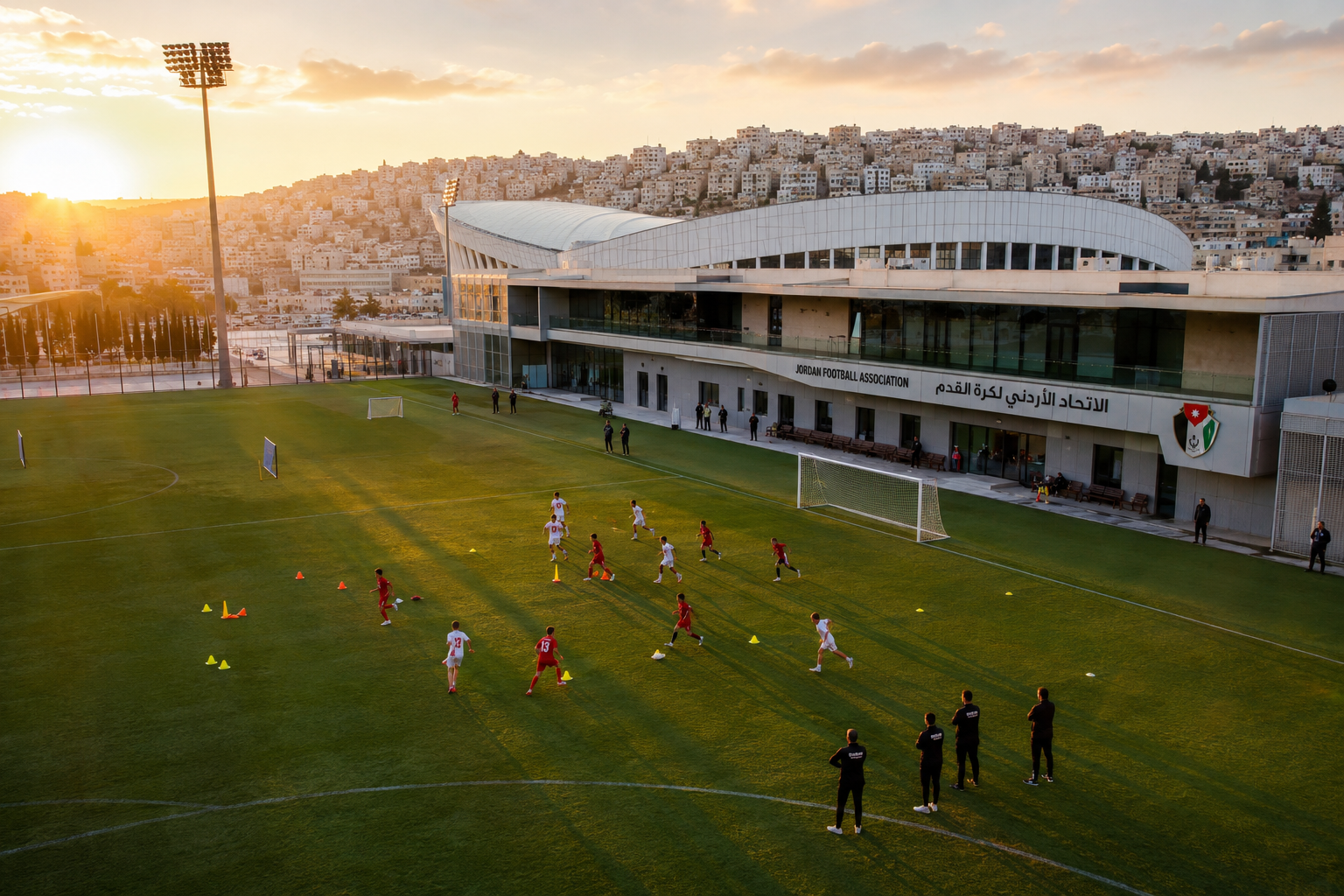
Jordan has made real strides in youth development over the past decade. The Jordan Football Association runs structured age-group national teams (U17, U20, U23) that compete in AFC youth competitions. Several clubs also run academies, with Al-Faisaly and Al-Wehdat being the most prominent.
Key development pathways:
- JFA Academy programs: Centralized training camps for top youth prospects
- Club academies: Al-Faisaly, Al-Wehdat, and Al-Ramtha run the most established youth setups
- UNHCR-supported programs: Given Jordan’s large refugee population, several NGO-backed programs use football as a social tool and have produced players who’ve entered the formal system
- Regional competitions: Jordan’s youth teams compete in West Asian Football Federation (WAFF) tournaments, which provide valuable competitive experience
The challenge is retaining talented youngsters. Many promising players leave for Gulf clubs in their late teens, which can disrupt long-term development within the domestic system.
Who Are the Top Coaches and Managers in Jordanian Soccer Right Now?
As of 2026, the Jordan national team has been managed by a series of coaches with both local and international backgrounds. The Jordan FA has increasingly looked at coaches with experience in competitive Asian football.
What makes a successful Jordan coach:
- Ability to blend local Jordan Pro League players with overseas-based Jordanians
- Tactical flexibility (Jordan often plays a compact defensive shape against stronger opponents)
- Strong man-management to handle players from different club environments
The domestic league’s top managers tend to come from Jordan, Palestine, and other Arab nations, with occasional appointments from Eastern Europe or South America at bigger clubs.
What Are the Main Differences Between Professional and Amateur Soccer Leagues in Jordan?
The Jordan Pro League sits at the top of the pyramid and is semi-professional, meaning most players earn a wage but not at levels comparable to Gulf leagues. Below it, the First Division and regional leagues are largely amateur, with players often holding day jobs alongside football.
Key differences:
- Wages: Pro League players earn anywhere from a few hundred to a few thousand JD per month; amateur league players typically receive expenses only
- Facilities: Pro League clubs have access to better pitches and gym facilities; lower divisions often train on public or municipal grounds
- Scouting: National team scouts focus almost exclusively on the Pro League and overseas-based players
- Competition level: The gap between the Pro League and lower divisions is significant, making promotion difficult for smaller clubs
What Are the Biggest Soccer Rivalries for Jordan in the Middle East?
Jordan’s fiercest rivalries are with Palestine, Iraq, and Saudi Arabia. The Palestine match carries cultural and political weight that goes far beyond football. Iraq matches tend to be physically intense with both sides historically competitive. Saudi Arabia represents the regional power Jordan most wants to beat.
The WAFF Championship (West Asian Football Federation) is where many of these rivalries play out most regularly, with Jordan having won the tournament twice (2014 and 2023 — their 2023 win came just before their Asian Cup final run).
FAQ: World Cup Jordan
Has Jordan ever played in the FIFA World Cup? No. As of 2026, Jordan has never qualified for the FIFA World Cup finals. Their closest attempts were intercontinental playoffs in 2014 (vs. Uruguay) and 2022 (vs. Australia).
What is Jordan’s national football team nickname? Jordan’s national team is called “Al-Nashama,” which translates roughly to “The Nobles” in Arabic.
How many AFC World Cup spots are available in 2026? The 2026 FIFA World Cup expanded to 48 teams, giving Asia (AFC) 8.5 guaranteed spots, up from the previous 4.5. This significantly improves Jordan’s chances.
Where does Jordan play its home World Cup qualifiers? Jordan typically uses the King Abdullah II Stadium in Amman, though larger matches are sometimes hosted at the Prince Mohammed Stadium or other venues depending on capacity needs.
Who is Jordan’s best football player ever? Historically, Ahmad Hayel is considered one of Jordan’s greatest. In the modern era, Musa Al-Taamari is widely regarded as the most talented player the country has produced.
What is the Jordan Pro League? The Jordan Pro League is the top tier of club football in Jordan, featuring clubs like Al-Faisaly, Al-Wehdat, and Al-Ramtha. It’s semi-professional, with players earning wages but at lower levels than Gulf leagues.
Can Jordanian diaspora players represent the national team? Yes. Players with Jordanian heritage who hold Jordanian citizenship and haven’t represented another nation at senior level can be called up. This has been a growing source of talent for the Nashama.
How can young Jordanian players improve their international chances? The clearest path is performing consistently in the Jordan Pro League, getting noticed by JFA scouts, joining youth national team programs, and ideally securing a move to a more competitive league abroad.
Conclusion: What’s Next for World Cup Jordan?
Jordan’s World Cup journey is one of football’s most compelling “nearly there” stories. The 2026 World Cup cycle represents a genuine, realistic opportunity for the Nashama to finally punch their ticket to the biggest stage in football, thanks to Asia’s expanded allocation.
Actionable next steps for fans:
- Follow the AFC qualifying schedule — check the Jordan FA’s official social media for fixture dates and ticket information
- Watch the Jordan Pro League — supporting domestic football strengthens the entire ecosystem
- Track players abroad — following Al-Taamari and other overseas-based Jordanians gives you the best preview of national team quality
- Attend a home qualifier — tickets are affordable and the atmosphere is electric
- Engage with WAFF tournaments — these regional competitions are where Jordan’s rivalry matches and form can be tracked between major qualifying rounds
The dream of World Cup Jordan is closer than it’s ever been. The expanded format, a maturing squad, and a passionate football culture all point in the right direction. Whether 2026 is finally the year — that’s the question every Jordanian football fan is asking right now. ⚽🇯🇴