Last updated: May 25, 2026
Quick Answer: France has won the FIFA World Cup twice — in 1998 on home soil and again in 2018 in Russia. Les Bleus are consistently among the world’s elite national teams, backed by one of the strongest player development systems on the planet. As of 2026, France remains a top contender in every major tournament they enter.
Key Takeaways 🏆
- France has won 2 World Cup titles (1998, 2018) and reached the final in 2022
- Les Bleus have qualified for 16 World Cup tournaments in their history
- The 1998 squad featured Zinedine Zidane; the 2018 squad was led by Kylian Mbappé
- France’s Clairefontaine academy is widely regarded as one of the best football development programs in the world
- Injuries to key players have derailed France in multiple tournaments
- French players at top clubs earn among the highest wages in world football
- France’s tactical system typically blends a solid defensive structure with explosive attacking transitions
- Les Bleus rank among the top 3 European nations by World Cup titles, alongside Germany (4) and Italy (4)
When Did France Win Their World Cup Titles?
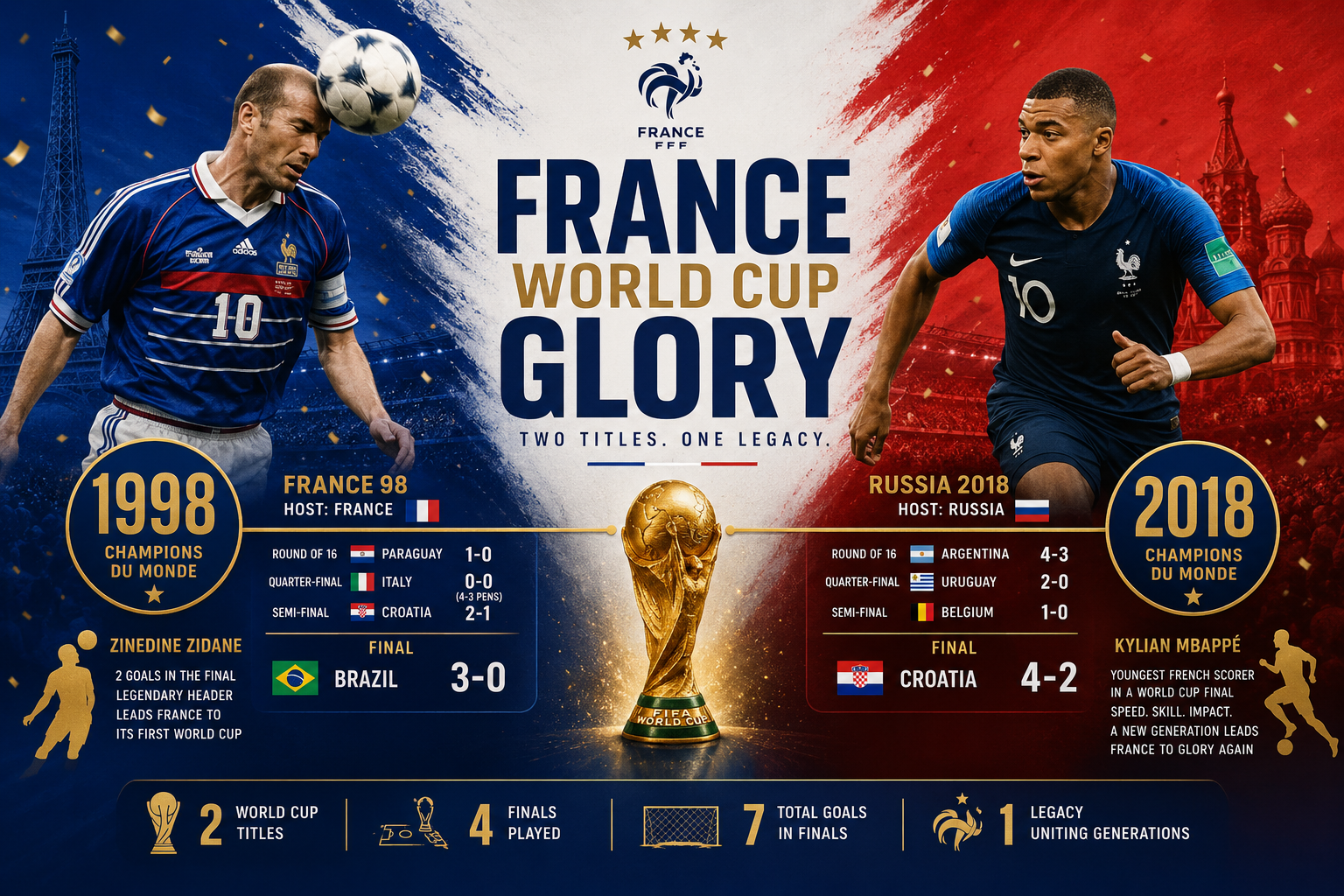
France has won the World Cup exactly twice. The first came in 1998, when France hosted the tournament and beat Brazil 3–0 in the final at the Stade de France. Zinedine Zidane scored two headers. The second title arrived in 2018 in Russia, with a 4–2 win over Croatia in the final — a match that featured goals from Mbappé, Griezmann, and Pogba.
| Year | Host | Final Opponent | Score | Key Player |
|---|---|---|---|---|
| 1998 | France | Brazil | 3–0 | Zinedine Zidane |
| 2018 | Russia | Croatia | 4–2 | Kylian Mbappé |
France also reached the 2022 final in Qatar, losing on penalties to Argentina after a stunning comeback from 2–0 down. Mbappé scored a hat-trick in that final — a performance for the ages, even in defeat.
How Many World Cups Has France Played In?
France has participated in 16 FIFA World Cup tournaments as of 2026. Their first appearance was in 1930, the very first World Cup, held in Uruguay. Their record includes some brilliant highs (two titles, a third-place finish in 1958 and 2006) and some forgettable lows — notably early group-stage exits in 2002 and 2010.
Notable World Cup appearances:
- 1958: Third place (Just Fontaine scored 13 goals — still a single-tournament record)
- 1982 & 1986: Semi-finals
- 1998: Champions (host nation)
- 2006: Runners-up (Zidane’s headbutt in the final)
- 2018: Champions
- 2022: Runners-up
Which French Players Were in the 2018 World Cup France Squad?
The 2018 World Cup France squad is considered one of the most talented in recent history. Manager Didier Deschamps built a balanced team with pace, physicality, and technical quality.
Key players from the 2018 squad:
- Kylian Mbappé — 19 years old, electric pace, won Best Young Player
- Antoine Griezmann — top scorer with 3 goals, won Golden Ball runner-up
- Paul Pogba — midfield engine, scored in the final
- N’Golo Kanté — defensive midfield anchor, world-class in that role
- Raphaël Varane — commanding centre-back
- Hugo Lloris — captain and goalkeeper
- Olivier Giroud — striker, didn’t score but linked play brilliantly
The squad’s average age was around 26, and several players had years of peak football still ahead of them — which made France’s 2022 final run feel almost inevitable in hindsight.
How Much Money Do French National Soccer Players Earn?
Top French international players earn among the highest wages in world football. Exact figures vary by club contract and are not always publicly confirmed, but based on widely reported estimates from sports finance outlets:
- Kylian Mbappé has been reported to earn in the region of €25–30 million per year at Real Madrid (estimated, based on media reports)
- Antoine Griezmann earns an estimated €15–20 million annually at Atlético Madrid
- Players on the national team also receive match bonuses from the French Football Federation (FFF), with World Cup winning bonuses reportedly in the range of €400,000+ per player (based on 2018 reports)
Note: Exact salary figures for footballers are rarely confirmed publicly. Treat reported numbers as estimates unless sourced directly from official club filings.
What Are the Biggest Mistakes France Made in World Cup History?
France has had some genuinely baffling World Cup moments alongside the glory.
The worst lowlights:
- 2002 Korea/Japan: Defending champions France went out in the group stage without scoring a single goal. Zidane was injured, the squad looked disjointed.
- 2010 South Africa: A full squad mutiny. Players refused to train, Nicolas Anelka was sent home after a reported argument with Domenech, and France finished bottom of their group.
- 2006 Final: Zidane’s headbutt on Marco Materazzi in extra time led to a red card. France lost on penalties. One moment changed everything.
The 2010 disaster is still studied as a case study in squad management failures. Too many egos, poor leadership, and a coach (Raymond Domenech) who had lost the dressing room completely.
Is France’s Soccer Team Considered the Best in Europe?
France is consistently ranked among Europe’s top two or three national teams. As of 2026, they sit near the top of the FIFA World Rankings alongside England, Spain, and Germany.
By World Cup titles alone:
- Germany: 4 titles
- Italy: 4 titles
- France: 2 titles
- England: 1 title
- Spain: 1 title
France’s strength lies in their depth of talent, their academy pipeline, and their tactical flexibility under Deschamps. Whether they’re the best in Europe is debatable — but few would leave them out of a top-three conversation.
Who Are the Top French Soccer Players Right Now?
As of 2026, the French national team has a remarkable generation of players still in or near their prime.
- Kylian Mbappé (Real Madrid) — widely considered one of the two or three best players on the planet
- Antoine Griezmann — still contributing at international level, though approaching the end of his career
- Aurélien Tchouaméni (Real Madrid) — the midfield future of Les Bleus
- Eduardo Camavinga (Real Madrid) — dynamic, box-to-box midfielder
- Marcus Thuram (Inter Milan) — powerful striker, son of 1998 World Cup winner Lilian Thuram
- William Saliba (Arsenal) — one of the best young centre-backs in world football
The depth is genuinely staggering. France can field multiple world-class players in almost every position.
Are French Soccer Academies Better Than Other Countries?
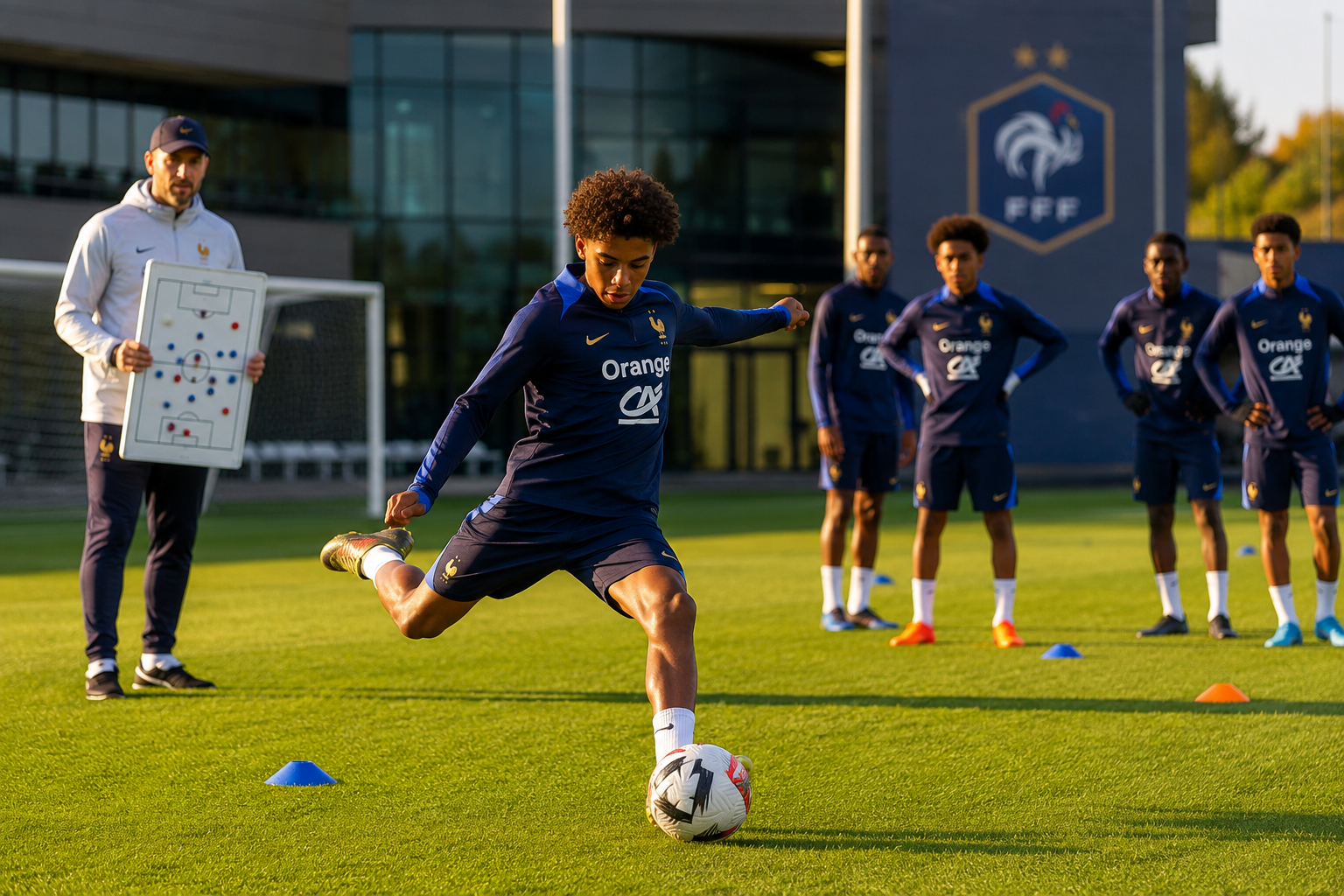
France’s youth development system is widely regarded as the best or one of the best in the world. The Clairefontaine National Football Institute, established in 1988, has produced an extraordinary list of graduates including Thierry Henry, Nicolas Anelka, and Mbappé.
What makes French academies stand out:
- Early identification of talent from diverse communities, particularly in Paris suburbs
- Technical and tactical coaching from a very young age
- Strong integration between club academies (PSG, Lyon, Monaco) and the national system
- Emphasis on physical development alongside football IQ
By comparison, English academies have improved significantly but historically focused more on physical attributes over technical skill. Spanish academies (La Masia at Barcelona, for example) rival France in technical output, but France’s sheer volume of elite talent production is hard to match.
What Training Programs Do French Soccer Players Use?
French national team players follow highly structured programs that combine club-level training with national team preparation camps.
Core elements of a French player’s training regime:
- Tactical sessions: Deschamps runs detailed video analysis and positional work
- Physical conditioning: High-intensity interval training, sprint work, and recovery protocols
- Technical drills: Passing patterns, pressing triggers, and set-piece preparation
- Nutrition and recovery: Sleep protocols, cryotherapy, and individualized nutrition plans are standard at top clubs
The FFF also runs age-group national teams (U17, U19, U21) that mirror the senior team’s tactical philosophy, so players arrive at the senior squad already familiar with the system.
What Injuries Have Impacted France’s World Cup Teams?
Injuries have cost France dearly at multiple tournaments.
- 2002: Zidane arrived injured and barely played. France scored zero goals and went home in the group stage.
- 2014: Franck Ribéry, one of France’s best players at the time, missed the tournament through injury.
- 2022: Karim Benzema won the Ballon d’Or that year but suffered a thigh injury just days before the tournament started and had to withdraw. France still reached the final, which says everything about their squad depth.
Managing fitness across a long club season remains one of the biggest challenges for any World Cup France squad.
How Do You Become a Professional Soccer Player in France?
Becoming a professional footballer in France follows a clear pathway, though it’s intensely competitive.
- Join a local club at age 6–10 through regional football associations
- Get scouted by a Ligue 1 or Ligue 2 academy (typically ages 11–14)
- Enter the academy system — top clubs like PSG, Lyon, and Marseille run full residential programs
- Apply to Clairefontaine (INF) — the national pre-training center takes around 24 players per year aged 13–15
- Sign a professional contract — in France, players can sign their first pro deal at 16
- Progress through reserve teams before breaking into the first team
The path is demanding and most players don’t make it to the top level. But France’s system gives talented kids more structured support than almost anywhere else in the world.
What Are the Most Common Tactics in France’s National Soccer Strategy?
France under Didier Deschamps typically sets up in a 4-3-3 or 4-2-3-1 formation, prioritizing defensive solidity first and explosive counter-attacks second.
Key tactical principles:
- Compact defensive shape: France rarely press high; they sit mid-block and absorb pressure
- Quick transitions: Once possession is won, Mbappé and the wide attackers exploit space at pace
- Set-piece threat: France are dangerous from corners and free kicks due to their aerial players
- Midfield control: Kanté (in his prime) and now Tchouaméni provide the defensive midfield anchor
Critics argue this approach is too conservative given France’s attacking talent. Supporters point to two World Cup titles and a 2022 final as proof it works.
FAQ: World Cup France
Q: How many times has France hosted the World Cup? France has hosted the FIFA World Cup once, in 1998, and won it on home soil.
Q: Who is France’s all-time top World Cup scorer? Just Fontaine holds the record for most goals in a single tournament (13 in 1958). Thierry Henry is France’s all-time top scorer overall with 51 international goals.
Q: Did France win the 2022 World Cup? No. France reached the final in Qatar 2022 but lost to Argentina on penalties after a 3–3 draw. Mbappé scored a hat-trick in the final.
Q: Who manages the French national team in 2026? Didier Deschamps has managed France since 2012, making him one of the longest-serving coaches in the team’s history.
Q: What is the French national team’s nickname? Les Bleus, meaning “The Blues,” after their traditional blue home kit.
Q: Has any French player won the Ballon d’Or? Yes. Zinedine Zidane won it three times (1998, 2000, 2003), and Karim Benzema won it in 2022.
Q: How does France qualify for the World Cup? France qualifies through UEFA European qualifying, competing in a group stage and then playoffs if needed.
Q: Is Kylian Mbappé the best player in the world in 2026? Mbappé is consistently ranked among the top two or three players globally, though “best in the world” is always subjective and debated.
Conclusion: Why World Cup France Still Matters in 2026
France’s World Cup story is one of the richest in football history — two titles, heartbreaking near-misses, a disastrous 2010 meltdown, and a generation of players that may be the most talented the country has ever produced. The combination of elite academies, a deep talent pool from diverse communities, and a tactically disciplined national setup makes France a near-permanent fixture in World Cup conversations.
Actionable next steps for football fans:
- Watch highlights of the 1998 and 2018 finals if you haven’t already — both are masterclasses in tournament football
- Follow Ligue 1 to catch the next generation of French talent before they hit the global stage
- Keep an eye on France’s U21 and U23 squads, where the next Mbappé is almost certainly already playing
Les Bleus aren’t just a great team. They’re a system, a culture, and a football factory that shows no signs of slowing down. 🇫🇷