Last updated: May 27, 2026
Quick Answer: The 2026 FIFA World Cup runs from June 11 to July 19, 2026, hosted across 16 cities in the United States, Canada, and Mexico. The expanded tournament features 48 teams competing across a group stage, round of 32, and knockout rounds. Fans can track the full World Cup football schedule on FIFA’s official website and major sports broadcasters.
Key Takeaways
- 📅 Tournament dates: June 11 – July 19, 2026
- 🌎 Host countries: USA (11 cities), Canada (2 cities), Mexico (3 cities)
- ⚽ Teams: 48 nations, up from 32 in previous editions
- 🏟️ Format: 12 groups of 4 teams, then a round of 32 knockout stage
- 🎟️ Tickets: Prices range from roughly $70 (group stage) to $1,000+ (final)
- 📺 Streaming: FOX/Telemundo (USA), BBC/ITV (UK), beIN Sports (MENA), and FIFA+
- ✈️ Travel: Multi-city hosting means fans may need domestic flights between venues
- 🏆 Favorites: Brazil, France, England, and Argentina are widely tipped by oddsmakers
- 🔁 Qualification: 211 FIFA member nations competed across six continental zones
- ⚠️ Common mistake: Assuming one host city handles all group games — matches are spread across three countries
When and Where Is the 2026 World Cup Happening?
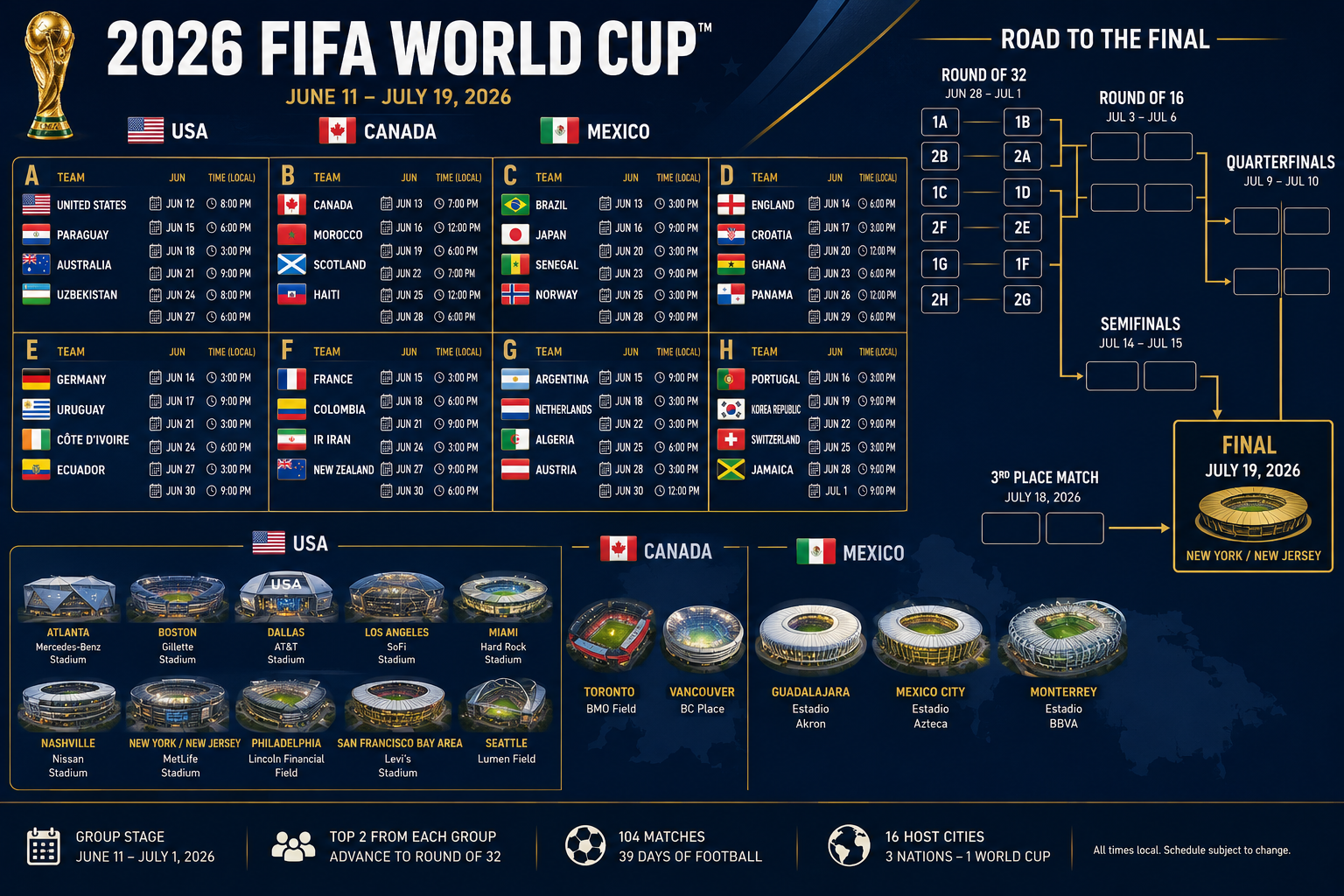
The 2026 FIFA World Cup kicks off on June 11, 2026, with the final scheduled for July 19, 2026, at MetLife Stadium in East Rutherford, New Jersey. It is the first World Cup co-hosted by three nations simultaneously.
Host cities by country:
| Country | Host Cities |
|---|---|
| United States | New York/NJ, Los Angeles, Dallas, San Francisco, Miami, Atlanta, Seattle, Kansas City, Houston, Philadelphia, Boston |
| Mexico | Mexico City, Guadalajara, Monterrey |
| Canada | Toronto, Vancouver |
The tournament spans 39 days and features 104 matches — a significant jump from the 64 matches played at Qatar 2022. Fans following the World Cup football schedule should note that matches in the group stage will run simultaneously across all three countries, so time zone differences matter when planning viewing or travel.
How Do World Cup Qualifications Work?
World Cup qualification is managed by FIFA’s six continental confederations. Each confederation receives an allocated number of berths, and member nations compete in regional qualifying campaigns over roughly two to three years before the tournament.
Berth allocation for 2026 (48 total spots):
- UEFA (Europe): 16 spots
- CONMEBOL (South America): 6 spots
- CAF (Africa): 9 spots
- AFC (Asia): 8 spots
- CONCACAF (North/Central America & Caribbean): 6 spots (plus the 3 host nations)
- OFC (Oceania): 1 spot
- Inter-confederation playoffs: 2 spots
The three host nations — USA, Canada, and Mexico — qualify automatically, which is standard FIFA practice. All other spots are earned through competitive regional play.
Which Teams Have Qualified and What Are the Group Stage Matchups?
All 48 teams have confirmed their spots as of the 2026 draw. Notable qualifiers include Brazil, Argentina, France, England, Germany, Spain, Portugal, Japan, Morocco, and Nigeria, among others.
The group stage draw placed teams into 12 groups of four. Each team plays three matches in the group stage. The top two from each group, plus the eight best third-place finishers, advance to the round of 32.
Example group stage format:
- Group A: USA, [Opponent 1], [Opponent 2], [Opponent 3]
- Groups are seeded based on FIFA world rankings at the time of the draw
Note: Full confirmed group pairings are published on FIFA’s official website (fifa.com) and updated in real time. Check there for the definitive World Cup football schedule and group assignments.
What Time Do Matches Usually Start in Local Time Zones?
Kickoff times vary by venue and are designed to maximize global TV audiences. Most matches fall into three daily windows.
Typical daily kickoff windows (local venue time):
- Early slot: 12:00 PM – 1:00 PM local
- Afternoon slot: 3:00 PM – 4:00 PM local
- Evening slot: 6:00 PM – 9:00 PM local
For US-based fans, that translates roughly to Eastern Time slots of noon, 3 PM, and 6 PM. Fans in Europe watching live will see many matches broadcast in evening prime time, while South American viewers get afternoon and late-night slots.
Practical tip: Use the FIFA official app or Google’s match schedule tool — both convert kickoff times automatically to your device’s local time zone.
How Can I Watch World Cup Matches Online?
Most major markets have confirmed broadcast rights, and streaming options are widely available for the 2026 tournament.
Confirmed broadcasters by region (as of May 2026):
| Region | Broadcaster | Streaming |
|---|---|---|
| USA | FOX Sports, Telemundo | FOX Sports app, Peacock |
| UK | BBC, ITV | BBC iPlayer, ITVX |
| Australia | SBS | SBS On Demand |
| Middle East/North Africa | beIN Sports | beIN Sports Connect |
| Global | FIFA+ | fifa.com (select matches free) |
FIFA+ streams select matches for free globally, making it a solid fallback for fans without a cable subscription. Check local listings, as sublicensing deals vary by country.
How Much Do World Cup Tickets Cost?
Ticket prices for the 2026 World Cup start at approximately $70 USD for group stage matches in Category 4 (local resident pricing) and rise significantly for knockout rounds.
Estimated ticket price ranges (USD):
| Match Stage | Category 1 | Category 3 |
|---|---|---|
| Group Stage | ~$200 | ~$70–$100 |
| Round of 32 | ~$300 | ~$120 |
| Quarterfinal | ~$500 | ~$200 |
| Semifinal | ~$700 | ~$300 |
| Final | ~$1,000+ | ~$500+ |
Tickets are sold exclusively through FIFA’s official ticketing portal. Resale through unofficial platforms carries the risk of fraud and is not endorsed by FIFA. Hospitality packages, which bundle tickets with hotel and event access, can run $3,000–$10,000+ per person for premium matches.
Is It Worth Traveling to the World Cup This Year?
For dedicated football fans, attending in person is a genuinely rare experience — but the multi-country format adds logistical complexity that previous tournaments didn’t have.
Pros of attending:
- Once-in-a-generation atmosphere in iconic stadiums
- Three countries means more diverse fan cultures in one trip
- North American host cities offer strong infrastructure and tourism options
Cons to consider:
- Flights between host cities add cost (domestic US flights, cross-border travel)
- Hotel prices near venues spike sharply during match weeks
- Group stage games may be in different cities than knockout rounds
Choose to travel if: You’re flexible on which matches to attend, have booked accommodation early, and are comfortable with multi-city itineraries.
Skip the trip if: You’re on a tight budget or need guaranteed tickets to specific teams — demand for top nations far exceeds supply.
What Are Common Mistakes Fans Make When Planning World Cup Travel?
The biggest mistake is treating this World Cup like a single-city event. With 16 host cities across three countries, planning requires more lead time than Qatar 2022 or Russia 2018.
Top planning mistakes to avoid:
- Booking flights before confirming ticket allocation — ticket draws happen in phases; don’t assume you’ll get the match you want
- Ignoring visa requirements — US, Canada, and Mexico each have separate entry rules for different nationalities
- Underestimating inter-city travel time — Dallas to Vancouver is a 4-hour flight, not a short train ride
- Waiting on accommodation — host city hotels near stadiums sold out months in advance
- Missing the resale scam risk — only buy through FIFA’s official portal or authorized resellers
Are There Age Restrictions for World Cup Events?
There are no minimum age restrictions for attending World Cup matches. Children of all ages can attend with a valid ticket. However, infants under 2 years old typically do not require a separate ticket in most FIFA ticketing categories — confirm this on the official FIFA ticketing FAQ before purchasing.
Alcohol is sold at designated areas in stadiums, and local laws in each host country apply. In Mexico, the legal drinking age is 18; in the USA and Canada, it is 21 and 19 (province-dependent), respectively.
Which Countries Are Favorites to Win the 2026 World Cup?
Based on pre-tournament odds from major bookmakers (as of May 2026), the leading contenders are:
- 🇧🇷 Brazil — consistently near the top of betting markets
- 🇫🇷 France — defending runners-up with a deep squad
- 🇦🇷 Argentina — reigning champions, led by Lionel Messi’s final tournament
- 🏴 England — strong generation of players, tournament experience growing
- 🇩🇪 Germany — rebuilt squad with renewed momentum
Dark horses include Portugal, Spain, and Morocco, who reached the semifinals at Qatar 2022. Odds shift significantly once the group stage begins, so track live markets for updated assessments.
What Happens If a Match Gets Canceled or Postponed?
FIFA’s official policy states that if a match is postponed due to weather, safety concerns, or other force majeure events, tickets remain valid for the rescheduled date. If a match is canceled outright (an extremely rare scenario), FIFA issues refunds through the original purchase channel.
Fans should register their tickets to a FIFA account to ensure refund eligibility and receive official communications. Travel insurance that covers event cancellation is strongly recommended for anyone purchasing flights and hotels around specific match dates.
FAQ: World Cup Football Schedule
Q: Where can I find the official World Cup football schedule? The official schedule is published and regularly updated at fifa.com. The FIFA app also provides real-time match alerts and schedule changes.
Q: How many matches are in the 2026 World Cup? There are 104 matches total — 72 in the group stage and 32 in the knockout rounds, including the final.
Q: When does the group stage end? The group stage runs from June 11 to approximately July 2, 2026, with the knockout rounds beginning shortly after.
Q: Can I buy tickets at the stadium on match day? No. FIFA does not sell walk-up tickets at venues. All tickets must be purchased in advance through the official FIFA ticketing portal.
Q: Do I need a visa to attend matches in all three host countries? Visa requirements depend on your nationality. Check the official government websites for the USA (travel.state.gov), Canada (ircc.canada.ca), and Mexico (gob.mx) well in advance.
Q: What happens to my ticket if my team is eliminated before the knockout round? Group stage tickets are tied to specific matches, not specific teams. Your ticket is valid regardless of which teams are playing in that fixture.
Q: Is FIFA+ free to use? FIFA+ offers a free tier that includes select live matches and replays. Some premium content requires a subscription. Availability varies by country due to broadcast rights.
Q: How early should I arrive at the stadium? FIFA recommends arriving at least 90 minutes before kickoff. Security screening at large stadiums can be lengthy, especially for high-profile knockout matches.
Conclusion
The 2026 World Cup football schedule represents the most ambitious tournament in FIFA history — 48 teams, 104 matches, and three host nations spanning an entire continent. Whether you’re planning to attend in person or follow every fixture from home, preparation is everything.
Actionable next steps for fans:
- Bookmark fifa.com for the live, updated World Cup football schedule and ticketing portal
- Set up a FIFA account now to be eligible for ticket ballots and resale access
- Check visa requirements for all three host countries if traveling internationally
- Compare streaming options in your region and subscribe before the tournament begins
- Book accommodation early — host city hotels near stadiums fill up months ahead of match weeks
- Get travel insurance that covers event cancellation if building a trip around specific fixtures
The tournament runs through July 19, 2026. There’s still time to plan — but not much of it.
References
- FIFA Official Website — FIFA World Cup 2026 Host Cities and Venues — fifa.com
- FIFA Ticketing Portal — Official ticket pricing categories — fifa.com/tickets
- U.S. Soccer Federation — 2026 World Cup Host City Information — ussoccer.com
- Canada Soccer — FIFA World Cup 2026 Canada venues — canadasoccer.com
- FMF (Federación Mexicana de Fútbol) — Mexico 2026 host city details — femexfut.org.mx