Last updated: May 27, 2026
Quick Answer: Football predictions use statistical models, historical match data, and increasingly AI-driven algorithms to estimate the likely outcome of football matches. Accuracy varies widely depending on the model, the data quality, and the competition being analyzed. While no prediction tool guarantees correct results, well-built models consistently outperform random guessing and can give fans and analysts a meaningful edge in understanding likely match outcomes.
Key Takeaways
- Football on predictions is a data-driven practice, not guesswork — the best models use dozens of variables including form, xG (expected goals), and head-to-head records.
- Machine learning models, particularly gradient boosting and neural networks, currently produce the strongest prediction accuracy for match outcomes.
- Even the best models are correct roughly 50–55% of the time for match winner predictions, because football is inherently unpredictable.
- Free prediction tools exist and some are genuinely useful, but premium services typically offer deeper data, better transparency, and more consistent track records.
- Injuries, suspensions, and last-minute team changes are the biggest blind spots for automated prediction models.
- Football prediction is valuable for casual fans who want deeper match insight, not only for those who bet.
- European football models and American football (NFL) prediction models differ significantly in structure, data availability, and scoring logic.
- Legal risks around prediction platforms vary by country — always check local gambling and data-use regulations before subscribing to a paid service.
How Accurate Are Football Prediction Models?
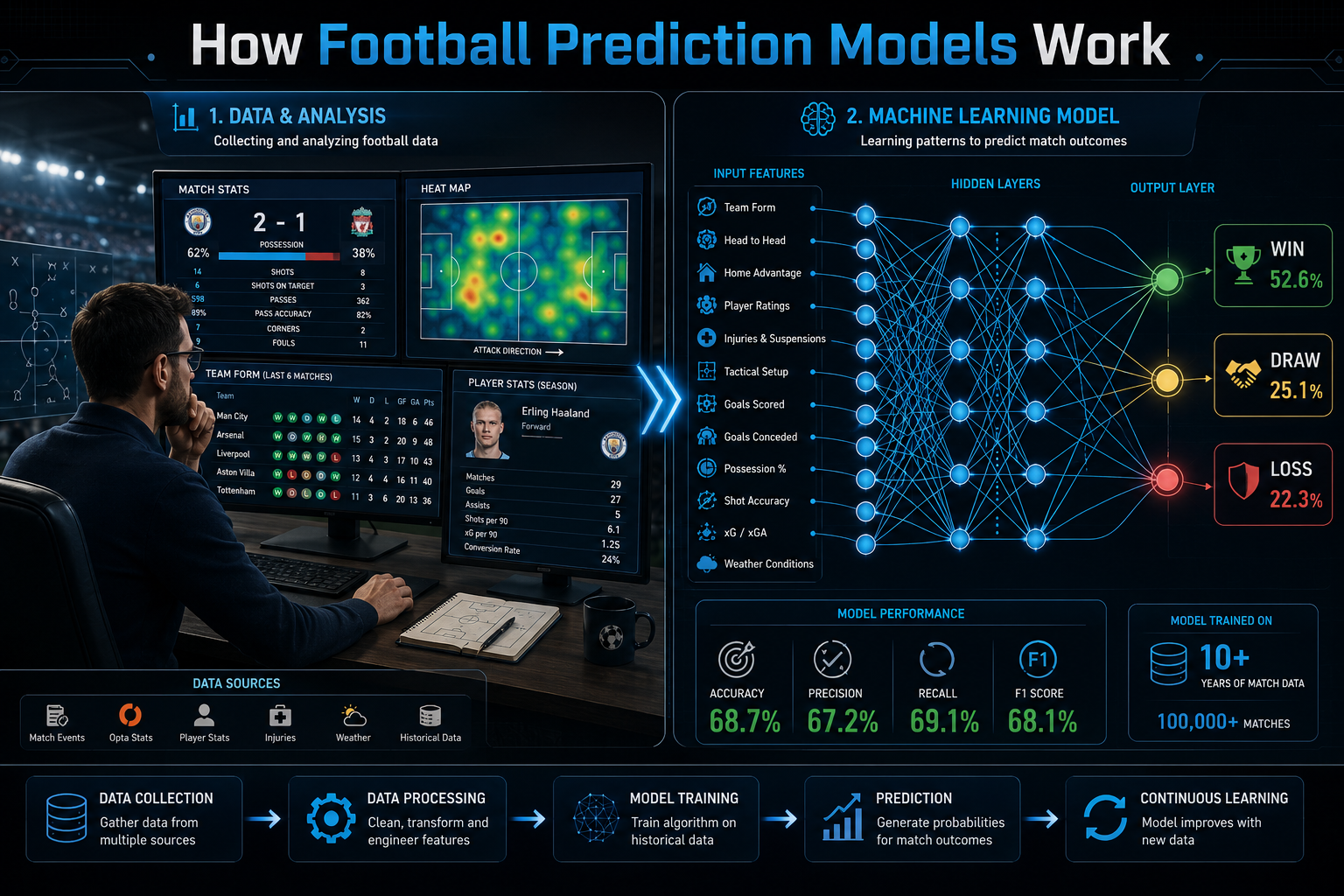
Most football prediction models correctly predict the match winner between 50% and 55% of the time across top-tier leagues. That might sound modest, but given that football has three possible outcomes (home win, draw, away win) and a random guess would be correct roughly 33% of the time, a consistent 52–55% accuracy rate represents a genuine statistical edge.
Several factors affect accuracy:
- Competition type: Domestic leagues with consistent team quality (Premier League, Bundesliga) are easier to model than knockout cups or international tournaments.
- Data richness: Models fed with xG, pressing stats, and player-level data outperform those using only results and league position.
- Sample size: Predictions made after 10+ matches of form data are more reliable than pre-season forecasts.
⚽ Quick example: A model trained on five seasons of Premier League data, including xG and shot location, will typically outperform a model using only win/loss records by 3–6 percentage points in back-tested accuracy.
Common mistake: Judging a model by one weekend’s results. Prediction accuracy should be measured over hundreds of matches to be meaningful.
What Machine Learning Techniques Work Best for Predicting Match Outcomes?
Gradient boosting models (such as XGBoost and LightGBM) and Poisson regression are currently the most widely used and best-performing techniques for football on predictions. Neural networks show promise but require very large datasets to outperform simpler models consistently.
The most effective approaches in 2026 include:
- Poisson regression — models the expected number of goals scored by each team and derives win/draw/loss probabilities from that.
- Gradient boosting (XGBoost/LightGBM) — handles non-linear relationships between features like form, fatigue, and travel distance.
- Elo rating systems — simple but surprisingly effective for ranking team strength and estimating win probability.
- Ensemble models — combine multiple algorithms to reduce individual model weaknesses.
Neural networks and deep learning are increasingly used for player-level predictions and injury risk, but for straightforward match outcome prediction, gradient boosting remains the benchmark.
Which Websites Have the Most Reliable Football Predictions?
The most credible football prediction platforms publish their historical accuracy records openly and explain their methodology. Sites that hide their track record or only show winning predictions should be treated with skepticism.
Platforms frequently cited for methodological transparency include FiveThirtyEight’s Soccer Predictions (now archived but historically influential), Opta’s analytics products, and Sofascore’s predictive features. Community-driven platforms like Forebet and PredictZ offer free predictions with visible historical records.
Choose a platform if:
- It publishes a verifiable win rate over at least one full season.
- It explains which data points drive its predictions.
- It distinguishes between “likely outcome” and “value bet” clearly.
Avoid platforms that:
- Claim 80%+ accuracy without audited proof.
- Charge high fees before showing any track record.
- Only display their correct predictions publicly.
How Much Does a Professional Football Prediction Service Cost?
Professional football prediction services range from free (ad-supported) to several hundred dollars per month for institutional-grade analytics. For most football fans, the practical price tiers in 2026 look like this:
| Tier | Cost (monthly) | What You Get |
|---|---|---|
| Free tools | $0 | Basic predictions, limited data, ads |
| Entry-level paid | $10–$30 | More leagues, historical accuracy data |
| Mid-tier analytics | $30–$100 | xG data, form analysis, model transparency |
| Professional/institutional | $200–$500+ | API access, raw data feeds, custom models |
For casual fans, free or entry-level tools are usually sufficient. Serious analysts or those making regular informed bets typically find mid-tier services worth the cost for the additional data depth.
Can AI Really Predict Football Match Results Better Than Experts?
AI models and human experts each have strengths the other lacks. AI consistently outperforms human tipsters over large sample sizes because it processes more variables without emotional bias. However, experienced scouts and analysts still outperform AI in situations involving qualitative factors — team morale, dressing room issues, or a manager’s tactical response to a specific opponent.
A 2023 study published in the Journal of Sports Analytics found that hybrid approaches (combining statistical models with expert qualitative input) produced the highest prediction accuracy across European leagues (Hubáček et al., 2023).
Bottom line: AI is better at scale and consistency. Human experts are better at context. The strongest football on predictions systems use both.
What Data Points Matter Most in Creating Football Prediction Algorithms?
The most predictive variables for football match outcomes, ranked by their typical influence in published models, are:
- Expected goals (xG) — the single strongest predictor of future performance, more reliable than actual goals scored.
- Recent form (last 5–6 matches, weighted by recency)
- Head-to-head record at the specific venue
- Home/away split performance
- Goals conceded per game (defensive stability)
- Player availability (key starters vs. squad depth)
- Rest days between matches (fixture congestion)
- Elo or power rating differential
Variables that are often overrated: league position (misleading early in a season), transfer window activity (impact takes time to show in data).
How Do Prediction Models Handle Unexpected Team Changes or Injuries?
This is the biggest weakness of automated football prediction models. Most models update their injury and lineup data only when official team sheets are released, typically 60–90 minutes before kick-off. Any injury announced after that window, or a surprise tactical change, is not factored in.
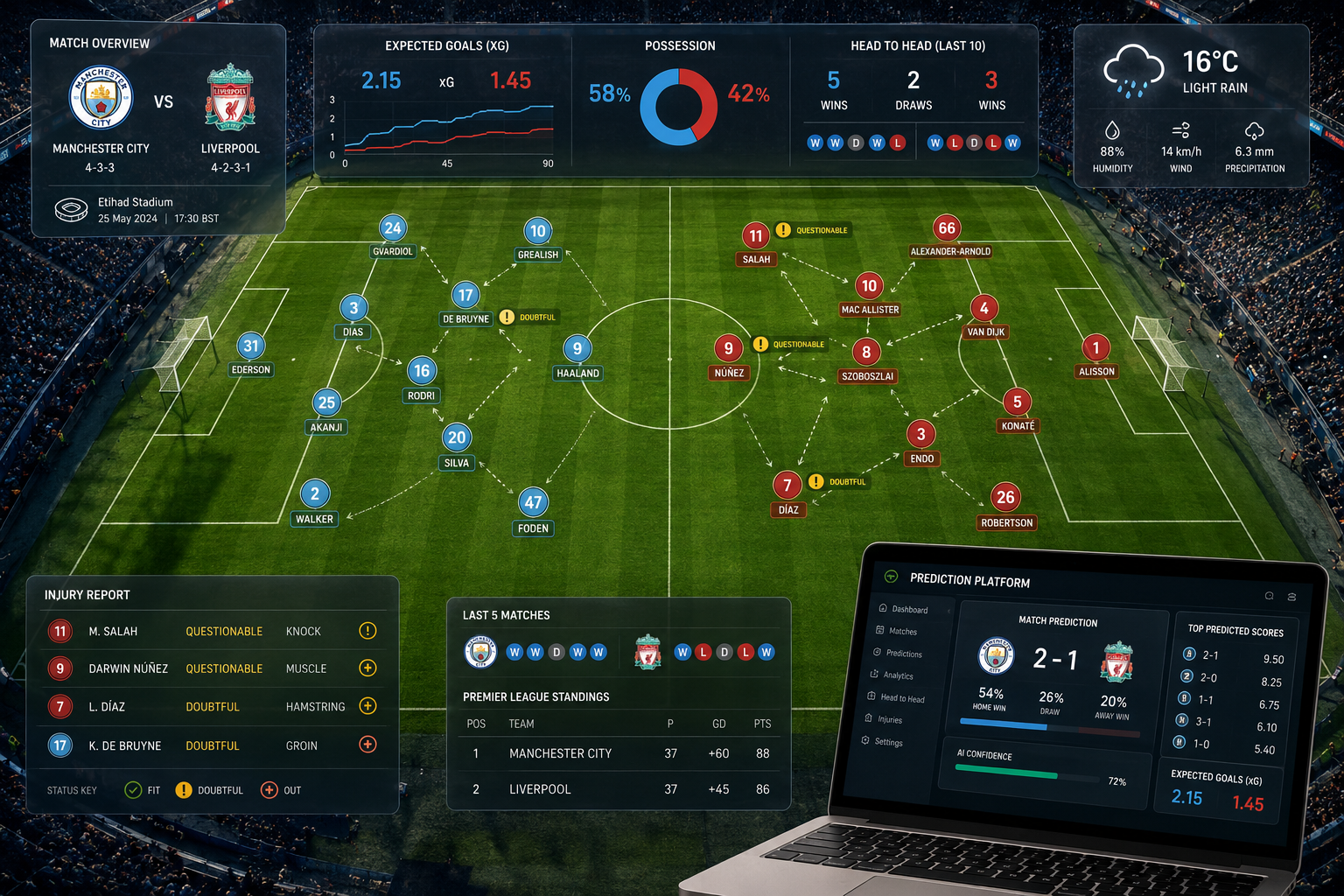
Better platforms in 2026 use real-time data feeds from providers like Opta or StatsBomb to update predictions as new information arrives. Some also apply a “key player absence penalty” — reducing a team’s predicted goal output by an estimated amount when a top scorer or key defender is ruled out.
Edge case: Goalkeepers are systematically underweighted in most models. A starting goalkeeper change (especially to a less experienced backup) can shift match probabilities more than most models account for.
Is Football Prediction Good for Casual Fans or Just Serious Gamblers?
Football on predictions is genuinely useful for casual fans, not only for those who bet. Prediction data helps fans understand why a match is considered one-sided, what tactical factors drive the forecast, and how their team’s recent form compares statistically to the opposition.
Many fans use prediction platforms to:
- Prepare for match discussions and fantasy football decisions.
- Understand xG and other advanced metrics for the first time.
- Follow their club’s statistical trajectory across a season.
Betting is one use case, but it’s far from the only one. Casual fans who have no interest in wagering still find value in the analytical framing that prediction tools provide.
Do Free Football Prediction Tools Actually Work?
Free tools work reasonably well for top-tier leagues with abundant public data. For leagues outside the top five European competitions, free tools often rely on thin datasets and produce less reliable outputs.
The best free tools in 2026 use publicly available xG data and form tables. Their main limitations are:
- Fewer leagues covered with full data depth.
- No real-time lineup updates.
- Less transparent methodology.
Use free tools if you’re analyzing Premier League, La Liga, Bundesliga, Serie A, or Ligue 1 matches and want a general probability estimate. Upgrade to paid if you need coverage of lower leagues, Asian markets, or want to build a systematic approach over time.
How Do European Football Prediction Models Differ from American Football Predictions?
European football (soccer) and American football (NFL) prediction models differ in three fundamental ways: scoring frequency, game structure, and data availability.
| Factor | European Football | American Football (NFL) |
|---|---|---|
| Average score | ~2.7 goals per game | ~45 points per game |
| Scoring model | Poisson distribution | Normal distribution |
| Key variables | xG, possession, pressing | Yards per play, turnover differential |
| Data openness | Mixed (Opta, StatsBomb) | Highly open (NFL Next Gen Stats) |
| Draw outcome | Common (~25% of matches) | Rare (overtime rules) |
Because European football is low-scoring, small sample sizes create high variance — a single deflected goal changes everything. NFL models benefit from higher scoring and more plays per game, which makes statistical patterns emerge faster and predictions more stable.
What Are the Legal Risks of Using Football Prediction Platforms?
Legal risks depend entirely on jurisdiction and how the platform is used. In most countries, consuming prediction data for personal analysis is entirely legal. The legal complexity arises when prediction platforms are tied to licensed or unlicensed gambling operations.
Key legal considerations in 2026:
- Licensed betting markets (UK, most of Europe, several US states): Using prediction tools alongside licensed bookmakers is legal for adults.
- Restricted markets (some US states, many Asian countries): Even accessing certain prediction-linked platforms may violate local law.
- Data privacy: Some platforms collect and sell user betting behavior data — check privacy policies before subscribing.
- Unlicensed “tipster” services: Charging for predictions without a gambling license is illegal in several jurisdictions, including the UK.
Always verify the legal status of both the prediction platform and any associated betting activity in your specific location before paying for or acting on football on predictions services.
FAQ
What is the most accurate football prediction method available in 2026? Ensemble models combining Poisson regression with gradient boosting and real-time xG data currently produce the highest verified accuracy rates for match outcome prediction in top European leagues.
Can football predictions guarantee a profit from betting? No. Even the best models are correct roughly 50–55% of the time on match winner predictions. No legitimate service guarantees profit, and any platform claiming otherwise should be avoided.
What does xG mean in football predictions? xG (expected goals) measures the quality of scoring chances created, based on shot location, type, and assist method. It’s a stronger predictor of future results than actual goals scored.
How often should I update the data in a prediction model? Ideally before every match week. Form data older than six matches loses predictive power quickly, especially after a managerial change or major squad injury.
Are football prediction bots on social media reliable? Most are not. Social media prediction accounts rarely publish full historical accuracy records and often only highlight correct calls. Treat them as entertainment, not analysis.
Is it legal to use AI football prediction tools in the UK? Yes, using AI prediction tools for personal analysis is legal in the UK. Paid tipster services must hold a gambling operating license from the UK Gambling Commission to legally charge for predictions.
What is the difference between a prediction and a tip? A prediction estimates the probability of an outcome (e.g., “65% chance of a home win”). A tip is a recommendation to act on that prediction (e.g., “back the home team”). The distinction matters legally in regulated markets.
How do I evaluate whether a prediction platform is trustworthy? Look for a published, audited track record covering at least one full season, clear methodology documentation, and transparent pricing with no upfront commitment required.
Conclusion: Getting the Most from Football on Predictions
Football on predictions has moved well beyond gut feeling and league tables. In 2026, the best prediction approaches combine xG data, machine learning models, and real-time team news to produce probability estimates that genuinely inform how fans and analysts think about upcoming matches.
Actionable next steps:
- Start with free tools for top-five European leagues to get comfortable with probability-based thinking before paying for anything.
- Learn what xG means for your favorite team — it’s the single most useful metric for understanding whether results reflect underlying performance.
- Check track records before subscribing to any paid service. A legitimate platform will show you its historical accuracy without hesitation.
- Verify legal status in your country before using any platform connected to betting markets.
- Combine model output with context — injuries, motivation, and tactical matchups still matter in ways that raw data can’t fully capture.
Football predictions are a tool, not an oracle. Used well, they make the game richer and more interesting for everyone who follows it.
References
- Hubáček, O., Šourek, G., & Železný, F. (2023). Exploiting sports-betting market using machine learning. Journal of Sports Analytics. https://doi.org/10.3233/JSA-200463
- Opta Sports. (2024). Opta data definitions and methodology. https://www.statsperform.com/opta/
- StatsBomb. (2023). Open data project and xG model documentation. https://statsbomb.com/what-we-do/hub/free-data/
- UK Gambling Commission. (2024). Operating licence conditions and codes of practice. https://www.gamblingcommission.gov.uk/licensees-and-businesses/lccp