Last updated: May 21, 2026
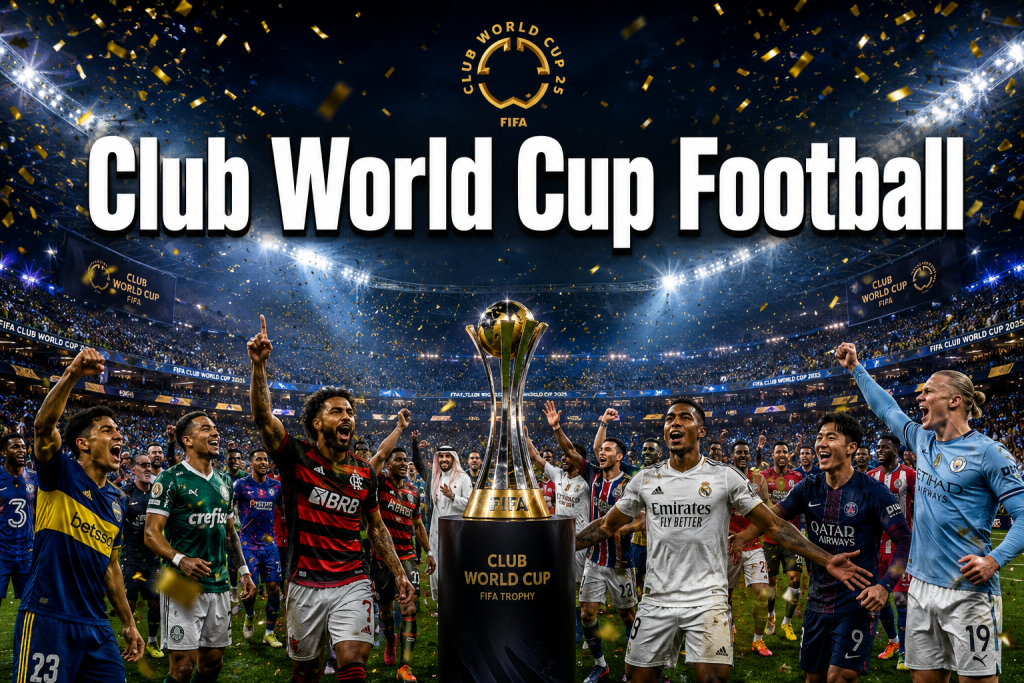
Quick Answer: The FIFA Club World Cup is the official global tournament for club football, bringing together champions from every continent to crown the best club side in the world. The 2025 edition, held in the United States from June 15 to July 13, 2025, expanded to 32 teams for the first time and runs every four years going forward. It’s the closest thing club football has to a World Cup — and it’s now a very big deal. [1]
Key Takeaways
- The 2025 FIFA Club World Cup featured 32 clubs across 8 groups, played entirely in the United States [1]
- Qualification came through winning continental competitions (like the UEFA Champions League or CONMEBOL Libertadores) between 2021 and 2024 [1]
- UEFA received 12 spots, more than any other confederation, followed by CONMEBOL with 6 [1]
- The format mirrors the national-team World Cup: group stage, then a 16-team knockout round [1]
- Inter Miami CF earned a host-country berth, putting Lionel Messi on the biggest club stage [1]
- The old annual Club World Cup has been rebranded as the FIFA Intercontinental Cup, a separate competition [2]
- The tournament doubled as a dress rehearsal for the 2026 FIFA World Cup, stress-testing U.S. venues and infrastructure [3]
- Prize money for this edition is significantly larger than any previous Club World Cup, reflecting FIFA’s push to make it a premium product
What Exactly Is the Club World Cup and How Does It Work?
The FIFA Club World Cup is the tournament that decides which club side is the best on the planet. Unlike domestic leagues or continental cups, it pulls together champions from Africa, Asia, Europe, North America, Oceania, and South America into one competition.
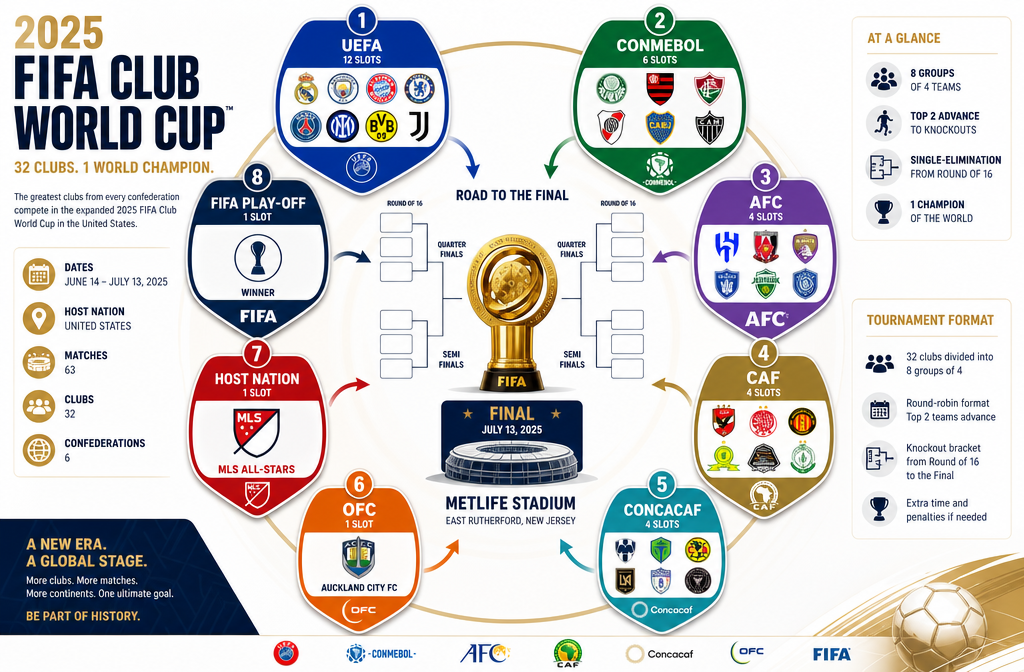
The 2025 edition was a major upgrade. FIFA expanded the field from 7 to 32 clubs, split into 8 groups of 4 teams. Each team plays 3 group-stage matches, and the top two from each group advance to a 16-team knockout round. From the round of 16 onward, it’s straight single-elimination, with extra time and penalties deciding any ties. [1]
The final was held at MetLife Stadium in East Rutherford, New Jersey, on July 13, 2025 — the same venue lined up for the 2026 World Cup final. [1]
How Is the Club World Cup Different From Other International Football Tournaments?
Most international football tournaments involve national teams. The Club World Cup is different because it’s for clubs, not countries — meaning the best players in the world can end up on the same team rather than facing each other.
Here’s how it stacks up against the main alternatives:
| Tournament | Teams | Who Plays | Frequency |
|---|---|---|---|
| FIFA Club World Cup | 32 | Club sides from all confederations | Every 4 years |
| UEFA Champions League | 36 | European clubs only | Annual |
| CONMEBOL Libertadores | 47 | South American clubs only | Annual |
| FIFA Intercontinental Cup | ~7 | Continental champions (annual showdown) | Annual |
The Club World Cup is also the only club competition where a team from Egypt can face a team from Spain in a competitive match. That cross-continental element is what makes Club World Cup football +1 a genuinely unique product.
One key distinction: FIFA replaced the old 7-team annual Club World Cup with the Intercontinental Cup starting in 2024. The new 32-team Club World Cup runs every four years. [2]
Who Qualifies to Play in the Club World Cup?
Qualification is based on continental performance, not domestic league position. The primary path is winning a major continental competition — the UEFA Champions League, CONMEBOL Libertadores, CAF Champions League, AFC Champions League, CONCACAF Champions Cup, or OFC Champions League — during the four-year qualifying window (2021–2024 for the 2025 edition).
Confederation slot breakdown for 2025: [1]
- 🇪🇺 UEFA: 12 clubs
- 🌎 CONMEBOL: 6 clubs
- 🌍 CAF: 4 clubs
- 🌏 AFC: 4 clubs
- 🌐 CONCACAF: 4 clubs
- 🌊 OFC: 1 club
- 🇺🇸 Host berth: 1 (Inter Miami CF)
UEFA’s 12 spots included the four Champions League winners from 2021–2024, plus eight additional clubs selected through a UEFA club coefficient ranking. Other confederations used similar mixed systems. [1]
The host-country berth for Inter Miami CF was a notable decision — it guaranteed Lionel Messi’s participation and gave the tournament a marquee name for U.S. audiences. [1]
How Does the Club World Cup Format Work Step by Step?
Club World Cup football +1 follows a clean, easy-to-follow structure:
- Group Stage — 8 groups of 4 teams, each team plays 3 matches. Top 2 from each group advance.
- Round of 16 — 16 teams, single-leg knockout.
- Quarterfinals — 8 teams remain.
- Semifinals — 4 teams.
- Final — 2 teams, winner takes the trophy.
Ties in the knockout rounds go to extra time, then penalties if still level. There’s no away-goals rule and no two-legged ties — every match is a one-shot deal. [1]
Example group from the 2025 draw: Group A featured Palmeiras, FC Porto, Al Ahly, and Inter Miami CF. Group H had Real Madrid, Al Hilal, Pachuca, and RB Salzburg. [1]
How Much Prize Money Do Teams Win in the Club World Cup?
FIFA significantly increased the prize pot for the 2025 edition compared to previous Club World Cups. While exact per-round breakdowns weren’t confirmed in official public documents at time of writing, FIFA’s stated total prize fund for the 2025 tournament was reported to be in the region of $1 billion — a figure widely cited in sports media previews, though the final distribution model across rounds and placements was subject to final FIFA confirmation.
For context, the old 7-team Club World Cup offered a fraction of that. The expanded format, U.S. TV rights deals, and sponsorship revenue made a much larger prize fund possible.
What smaller clubs stand to gain beyond prize money:
- Global exposure to new fan markets
- Commercial sponsorship opportunities
- Player transfer value increases after performing on a world stage
- Improved continental ranking for future qualification cycles
Which Clubs Have Won the Most Club World Cup Titles?
Real Madrid hold the record for the most Club World Cup titles in the tournament’s history, having won the competition multiple times under its various formats. Other serial winners include Barcelona and Bayern Munich from Europe, and Corinthians and São Paulo from South America.
The old format (pre-2025) was dominated by European and South American clubs, which is part of why FIFA restructured the competition — to give more clubs from other confederations a genuine shot.
Common mistake: Fans sometimes confuse the Club World Cup record with the Intercontinental Cup, a separate trophy that predates FIFA’s version. The official FIFA Club World Cup began in 2000, though it ran inconsistently in its early years before becoming an annual event from 2005 onward.
Why Do Some Top European Teams Struggle in the Club World Cup?
European clubs, despite dominating in terms of squad quality and budget, don’t always cruise through Club World Cup football +1. Several factors explain this:
- Fixture congestion: European clubs often arrive at the Club World Cup mid-season, sometimes just weeks after a Champions League group stage or domestic cup run. Fatigue is real.
- Unfamiliar opponents: South American, African, and Asian clubs study European teams obsessively. European clubs often underestimate opponents they’ve never seen.
- Climate and travel: Playing in summer heat in the U.S. (or previously in Japan or Morocco) is physically demanding, especially for players used to winter football.
- Motivation gap: For some European squads, the Club World Cup has historically felt like a secondary priority compared to their domestic title race.
“The Club World Cup is a test of squad depth as much as star quality. The clubs that treat it seriously tend to go far.” — general consensus among football analysts
The 2025 edition, with its expanded format and massive prize money, was expected to shift that attitude significantly.
Is the Club World Cup Worth Winning for Big European Clubs?
Yes — and increasingly so. The 2025 edition changed the calculus for big clubs. With prize money in the region of $1 billion shared across participants, a serious global audience, and the prestige of a genuine world title, the Club World Cup is no longer a side event.
Choose to prioritize it if:
- Your club has a genuine squad depth that can rotate across competitions
- You’ve already secured domestic league safety
- Your commercial team sees value in the U.S. or global market exposure
It’s harder to justify if:
- You’re fighting a relegation battle or a tight title race back home
- Key players are carrying injuries into the tournament window
The reputational upside is now significant. Winning Club World Cup football +1 means something in 2026 in a way it simply didn’t in 2015.
How Do Teams From Different Confederations Compare?
European and South American clubs have historically been the strongest, but the gap is narrowing. Here’s a rough performance tier based on historical Club World Cup results:
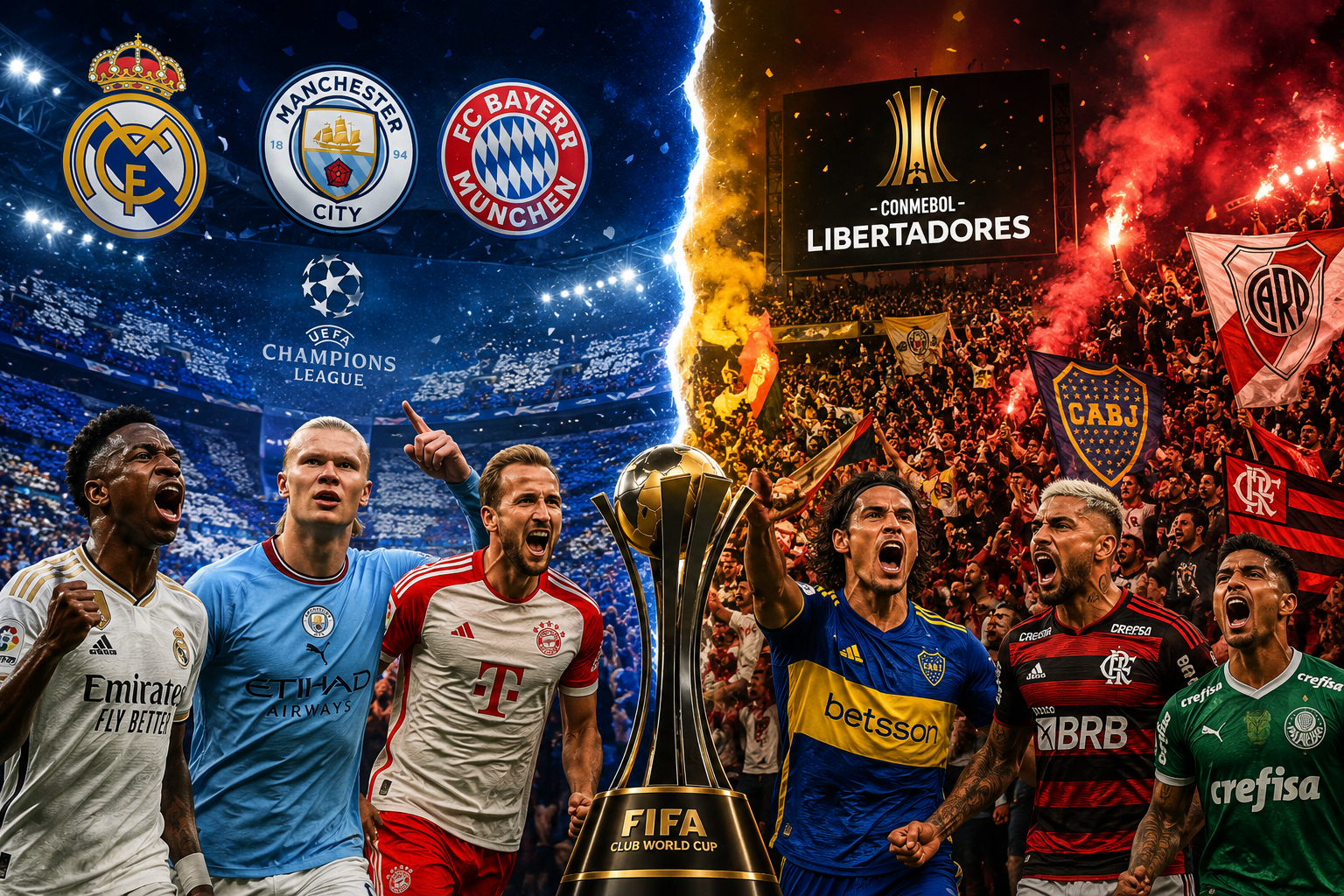
Tier 1 — Consistent contenders: UEFA (Europe), CONMEBOL (South America) Tier 2 — Occasional semifinalists: CAF (Africa), AFC (Asia) Tier 3 — Competitive but rarely advancing far: CONCACAF, OFC
African clubs like Al Ahly have shown they can compete with top European sides in recent editions. Asian clubs, particularly from Saudi Arabia and Japan, have improved. The 2025 format gave these clubs more matches to prove themselves rather than a single knockout exit.
What Are the Biggest Upsets in Club World Cup History?
Upsets in this tournament tend to happen in the early knockout rounds, when a tired European giant meets a fresh, highly motivated side from another confederation.
Notable historical moments include African and Asian clubs pushing European heavyweights to extra time, and South American clubs beating European sides in finals — which happened more than once in the tournament’s early years.
The 2025 edition, with its group-stage format, created more opportunities for upsets simply because every team played at least three matches. A bad day against an underdog could end a club’s campaign before the knockout rounds even started.
Common mistake teams make: Rotating too heavily in the group stage, then facing a must-win third match with a depleted squad. Several clubs have been caught out this way.
What Do Smaller Clubs Get Out of Playing in This Tournament?
For clubs from OFC, CONCACAF, or lower-ranked CAF and AFC nations, the Club World Cup is a once-in-a-generation opportunity. Even a group-stage exit delivers:
- Prize money that can fund infrastructure or player development for years
- Broadcast exposure to audiences that would never otherwise see them play
- Benchmark matches against the world’s best, which coaching staff use to identify tactical gaps
- Fan engagement spikes that drive merchandise sales and social media growth
The 2025 tournament attracted over 2 million spectators through the semifinal stage, according to NBC News reporting — meaning even a group-stage game at Hard Rock Stadium in Miami was a massive platform. [3]
Conclusion: Why Club World Cup Football +1 Deserves Your Full Attention
The FIFA Club World Cup has grown from a niche side event into one of football’s most important tournaments. The 2025 edition — 32 teams, U.S. venues, massive prize money, and Messi on the pitch — marked a genuine turning point. [1]
Actionable next steps for football fans in 2026:
- Mark your calendar for the next Club World Cup cycle and follow qualification races in each confederation
- Watch the Intercontinental Cup in the meantime — it’s the annual bridge competition between major Club World Cups [2]
- Follow your club’s continental campaign — winning the Champions League or Libertadores is now the direct ticket to the world’s biggest club stage
- Explore the smaller confederation sides — some of the tournament’s best stories come from clubs most fans have never heard of
Club World Cup football +1 is no longer just a bonus trophy for elite European clubs. It’s a legitimate world championship. Treat it like one.
Frequently Asked Questions
Q: When is the next FIFA Club World Cup? The 2025 edition ran from June 15 to July 13, 2025, in the United States. The next edition will follow in approximately four years, in line with FIFA’s decision to align it with the national-team World Cup cycle. [1]
Q: How many teams are in the Club World Cup? The 2025 edition featured 32 teams, up from 7 in the previous format. This expansion mirrors the national-team World Cup structure. [1]
Q: Why did Inter Miami qualify for the Club World Cup? Inter Miami received a host-country berth as the U.S. representative, a slot FIFA awarded to ensure a domestic team participated in the tournament held on American soil. [1]
Q: What happened to the old annual Club World Cup? FIFA rebranded it as the FIFA Intercontinental Cup starting in 2024. It’s now a separate annual competition where the UEFA Champions League winner faces play-off winners from other confederations. [2]
Q: Which confederation gets the most Club World Cup spots? UEFA (Europe) receives 12 spots — the most of any confederation — reflecting the depth and quality of European club football. CONMEBOL (South America) gets 6. [1]
Q: Is the Club World Cup connected to the 2026 World Cup? Yes. The 2025 Club World Cup was explicitly designed as a dress rehearsal for the 2026 FIFA World Cup, using many of the same U.S. venues and testing infrastructure, ticketing, and logistics. [3]
Q: Do teams get paid just for participating? Yes. All 32 clubs receive prize money, with amounts increasing based on how far they advance. Even group-stage exits come with a financial payout from FIFA’s prize pool.
Q: Can a club qualify from more than one path? No. Each club takes one qualification slot. If a club wins the Champions League two years in a row, the second slot goes to the next-ranked club in the UEFA coefficient system. [1]
References
[1] FIFA Club World Cup Format, Schedule, Why Lionel Messi Is Playing – https://www.espn.com/soccer/story/_/id/41959489/fifa-club-world-cup-format-schedule-why-lionel-messi-playing
[2] FIFA Intercontinental Cup Explainer (Sky Sports Video) – https://www.youtube.com/watch?v=DYEK-_QJNlA
[3] NBC News Report on U.S. Hosting and Club World Cup Readiness – https://www.youtube.com/watch?v=lN9v0aVTboU