Last updated: June 1, 2026
Quick Answer: Canada and Bosnia are two nations with very different football histories, cultures, and economic profiles. Canada is a vast, wealthy North American country co-hosting the 2026 FIFA World Cup, while Bosnia and Herzegovina is a smaller Balkan nation with a passionate football culture and a single World Cup appearance to its name. For football fans, the Canada Vs Bosnia matchup represents a fascinating contrast in footballing identity, diaspora communities, and national ambition.
Key Takeaways
- Canada is co-hosting the 2026 FIFA World Cup alongside the USA and Mexico, making it one of the most watched footballing nations right now.
- Bosnia and Herzegovina qualified for their only World Cup in 2014, finishing in the group stage.
- Canada is roughly 148 times larger in land area than Bosnia.
- Bosnia’s cost of living is significantly cheaper than Canada’s across almost every category.
- There are an estimated 350,000 to 400,000 Bosnians living in Canada, forming one of the largest Bosnian diaspora communities in the world.
- Canada’s healthcare system is publicly funded; Bosnia’s is fragmented and under-resourced by comparison.
- Football is the dominant sport in Bosnia; hockey and Canadian football lead in Canada, though soccer is growing fast.
- Bosnian nationals require a visa or Electronic Travel Authorization (eTA) to enter Canada, depending on travel method.
- Canada ranks consistently in the top 15 countries globally for quality of life; Bosnia ranks considerably lower.
- The biggest challenges for Bosnian immigrants in Canada include language barriers, credential recognition, and cultural adjustment.

How Big Is Bosnia Compared to Canada?
Bosnia and Herzegovina covers approximately 51,197 square kilometres. Canada spans roughly 9.98 million square kilometres, making it the second-largest country on Earth by total area. In practical terms, Canada is about 195 times the size of Bosnia by land area.
This size difference has enormous consequences for both countries. Canada has a population of around 40 million spread across a massive geography. Bosnia has a population of approximately 3.2 million. Canadian cities like Toronto, Vancouver, and Montreal are global metropolises. Bosnia’s capital, Sarajevo, has a population of roughly 275,000.
For football fans watching the Canada Vs Bosnia dynamic play out, this scale difference matters. Canada’s footballing infrastructure is still catching up to its size and wealth. Bosnia punches above its weight given its small population.
How Are Canada and Bosnia Different Culturally?
Canada is a multicultural country built largely on waves of immigration. Its culture blends Indigenous traditions with British, French, and dozens of other immigrant influences. Official bilingualism in English and French shapes everything from government to media.
Bosnia and Herzegovina is a post-conflict Balkan nation with three main ethnic groups: Bosniaks, Serbs, and Croats. Its culture is shaped by Ottoman history, Austro-Hungarian architecture, and the trauma of the 1990s war. Coffee culture, hospitality, and strong family ties are central to Bosnian daily life.
Key cultural contrasts:
- Religion: Bosnia has a significant Muslim population (Bosniaks), alongside Orthodox Christian Serbs and Catholic Croats. Canada is officially secular with a Christian majority and growing religious diversity.
- Food: Bosnian cuisine features cevapi, burek, and slow-cooked meats. Canadian cuisine is regional and diverse, from poutine in Quebec to Pacific salmon on the west coast.
- Social pace: Bosnian social life centres on long coffee conversations and community gatherings. Canadian culture tends to be more individualistic and fast-paced in urban settings.
What Languages Do People Speak in Bosnia Vs Canada?
In Bosnia, the three official languages are Bosnian, Serbian, and Croatian. These are mutually intelligible South Slavic languages, meaning most citizens can communicate easily across ethnic lines despite the political distinction.
In Canada, English and French are the two official languages. English dominates outside Quebec, while French is the primary language in Quebec and parts of New Brunswick. Canada also recognises dozens of Indigenous languages, though most are endangered.
For Bosnian immigrants arriving in Canada, learning English (or French in Quebec) is the first and most critical step toward integration.
Which Country Has a Better Quality of Life?
Canada consistently ranks among the top countries globally for quality of life. The UN Human Development Index (HDI) places Canada in the “very high human development” tier, typically ranking between 12th and 16th globally in recent years. Bosnia ranks significantly lower, usually in the mid-70s range on the same index.
Factors where Canada leads Bosnia:
- Average income and wages
- Healthcare access and outcomes
- Education quality and university access
- Infrastructure and public transport in major cities
- Political stability and rule of law
Bosnia faces ongoing challenges including high unemployment (particularly among youth), political gridlock between its ethnic entities, and significant emigration of working-age people seeking better opportunities abroad.
What Are the Main Economic Differences Between Canada and Bosnia?
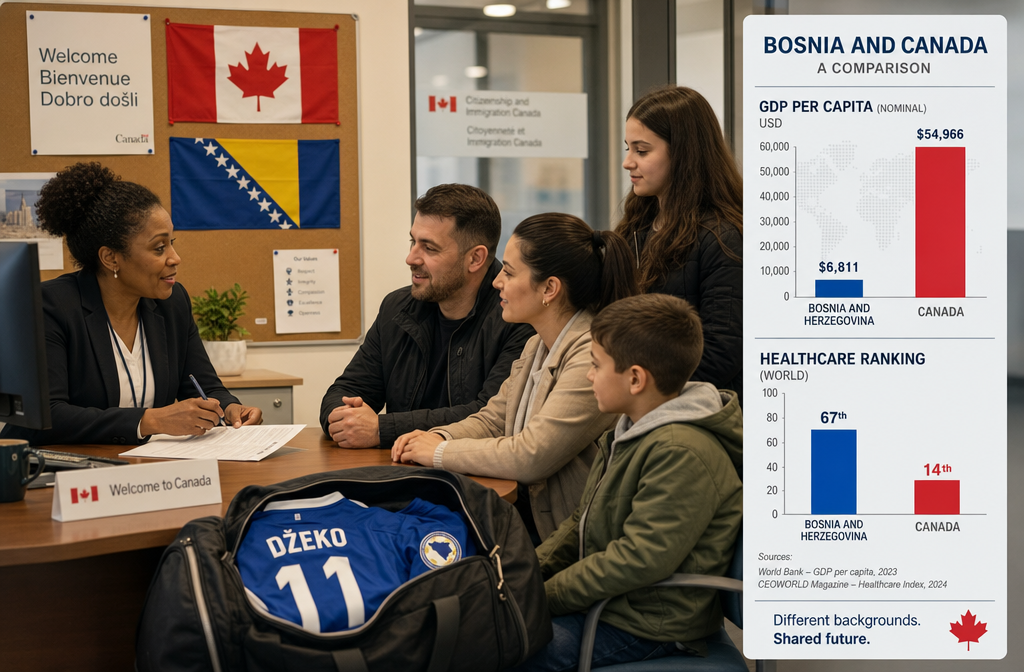
Canada’s GDP per capita is approximately USD 55,000 (World Bank estimate, 2023). Bosnia’s GDP per capita is approximately USD 7,500 by the same measure. That gap is enormous and shapes almost every aspect of daily life.
| Indicator | Canada | Bosnia |
|---|---|---|
| GDP per capita (est.) | ~USD 55,000 | ~USD 7,500 |
| Unemployment rate | ~5-6% | ~10-14% |
| Currency | Canadian Dollar (CAD) | Bosnian Mark (BAM) |
| Major industries | Energy, finance, tech, mining | Manufacturing, tourism, agriculture |
| World Bank income group | High income | Upper-middle income |
Source: World Bank, 2023 data.
Canada’s economy is diversified and globally integrated. Bosnia’s economy remains smaller, more dependent on remittances from its diaspora abroad, and constrained by complex political structures.
Which Country Has a Cheaper Cost of Living?
Bosnia is dramatically cheaper than Canada. Rent, food, transport, and entertainment all cost a fraction of Canadian prices.
As a rough comparison (based on Numbeo community data, 2024):
- A meal at a mid-range restaurant in Sarajevo costs around EUR 10-15. The equivalent in Toronto runs CAD 50-80.
- Monthly rent for a one-bedroom apartment in Sarajevo city centre is roughly EUR 400-600. In Toronto, the same is CAD 2,200-2,800.
- Public transport monthly passes in Sarajevo cost under EUR 30. In Toronto, a monthly Presto pass costs around CAD 156.
For football fans travelling to Bosnia, the low cost of living makes it an attractive destination. For Bosnians arriving in Canada, the cost of living shock is one of the most immediate challenges.
Do Canadians and Bosnians Need Visas to Visit Each Other’s Countries?
Bosnian citizens travelling to Canada by air can use an Electronic Travel Authorization (eTA) rather than a full visa, following Canada’s 2017 eTA expansion for certain countries. However, Bosnian passport holders travelling by land or sea still require a Temporary Resident Visa (TRV). Always verify current requirements with the Government of Canada’s official immigration portal before booking travel.
Canadian citizens travelling to Bosnia do not require a visa for stays of up to 90 days within a 180-day period, in line with Bosnia’s standard visitor policy for Western nations.
Can I Immigrate from Bosnia to Canada Easily?
Canada is one of the more accessible immigration destinations for Bosnian nationals, but it is not simple. The main pathways include Express Entry (for skilled workers), Provincial Nominee Programs (PNPs), family sponsorship, and student visas leading to permanent residency.
The biggest barriers for Bosnian applicants are:
- Meeting the Canadian Language Benchmark (CLB) requirements in English or French
- Having credentials recognised by Canadian professional bodies
- Accumulating enough Comprehensive Ranking System (CRS) points under Express Entry
Processing times and CRS score thresholds change frequently. Applicants should consult a Regulated Canadian Immigration Consultant (RCIC) for current guidance.
Are There Bosnian Communities in Canada?
Yes, and they are substantial. Canada is home to one of the largest Bosnian diaspora populations in the world, with estimates ranging from 350,000 to 400,000 people of Bosnian heritage. The majority settled in Canada during and after the 1992-1995 Bosnian War, when Canada accepted tens of thousands of refugees.
Key Bosnian communities are concentrated in:
- Hamilton, Ontario (sometimes called “Little Bosnia”)
- Toronto, Ontario
- Windsor, Ontario
- Vancouver, British Columbia
These communities have established mosques, cultural associations, restaurants, and football clubs. The Bosnian diaspora in Canada is also a significant source of remittances back to Bosnia.
What Are the Biggest Challenges for Bosnian Immigrants in Canada?
The transition from Bosnia to Canada is significant. The most common challenges reported by Bosnian immigrants include:
- Language: Bosnian is a South Slavic language with no connection to English or French. Reaching professional-level fluency takes years.
- Credential recognition: Doctors, engineers, and lawyers trained in Bosnia often need to retrain or requalify in Canada.
- Cultural adjustment: Canadian workplace culture, social norms, and communication styles differ sharply from Bosnian ones.
- Mental health: Many Bosnian immigrants carry trauma from the 1990s war. Access to culturally competent mental health services remains limited.
- Economic expectations: High Canadian living costs can be a shock for new arrivals accustomed to Bosnian price levels.
How Do Healthcare Systems Compare Between Bosnia and Canada?
Canada has a publicly funded universal healthcare system, meaning most doctor visits, hospital stays, and surgeries are covered by provincial health insurance. Wait times for specialist care are a known issue, but the system provides broad coverage without direct patient cost at the point of service.
Bosnia’s healthcare system is fragmented along ethnic and administrative lines, divided between the Federation of Bosnia and Herzegovina and Republika Srpska entities. Coverage is inconsistent, underfunded, and many patients pay out-of-pocket for services that would be free in Canada. Brain drain of medical professionals to Western Europe and Canada is an ongoing problem.
For Bosnian immigrants, access to Canadian healthcare is one of the most valued benefits of living in Canada.
What Sports Are Most Popular in Bosnia Versus Canada?
Football (soccer) is by far the most popular sport in Bosnia. The national team, nicknamed the Dragons, qualified for the 2014 FIFA World Cup in Brazil, their only World Cup appearance to date. Club football, particularly FK Sarajevo and FK Zeljeznicar, commands fierce local loyalty.
In Canada, ice hockey is the national sport and cultural obsession. However, football/soccer is the most-played sport by participation numbers, especially among youth and immigrant communities. Canada’s qualification as host for the 2026 FIFA World Cup has dramatically raised the profile of the Canada national team and Canada soccer more broadly.
The Bosnian diaspora in Canada has played a meaningful role in growing grassroots football in cities like Hamilton and Toronto, contributing players and coaches to CONCACAF youth development pathways.
Is Bosnia Safer or Less Safe Than Canada?
Canada is generally considered safer than Bosnia on most global indices. Canada ranks highly on political stability, rule of law, and personal safety metrics. Violent crime rates in major Canadian cities, while rising in recent years, remain low by global standards.
Bosnia is a stable country today, but it carries the legacy of the 1990s conflict. Landmines remain a hazard in some rural areas, though urban centres are safe for tourists and residents. Organised crime and political corruption are more prominent concerns in Bosnia than in Canada.
For everyday life, both countries are safe for residents. Tourists visiting either country face minimal risk in urban areas.
Canada Vs Bosnia on the Football Pitch: What to Watch
The Canada Vs Bosnia footballing rivalry is not a historic one, but it is growing in relevance. With Canada co-hosting the World Cup Football 2026 alongside the USA and Mexico, Canadian football is at a historic high point. Bosnia, meanwhile, is fighting through UEFA qualification cycles and hoping to return to a World Cup for the first time since 2014.
The large Bosnian diaspora in Canada means that any friendly or competitive fixture between these two nations would draw significant crowds, particularly in Hamilton and Toronto. Bosnian-Canadian players have occasionally appeared in both national team setups, creating genuine split loyalties in the stands.
For fans tracking CONCACAF World Cup developments and UEFA qualifying simultaneously, the Canada Vs Bosnia comparison is a lens into how different footballing ecosystems develop talent, fund infrastructure, and build national identity through the game.
FAQ
Has Canada ever played Bosnia in an official football match? As of 2026, Canada and Bosnia have not met in a major FIFA competitive fixture. Any encounters have been in the form of international friendlies, which are not part of either team’s World Cup qualifying records.
Which country has a stronger football team right now? Canada is currently ranked higher by FIFA, boosted by their 2026 World Cup host status and a generation of talented players including Alphonso Davies. Bosnia has historically been competitive in UEFA qualifying but has not qualified for a major tournament since 2014.
How many Bosnians live in Canada? Estimates suggest between 350,000 and 400,000 people of Bosnian heritage live in Canada, making it one of the largest Bosnian diaspora communities globally.
Can Bosnians work in Canada without a degree? Yes. Canada’s immigration system includes pathways for skilled tradespeople and workers without university degrees, including through Provincial Nominee Programs and the Atlantic Immigration Program.
What is the time difference between Canada and Bosnia? Bosnia (Central European Time) is 6 hours ahead of Eastern Canada (EST) and 9 hours ahead of Western Canada (PST).
Is Bosnian food available in Canada? Yes, particularly in cities with large Bosnian communities such as Hamilton, Toronto, and Windsor. Bosnian restaurants, bakeries, and butchers serving cevapi and burek are well established in these areas.
Do Bosnian football fans travel to Canada for matches? Some do, particularly for high-profile friendlies. The large Bosnian diaspora in Canada means local support is strong without requiring fans to travel from Bosnia itself.
What is Bosnia’s best FIFA World Cup result? Bosnia’s only World Cup appearance was in 2014 in Brazil. They finished third in their group with one win, one draw, and one loss, and were eliminated in the group stage.
Is English widely spoken in Bosnia? English proficiency is growing in Bosnia, particularly among younger generations and in urban areas. However, it is not as widely spoken as in Western European countries, and Bosnian/Serbian/Croatian remains essential for daily life.
Which country has better universities? Canada has several world-ranked universities, including the University of Toronto, McGill, and UBC. Bosnia’s universities are not ranked globally at the same level and face challenges around funding and political influence.
Conclusion
The Canada Vs Bosnia comparison covers enormous ground, from football rivalries to immigration pathways, cultural contrasts, and economic realities. Canada is a wealthier, larger, and more globally connected country, currently riding a wave of footballing excitement as it co-hosts the 2026 World Cup. Bosnia is a smaller, tighter-knit Balkan nation with a deep football culture and a large, proud diaspora community spread across Canada and beyond.
Actionable next steps for readers:
- If you are a football fan planning to attend 2026 World Cup matches in Canada, check the full 2026 World Cup fan guide for fixture schedules and city guides.
- If you are Bosnian and considering immigration to Canada, begin by assessing your Express Entry eligibility and language test requirements through Canada’s official IRCC portal.
- If you follow the Canada national team or Bosnian football, keep an eye on both teams’ qualifying campaigns and friendly schedules for potential Canada Vs Bosnia fixtures in 2026 and beyond.
- Explore the CONCACAF World Cup tag for the latest on Canada’s footballing journey at home.
References
- World Bank. (2023). GDP per capita data. https://data.worldbank.org
- United Nations Development Programme. (2023). Human Development Report. https://hdr.undp.org
- Numbeo. (2024). Cost of Living Comparison. https://www.numbeo.com
- Government of Canada. (2024). Electronic Travel Authorization. https://www.canada.ca/en/immigration-refugees-citizenship/services/visit-canada/eta.html
- FIFA. (2014). 2014 FIFA World Cup Brazil Group F Results. https://www.fifa.com