
Last updated: May 31, 2026
Quick Answer: A World Cup table is the standings chart used during the FIFA World Cup group stage to rank teams based on points earned from wins, draws, and losses. It determines which teams advance to the knockout rounds. Understanding how it works, from points calculation to tiebreakers, is essential for following the tournament intelligently.
Key Takeaways
- A World Cup table ranks teams in each group by points: 3 for a win, 1 for a draw, 0 for a loss.
- The top two teams in each group advance to the knockout stage.
- Goal difference is the first tiebreaker when teams finish level on points.
- Head-to-head results between tied teams are used before overall goal difference in many tiebreaker scenarios.
- Brazil, Germany, and Argentina have historically dominated World Cup group tables.
- A team can be eliminated despite a positive goal difference if other results go against them.
- Referee decisions and late goals can shift group standings dramatically in the final matchday.
- Predicting World Cup table outcomes is possible using form, squad depth, and fixture difficulty, but upsets are common.
What Exactly Is a World Cup Table and How Does It Work
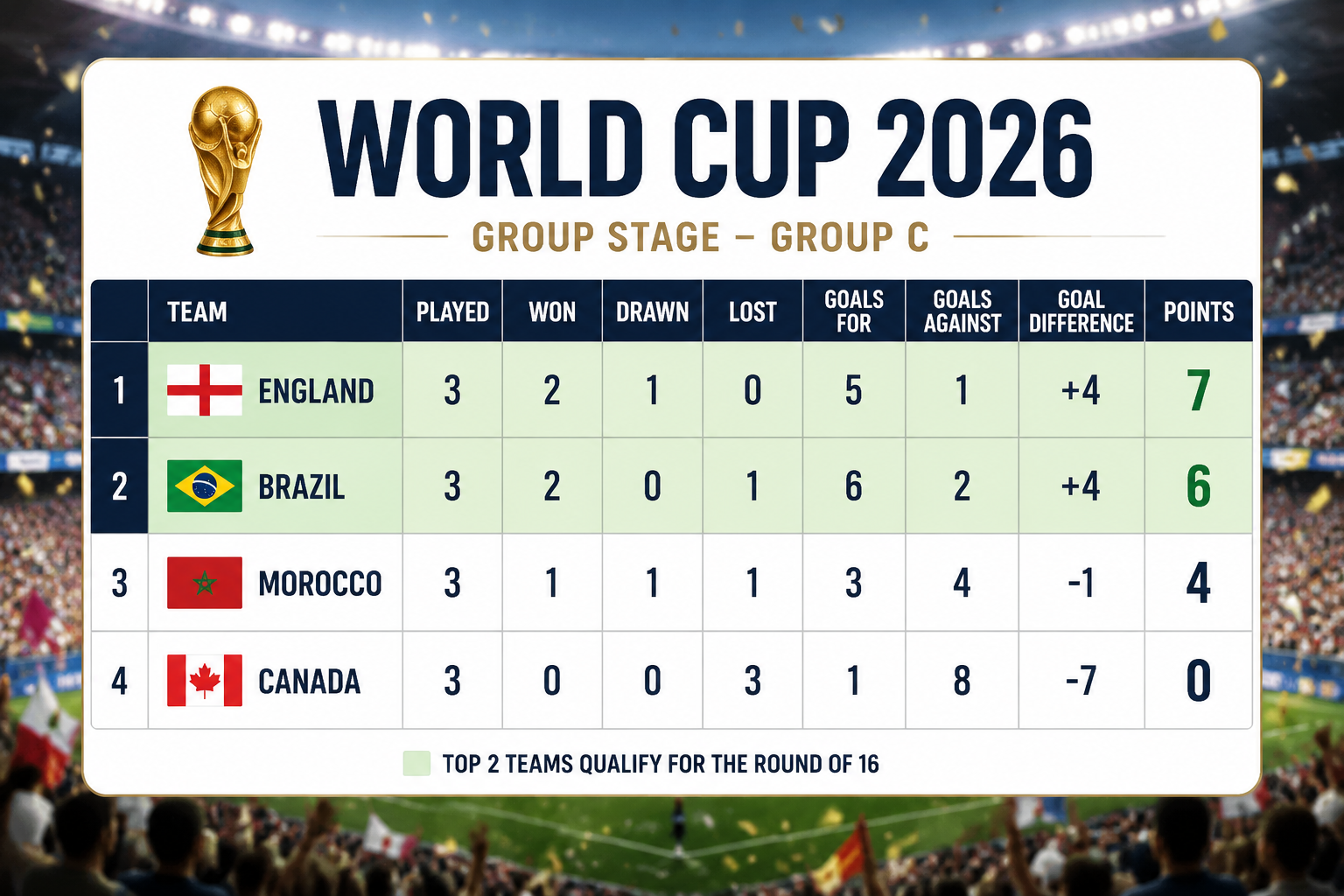
A World Cup table is a ranked standings chart that tracks each team’s performance during the group stage of the FIFA World Cup. It functions exactly like a league table in domestic football, with teams sorted by points accumulated across three group matches.
Each group in the FIFA World Cup contains four teams. Every team plays the other three once. The table updates after each match and shows the following columns:
| Column | What It Means |
|---|---|
| P | Matches Played |
| W | Wins |
| D | Draws |
| L | Losses |
| GF | Goals For |
| GA | Goals Against |
| GD | Goal Difference (GF minus GA) |
| Pts | Total Points |
Teams are ranked from highest to lowest points. When the group stage ends, the top two teams in each World Cup table group advance to the Round of 16.
How Are Points Calculated in World Cup Group Stages
Points in the World Cup group stage follow a straightforward system: 3 points for a win, 1 point for a draw, and 0 points for a loss. FIFA adopted the three-points-for-a-win rule starting with the 1994 World Cup, replacing the older two-points-for-a-win format (FIFA, 1994).
This change was deliberate. The three-point system encourages teams to attack rather than settle for draws, because the reward gap between a win and a draw is larger. A team that wins all three group games earns 9 points, the maximum possible.
Common mistake: Some fans assume a draw is “worth nothing.” In fact, a draw can be enough to advance, especially if other results in the group go your way.
Which Teams Are Currently Top of the World Cup Table
As of 2026, the FIFA World Cup 2026 is hosted across the United States, Canada, and Mexico, marking the first tournament with 48 teams across 12 groups. Early group stage results in 2026 have shown strong performances from traditional powerhouses including France, Brazil, England, and Argentina, alongside surprise early leaders from Africa and Asia.
For live and updated World Cup table standings, the official FIFA website (fifa.com) publishes real-time group standings throughout the tournament. Checking the official source ensures accuracy, as standings can shift with every goal scored.
How Does Goal Difference Impact World Cup Standings
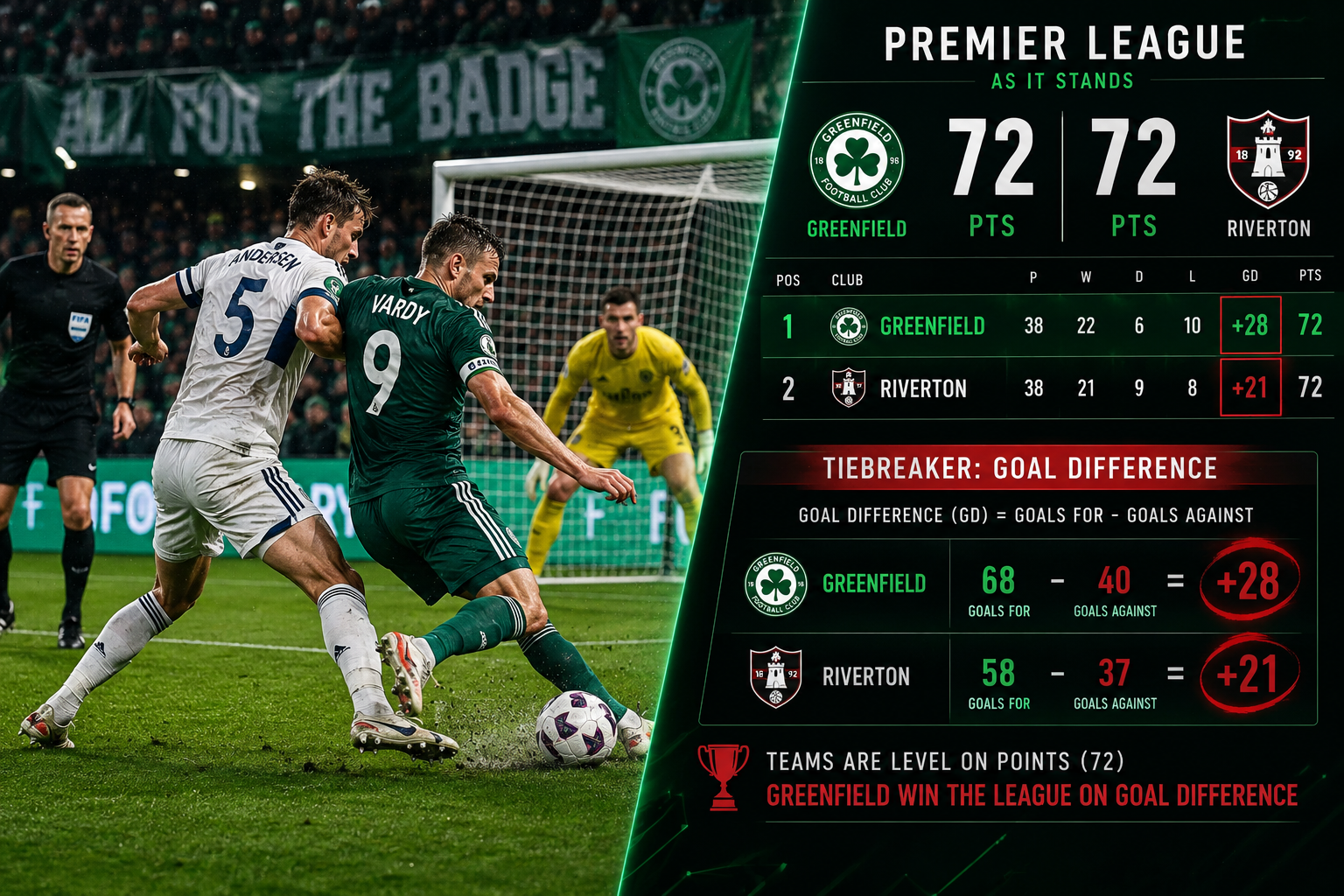
Goal difference (GD) is the number of goals a team has scored minus the number conceded. It is the first tiebreaker used when two or more teams finish level on points in the same World Cup table group.
A team that wins 3-0 is in a better position than one that wins 1-0, even though both earn 3 points. That extra margin could prove decisive at the end of the group stage.
Decision rule: If your team needs to advance on the final matchday and is level on points with a rival, focus on winning by as many goals as possible, not just winning. Goal difference can be the difference between advancing and going home.
How Many Teams Advance from the Group Stage Table
In the 2026 FIFA World Cup format, the top two teams from each of the 12 groups advance automatically to the knockout stage. Additionally, the eight best third-placed teams across all groups also qualify for the Round of 32, making a total of 32 teams advancing from 48 group stage participants (FIFA, 2023).
This expanded format, introduced for 2026, means finishing third is no longer an automatic elimination. Teams that finish third with strong records, measured by points, goal difference, and goals scored, can still progress.
What Happens If Teams Are Tied in the World Cup Table
When two or more teams finish level on points, FIFA applies a specific sequence of tiebreakers to separate them in the World Cup table standings.
FIFA tiebreaker order (as of 2026 tournament rules):
- Goal difference in all group matches
- Goals scored in all group matches
- Head-to-head points between the tied teams
- Head-to-head goal difference between the tied teams
- Head-to-head goals scored between the tied teams
- Fair play points (yellow and red card record)
- FIFA ranking or drawing of lots
Edge case: In 1990, Ireland and the Netherlands both advanced from their group with identical records. The drawing of lots has been used historically, though FIFA has refined tiebreaker rules significantly since then.
World Cup Table vs Tournament Bracket: What Is the Difference
The World Cup table applies only to the group stage. The tournament bracket is the knockout structure that begins after the group stage ends. These are two separate formats within the same competition.
- World Cup table (group stage): Cumulative points system, all teams play each other, standings determine who advances.
- Tournament bracket (knockout stage): Single-elimination format, one loss ends your tournament, no standings table applies.
Once a team exits the group stage and enters the bracket, their group table record is irrelevant. A team that topped their group gets no advantage over a team that finished second, other than potentially facing a weaker opponent in the first knockout round.
Which Countries Historically Perform Best in World Cup Tables
Brazil, Germany, Italy, Argentina, and France have historically been the most consistent performers in World Cup group tables, rarely failing to advance from the group stage.
- Brazil has never been eliminated in the group stage of a World Cup (as of 2026).
- Germany (including as West Germany) has reached the knockout rounds in every tournament they have entered.
- Argentina won the 2022 World Cup in Qatar and has consistently topped their group across multiple tournaments.
Smaller nations like Senegal (2002 quarter-finalists) and South Korea (2002 semi-finalists) have shown that group stage upsets are entirely possible when squad cohesion and tactical discipline align.
Can a Team Be Eliminated Early Even with Good Table Stats
Yes. A team can finish third in their group with a positive goal difference and still be eliminated if the eight best third-place finishes across all 12 groups are stronger. In the 2026 format, finishing third is not a guaranteed exit, but it is a risk.
Also, a team with a good goal difference but fewer points than two rivals will still be eliminated. Points always come before goal difference in the ranking hierarchy.
How Do Referee Decisions Impact World Cup Table Rankings
Referee decisions, including penalty awards, red cards, and disallowed goals, can directly shift World Cup table standings. A single penalty converted late in a group match can change a draw to a win, swinging 2 points and potentially altering goal difference.
In high-profile cases, VAR (Video Assistant Referee) reviews have overturned on-field decisions at World Cups since its introduction in 2018 (FIFA, 2018). While VAR aims to reduce errors, controversial calls still generate significant debate and can affect which teams qualify.
Is There a Way to Predict World Cup Table Outcomes
Statistical models can estimate probable World Cup table outcomes, but they cannot guarantee results. Analysts use factors including FIFA world rankings, recent form, squad age and depth, head-to-head history, and injury reports.
Useful prediction approaches:
- Elo ratings: Football-specific Elo models (such as those published by eloratings.net) assign teams a dynamic strength score and can estimate win probabilities.
- Expected goals (xG): Measures shot quality and can indicate whether a team’s results reflect genuine performance.
- Group difficulty index: Comparing the combined FIFA ranking of group opponents gives a rough fixture difficulty score.
No model predicted Germany’s 2022 group stage exit or Japan’s wins over Germany and Spain in the same tournament. Upsets are a core feature of the World Cup, not an anomaly.
What Are Common Mistakes Teams Make in World Cup Group Stages
Teams and coaches regularly make strategic errors that cost them in the World Cup table standings.
- Defending a lead too early: Dropping into a defensive shape with a one-goal lead invites pressure and risks conceding an equalizer that drops points.
- Ignoring goal difference: Teams that focus only on winning without running up the score can be eliminated on goal difference despite the same points as a rival.
- Rotation errors on matchday 3: Resting key players for the knockout stage while the group is still undecided has backfired for several nations historically.
- Underestimating minnows: Treating a weaker opponent as a guaranteed win leads to complacency. Saudi Arabia’s 2022 win over Argentina is a clear reminder.
FAQ
What is a World Cup table? A World Cup table is the standings chart used in the group stage of the FIFA World Cup, ranking teams by points earned from wins, draws, and losses across three group matches.
How many points is a win worth in the World Cup? A win is worth 3 points. A draw earns 1 point. A loss earns 0 points.
How many teams advance from each World Cup group? In the 2026 FIFA World Cup, the top two teams from each of the 12 groups advance automatically. The eight best third-placed teams across all groups also qualify.
What is the first tiebreaker in World Cup group standings? Goal difference (goals scored minus goals conceded across all group matches) is the first tiebreaker when teams are level on points.
Can a team with zero points still advance? No. A team with zero points from three group matches has lost all three games and cannot advance.
Has any team ever been eliminated despite winning a group game? Yes. Teams can win one game but lose the other two, finishing with 3 points, which may not be enough if rivals also earn 3 or more points.
When did FIFA switch to 3 points for a win? FIFA introduced the three-points-for-a-win system at the 1994 World Cup in the United States.
What happens if all four teams in a group finish level on points? FIFA applies a cascading tiebreaker sequence including goal difference, goals scored, head-to-head results, fair play points, and ultimately a drawing of lots if all other criteria are equal.
Does topping a World Cup group give any advantage? Yes. Group winners typically face a second-placed team from another group in the Round of 16, which is often considered a more favorable draw than facing a group winner.
How reliable are World Cup table predictions? Statistical models offer probability estimates but cannot account for injuries, referee decisions, or match-day conditions. Major upsets occur in nearly every tournament.
Conclusion
The World Cup table is far more than a simple scoreboard. It is the mechanism that determines which nations continue in the world’s most-watched sporting event and which go home. Understanding how points accumulate, how tiebreakers cascade, and how goal difference can decide fates in the final minutes of a group stage match makes watching the tournament significantly more engaging.
Actionable next steps for football fans in 2026:
- Bookmark the official FIFA website (fifa.com) for live, accurate World Cup table updates throughout the tournament.
- Before each matchday, check the current standings and calculate what results each team needs to advance or stay safe.
- Follow xG and Elo-based prediction sites for data-backed group stage analysis rather than relying on reputation alone.
- Pay close attention to the final matchday in each group, when both games are played simultaneously and standings can shift in real time.
The drama of the group stage is built into the structure of the World Cup table itself. Every goal, every card, and every referee call carries weight that echoes through the standings.
References
- FIFA. (1994). FIFA World Cup USA 1994 Technical Report. FIFA. https://www.fifa.com
- FIFA. (2018). VAR at the 2018 FIFA World Cup Russia: Technical Report. FIFA. https://www.fifa.com
- FIFA. (2023). FIFA World Cup 2026 Format and Regulations. FIFA. https://www.fifa.com