Last updated: May 27, 2026
Quick Answer: World Cup football 2026 is the FIFA World Cup hosted jointly by the United States, Canada, and Mexico, running from June 11 to July 19, 2026. It is the first World Cup to feature 48 national teams instead of 32, making it the largest edition in the tournament’s history. Matches are spread across 16 host cities and 16 stadiums throughout North America.
Key Takeaways
- 📅 Dates: June 11 – July 19, 2026
- 🌎 Hosts: USA (11 cities), Canada (2 cities), Mexico (3 cities)
- ⚽ Teams: 48 nations competing for the first time ever
- 🏟️ Stadiums: 16 venues, including MetLife Stadium (New Jersey) as the final host
- 🎟️ Tickets: Category prices range from roughly $50 (group stage) to $1,500+ (final), per FIFA’s official pricing tiers
- 📺 Broadcast: Fox Sports and Telemundo in the USA; BBC and ITV in the UK; global rights held by FIFA partners
- 🔄 Format change: New group stage of 12 groups of 4 teams, with top 2 plus 8 best third-place teams advancing
- 🌟 Favorites: Brazil, France, England, Argentina, and Spain are widely regarded as leading contenders
- ✈️ Travel tip: Book accommodation early — host cities like New York, Los Angeles, and Dallas fill up months in advance
- 🏆 Total matches: 104 games, up from 64 in Qatar 2022
When and Where Is the 2026 World Cup Happening?
World Cup football 2026 runs from June 11 to July 19, 2026, across three co-host nations: the United States, Canada, and Mexico. The tournament opener is scheduled in Mexico City, and the final takes place at MetLife Stadium in East Rutherford, New Jersey.
This is only the second time the tournament has had three co-hosts (the first was 2002, shared by Japan and South Korea). The cross-continental setup means fans may need to travel between countries to follow their team through multiple rounds.
Which Cities Are Hosting World Cup Matches?
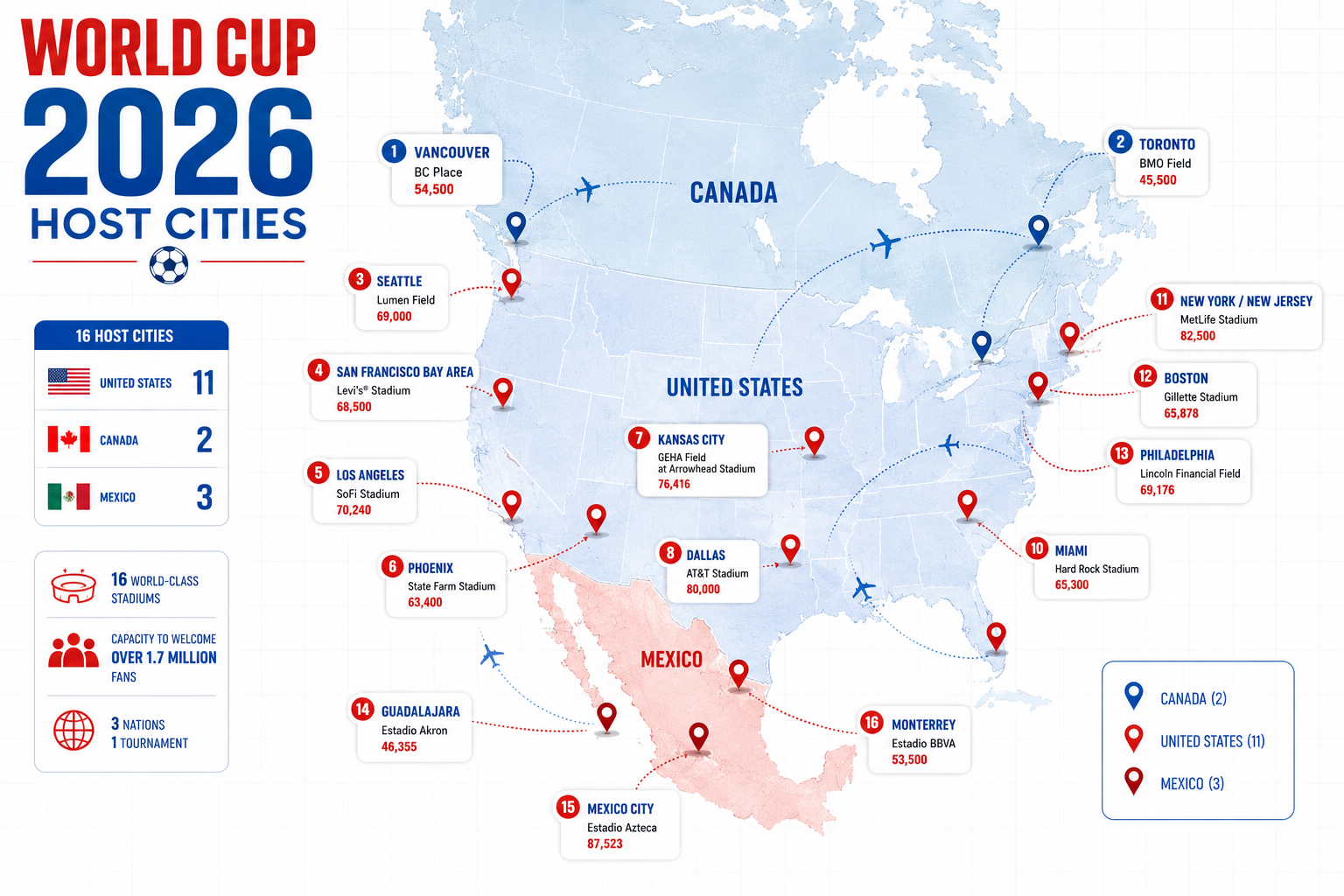
Sixteen cities across three countries are hosting matches. Here’s the full breakdown:
United States (11 cities)
| City | Stadium | Capacity |
|---|---|---|
| New York/New Jersey | MetLife Stadium | ~82,500 |
| Los Angeles | SoFi Stadium | ~70,000 |
| Dallas | AT&T Stadium | ~80,000 |
| San Francisco Bay Area | Levi’s Stadium | ~68,500 |
| Miami | Hard Rock Stadium | ~65,000 |
| Atlanta | Mercedes-Benz Stadium | ~71,000 |
| Seattle | Lumen Field | ~69,000 |
| Boston | Gillette Stadium | ~65,000 |
| Kansas City | Arrowhead Stadium | ~76,000 |
| Houston | NRG Stadium | ~72,000 |
| Philadelphia | Lincoln Financial Field | ~69,000 |
Canada (2 cities)
- Toronto (BMO Field, expanded)
- Vancouver (BC Place)
Mexico (3 cities)
- Mexico City (Estadio Azteca)
- Guadalajara (Estadio Akron)
- Monterrey (Estadio BBVA)
Common fan mistake: Assuming all matches in a region are close together. Dallas to Kansas City, for example, is a 9-hour drive. Plan transport carefully between rounds.
How Many Countries Will Play in the 2026 World Cup?
48 national teams will compete in World Cup football 2026, up from 32 in every tournament since 1998. FIFA expanded the field to give more nations from Africa, Asia, and the Americas a place at the table.
The allocation by confederation is:
- UEFA (Europe): 16 spots
- CAF (Africa): 9 spots
- CONMEBOL (South America): 6 spots
- AFC (Asia): 8 spots
- CONCACAF (North/Central America & Caribbean): 6 spots
- OFC (Oceania): 1 spot
- Inter-confederation playoffs: 2 spots
How Do Teams Qualify for the 2026 World Cup?
Qualification for World Cup football 2026 follows each confederation’s own process, most of which concluded by late 2025. The three host nations — USA, Canada, and Mexico — qualified automatically.
Key qualification facts:
- Europe: UEFA ran a Nations League-linked playoff system alongside standard qualifying groups
- South America: CONMEBOL used a single 10-team round-robin league (the classic format)
- Africa: CAF held group stages followed by two-legged home-and-away playoffs
- Asia: AFC expanded to three rounds to accommodate 8 berths plus playoff spots
Most squads were confirmed by March 2026 following the final international window.
What’s Different About This World Cup Compared to Previous Tournaments?
World Cup football 2026 breaks from tradition in three major ways: a larger field, a new group stage format, and a tri-nation hosting model.
Key changes at a glance:
- 48 teams instead of 32 — the biggest structural change since 1998
- New group format: 12 groups of 4 teams; the top 2 from each group plus the 8 best third-place finishers (32 total) advance to a round of 32
- 104 total matches — 40 more than Qatar 2022
- Three host countries — matches span thousands of miles across North America
- No neutral-country host — the USA, Canada, and Mexico all have teams competing on home soil
The round of 32 is a brand-new knockout round that has never appeared in a World Cup before. It adds an extra match for teams that advance, which some coaches have flagged as a player welfare concern given the compressed schedule.
How Has the Tournament Format Changed?

The expanded format is the most discussed change in World Cup football 2026. Here’s how it works step by step:
- Group stage: 12 groups × 4 teams = 48 teams play 3 matches each
- Advance: Top 2 from each group (24 teams) + 8 best third-place finishers = 32 teams
- Round of 32: 16 matches (new round, never seen before)
- Round of 16: 8 matches
- Quarterfinals: 4 matches
- Semifinals: 2 matches
- Third-place playoff + Final
Choose this format if you’re a neutral fan — more matches means more football. Be aware if you’re traveling — your team could play in three different cities before the knockouts even begin.
Who Are the Top Teams Likely to Compete in 2026?
Several nations enter World Cup football 2026 as consistent favorites based on FIFA rankings and recent tournament performance.
Top contenders (as of 2026):
- 🇧🇷 Brazil — consistent top-5 FIFA ranking, strong squad depth
- 🇫🇷 France — defending finalists from Qatar 2022, loaded with elite club talent
- 🇬🇧 England — Euro 2024 finalists, strong Premier League core
- 🇦🇷 Argentina — reigning world champions (Qatar 2022 winners)
- 🇪🇸 Spain — Euro 2024 winners, dynamic young squad
Dark horses to watch:
- Portugal, Germany, Morocco, Japan, and the USA
Is the USA, Canada, or Mexico Expected to Do Well?
All three host nations carry genuine expectations, though at different levels. The USA is considered the strongest of the three, ranked inside the top 15 globally and boosted by a generation of players developed in Europe’s top leagues. Canada reached its first World Cup in 36 years at Qatar 2022 and has a talented core including players from the Premier League and Bundesliga. Mexico has historically reached the round of 16 at seven consecutive World Cups (a streak broken in Qatar), and home support could be a significant factor.
Realistic expectations:
- USA: Quarterfinal contender on home soil
- Canada: Round of 16 possible
- Mexico: Group stage progression likely, deep run possible with home crowd advantage
What Are Ticket Prices for World Cup Games?
FIFA released official ticket pricing tiers for World Cup football 2026. Prices vary significantly by round and category.
| Round | Category 1 (Best seats) | Category 4 (Lowest tier) |
|---|---|---|
| Group stage | ~$200–$300 | ~$50–$80 |
| Round of 32 | ~$300–$450 | ~$100 |
| Round of 16 | ~$400–$600 | ~$150 |
| Quarterfinals | ~$600–$900 | ~$200 |
| Semifinals | ~$900–$1,200 | ~$300 |
| Final | ~$1,500–$3,000+ | ~$500 |
Note: These are official FIFA face-value prices. Resale market prices are significantly higher for high-demand matches.
Fan mistake to avoid: Buying tickets from unauthorized resellers. FIFA’s official platform is the only guaranteed legitimate source. Scams targeting international fans are common around major tournaments.
How Can I Watch the Matches If I’m Not in North America?
Fans outside North America can watch World Cup football 2026 through their country’s official FIFA broadcast partner. Rights are sold territory by territory, so the channel depends on where you are.
Key broadcasters by region:
- 🇬🇧 UK: BBC and ITV (free-to-air)
- 🇩🇪 Germany: ARD and ZDF (free-to-air)
- 🇦🇺 Australia: SBS (free-to-air)
- 🇮🇳 India: Sports18 and JioCinema
- 🌍 Middle East/North Africa: beIN Sports
- 🌎 Latin America (outside host nations): Televisa, ESPN Latin America
Most broadcasters also offer a streaming option. Check your local FIFA partner broadcaster’s app or website for live and on-demand access.
What Are the Biggest Challenges for Teams in This World Cup?
The expanded 48-team format and tri-nation geography create challenges that didn’t exist in previous tournaments.
Top challenges for competing teams:
- Travel fatigue: Teams may fly between the USA, Canada, and Mexico during the group stage
- Climate variation: Matches range from humid Miami summers to cooler evenings in Vancouver
- Longer tournament: The extra round of 32 adds matches to already packed club seasons
- Squad depth: With 104 games, rotation and fitness management are more critical than ever
- Adaptation time: Teams from Africa and Asia face longer travel distances and more significant time zone shifts
What Are Common Mistakes Fans Make When Traveling to the World Cup?
Traveling to World Cup football 2026 requires more planning than a typical sporting event because matches span three countries and 16 cities.
Mistakes to avoid:
- Booking non-refundable accommodation before your team’s schedule is confirmed — group stage venues are assigned late
- Underestimating travel time between host cities — flying from Vancouver to Miami takes 5+ hours
- Ignoring visa requirements — fans from many countries need separate visas for the USA, Canada, and Mexico
- Assuming public transport is enough — some stadiums (like AT&T Stadium in Dallas) are not easily accessible without a car or shuttle
- Waiting on tickets — official resale windows sell out fast; set FIFA alerts early
FAQ
Q: When does World Cup football 2026 start? The tournament begins on June 11, 2026, with the opening match in Mexico City at Estadio Azteca.
Q: Where is the 2026 World Cup final? The final is at MetLife Stadium in East Rutherford, New Jersey, on July 19, 2026.
Q: How many games are in the 2026 World Cup? 104 matches in total, up from 64 in Qatar 2022, because of the expanded 48-team field.
Q: Who won the last World Cup? Argentina won the 2022 FIFA World Cup in Qatar, defeating France on penalties in the final.
Q: Do I need a visa to attend matches in all three host countries? Yes, if you’re traveling to matches in the USA, Canada, and Mexico, you may need separate visas for each country depending on your nationality. Check each country’s embassy requirements well in advance.
Q: How long is the 2026 World Cup? The tournament runs for 39 days, from June 11 to July 19, 2026.
Q: Can I buy tickets at the stadium on match day? FIFA does not typically sell tickets at the gate. All purchases go through the official FIFA ticketing platform. Walk-up sales are not guaranteed and are rarely available.
Q: What time zone are most matches played in? Match kick-off times vary by host city. Expect games scheduled between 12:00 PM and 9:00 PM local time to accommodate global TV audiences.
Q: Is there a free viewing option for fans in the UK? Yes. BBC and ITV hold UK broadcast rights and will show matches free-to-air on television and their streaming platforms.
Q: Which stadium has the largest capacity for the 2026 World Cup? MetLife Stadium in New Jersey has the largest capacity at approximately 82,500 seats, which is also why it was chosen to host the final.
Conclusion
World Cup football 2026 is genuinely unlike any previous edition of the tournament. The jump to 48 teams, the introduction of a round of 32, and the sprawling three-country setup make this a logistical and sporting challenge on a new scale — and an extraordinary opportunity for football fans worldwide.
Actionable next steps for fans in 2026:
- Register on FIFA’s official ticketing platform now and set alerts for any remaining ticket releases
- Check visa requirements for all three host countries if you plan to attend multiple matches
- Book flexible accommodation in host cities — prioritize refundable rates until your team’s schedule is confirmed
- Find your country’s official broadcaster and subscribe or set reminders for match schedules
- Follow FIFA’s official channels for squad announcements, match schedules, and any late-breaking updates on venues or kick-off times
Whether attending in person or watching from home, World Cup football 2026 promises to be the most expansive, globally inclusive edition of the tournament ever staged.
References
- FIFA Official Website — 2026 FIFA World Cup Host Cities and Stadiums — fifa.com (2024)
- FIFA — 2026 FIFA World Cup Format Announcement — fifa.com (2023)
- FIFA — Ticket Pricing Information, FIFA World Cup 2026 — fifa.com (2025)
- BBC Sport — World Cup 2026: Everything You Need to Know — bbc.co.uk/sport (2025)
- The Athletic — World Cup 2026 Qualification Tracker — theathletic.com (2025)