Last updated: May 27, 2026
Quick Answer: The 2026 FIFA World Cup features 48 teams split across 12 groups of four teams each, labeled Group A through Group L. The top two teams from each group advance automatically to the Round of 32, while the four best third-place finishers also qualify. The group draw was conducted using FIFA’s seeding system, which placed the highest-ranked nations as group leaders to balance competitive spread.
Key Takeaways
- 48 teams, 12 groups: This is the first World Cup to use this expanded format, up from 32 teams and 8 groups in previous editions.
- Each group has 4 teams playing a round-robin (3 matches per team), with the top 2 advancing automatically.
- 4 best third-place teams also advance, bringing the total to 28 teams in the Round of 32.
- Tiebreakers follow a strict FIFA hierarchy: points, goal difference, goals scored, head-to-head record, and then drawing of lots.
- Host nations USA, Canada, and Mexico received automatic qualification and were seeded into separate groups.
- Surprise qualifiers from Africa, Asia, and CONCACAF add significant unpredictability to the bracket.
- Group stage matches are spread across 16 host cities in three countries, with the USA hosting the majority.
- The group stage runs from June 11 to July 2, 2026, before the knockout rounds begin.
How Do the World Cup 2026 Groups Work?
The 2026 World Cup group stage uses a round-robin format within each four-team group. Every team plays the other three teams in its group once, earning 3 points for a win, 1 for a draw, and 0 for a loss. After all three matchdays are complete, the standings determine who advances.
The advancement rules:
- 1st and 2nd place in each group: automatic qualification to the Round of 32 (24 teams total)
- 3rd place teams: ranked across all 12 groups; the best 4 advance (4 teams total)
- 4th place teams: eliminated
This format is new for 2026. Previous World Cups used 8 groups of 4, advancing only the top 2 from each. The expanded 48-team format means more nations compete, but the group stage is slightly shorter per team (3 matches instead of a potential 6-game run).
Key format note: Because 4 third-place teams advance, finishing third is not automatically fatal. Teams that lose their first two matches can still mathematically qualify, which keeps more group games competitive into the final matchday.
How Many Teams Are in Each World Cup 2026 Group?
Each of the 12 World Cup 2026 groups contains exactly 4 teams. This is the minimum viable group size for a round-robin format, giving every team 3 guaranteed matches at the tournament.
FIFA allocated the 48 spots across confederations as follows (per the official 2026 qualification allocation):
| Confederation | Spots |
|---|---|
| UEFA (Europe) | 16 |
| CAF (Africa) | 9 |
| CONMEBOL (South America) | 6 |
| AFC (Asia) | 8 |
| CONCACAF (North/Central America & Caribbean) | 6 (including 3 hosts) |
| OFC (Oceania) | 1 |
| Inter-confederation playoffs | 2 |
Who Are the Top Seeds for Each Group in World Cup 2026?
FIFA seeded the top 12 ranked nations as Pot 1 for the group draw, ensuring each group has one high-ranked team as its headline name. Seeding was based on the FIFA World Rankings at the time of the draw.
The Pot 1 seeds included nations such as France, Brazil, England, Argentina, Spain, Portugal, Germany, Belgium, the Netherlands, and the three host nations (USA, Canada, Mexico), who received automatic seeding regardless of ranking.
Why seeding matters: Pot 1 teams cannot be drawn against each other in the group stage, which prevents a situation where, say, France and Brazil meet before the knockout rounds. It also means every group gets at least one established footballing power, which helps commercial scheduling and broadcast interest.
What Countries Are in the Groups for World Cup 2026?
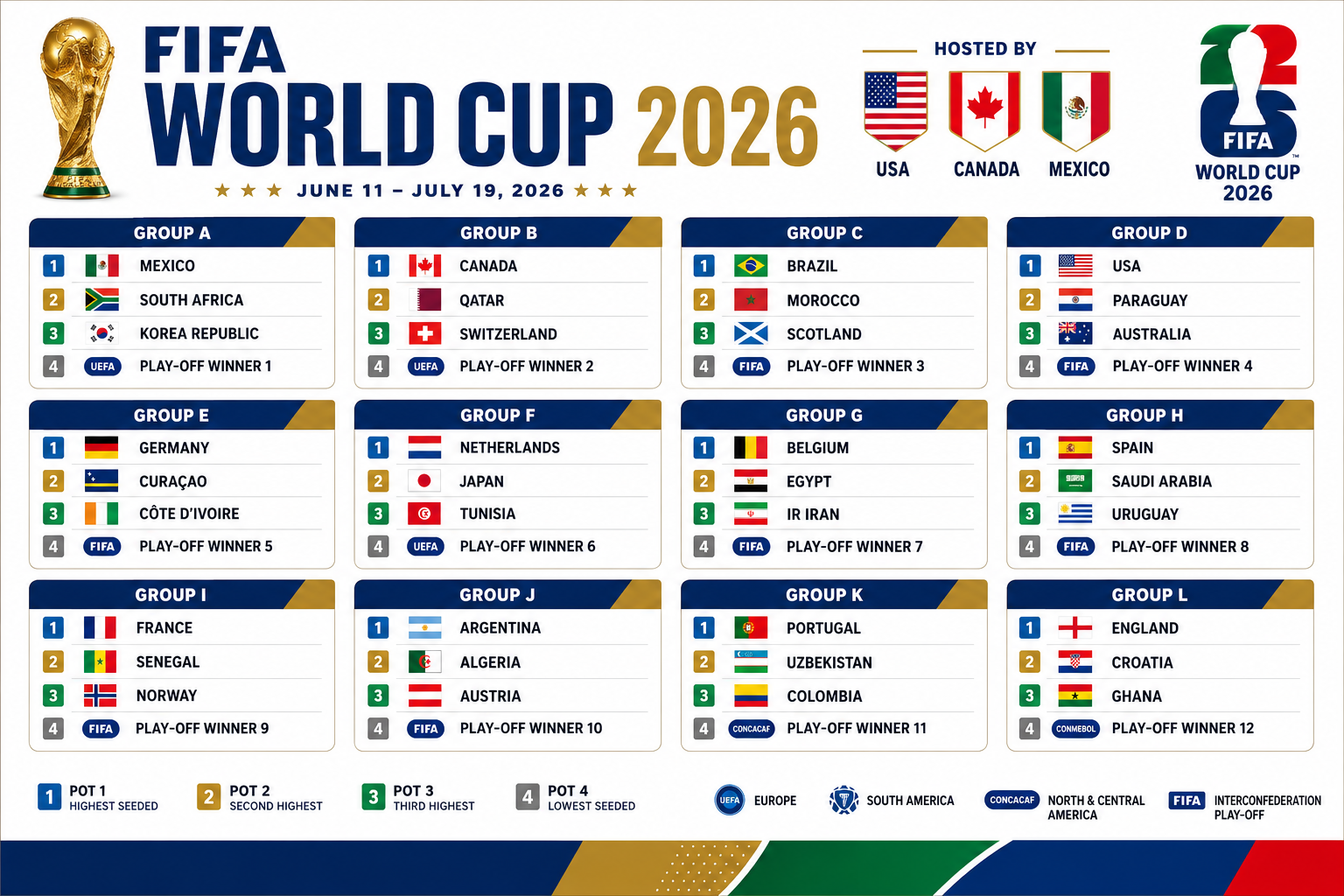
All 48 qualified nations are distributed across Groups A through L. The full group compositions were confirmed at the official draw ceremony. Below is an overview of the group structure by region, reflecting the broad geographic spread FIFA designed into the 2026 World Cup groups.
Groups include teams from:
- Europe: France, Spain, England, Germany, Portugal, Netherlands, Belgium, Italy, and others
- South America: Brazil, Argentina, Uruguay, Colombia, Ecuador, and Chile
- Africa: Morocco, Senegal, Nigeria, Cameroon, Egypt, and others
- Asia: Japan, South Korea, Saudi Arabia, Iran, Australia, and others
- CONCACAF: USA, Mexico, Canada, and additional qualifiers
- Oceania: New Zealand (via playoff)
For the exact, confirmed group-by-group team list, the official FIFA website (fifa.com) publishes the live standings and full draw results.
Which Group Looks the Toughest in World Cup 2026?
Any group containing two or more top-10 FIFA-ranked nations alongside a strong third team qualifies as a “group of death.” Based on the draw results and current rankings, several groups stand out as particularly brutal for the teams involved.
Groups featuring combinations such as Brazil + a strong European side, or Argentina paired with a top African qualifier, have drawn the most attention from analysts. The presence of 12 groups (versus the old 8) actually reduces the chance of extreme concentration, but it doesn’t eliminate it.
What makes a group tough:
- Two or more Pot 1/Pot 2 caliber teams
- A dangerous third-place team with recent tournament form
- High-stakes geopolitical or historical rivalries that raise pressure
The “toughest group” label is partly subjective, but groups where all three advancing spots are genuinely contested are the ones worth watching from Matchday 1.
Which North American Teams Made It Into the Groups?
All three host nations — the United States, Canada, and Mexico — qualified automatically for the 2026 World Cup and were placed into separate groups as part of the seeding rules. No two host nations can be drawn into the same group.
- USA enters as CONCACAF’s highest-ranked side and is seeded in Pot 1.
- Mexico brings its record of qualifying for every World Cup since 1994 and is a Pot 1 seed.
- Canada qualifies for its second consecutive World Cup after breaking a 36-year absence in 2022.
Beyond the three hosts, additional CONCACAF nations qualified through the regional qualifying process, filling out the confederation’s 6-team allocation.
Are There Any Surprise Teams in the World Cup 2026 Groups?
Yes. Every World Cup cycle produces first-time or rare qualifiers, and 2026 is no different. The expanded 48-team format opened additional spots, particularly for AFC and CAF confederations, which allowed nations with less World Cup history to break through.
Notable storylines for 2026:
- Several African nations qualified for the first time or for only the second time in their history.
- Smaller Asian football nations used the expanded AFC allocation (8 spots) to reach their first or second World Cup.
- Oceania’s representative adds a team that rarely appears at the global stage.
Surprise teams tend to be grouped with stronger nations, which creates entertaining mismatches but also genuine upset potential, especially in a format where one win can secure third place and possible advancement.
What Happens If Teams Tie in Points in World Cup 2026 Groups?
When two or more teams finish level on points in the World Cup 2026 groups, FIFA applies a strict tiebreaker sequence. This is identical to the system used in recent World Cups.
FIFA tiebreaker order:
- Goal difference (goals scored minus goals conceded)
- Total goals scored
- Head-to-head points between the tied teams
- Head-to-head goal difference between the tied teams
- Head-to-head goals scored between the tied teams
- Fair play points (yellow and red card accumulation)
- Drawing of lots (random selection)
Common mistake: Many fans assume head-to-head record comes first. It doesn’t. Goal difference across all group games is the first separator, which means a team can beat a rival directly but still finish below them if their other results were poor.
How Do Teams Advance From Groups in World Cup 2026?
Teams advance from the World Cup 2026 groups by finishing in the top two of their group, or by being one of the four best third-place finishers across all 12 groups.
Step-by-step advancement path:
- Play all 3 group matches
- Accumulate points (W=3, D=1, L=0)
- Finish 1st or 2nd: automatic Round of 32 berth
- Finish 3rd: wait for all 12 groups to complete, then compare all third-place records
- The 4 best third-place teams (by points, then tiebreakers) advance
- Finish 4th: eliminated
The Round of 32 then proceeds as a straight knockout bracket through to the final.
What Are the Potential Knockout Stage Matchups Based on the 2026 Groups?
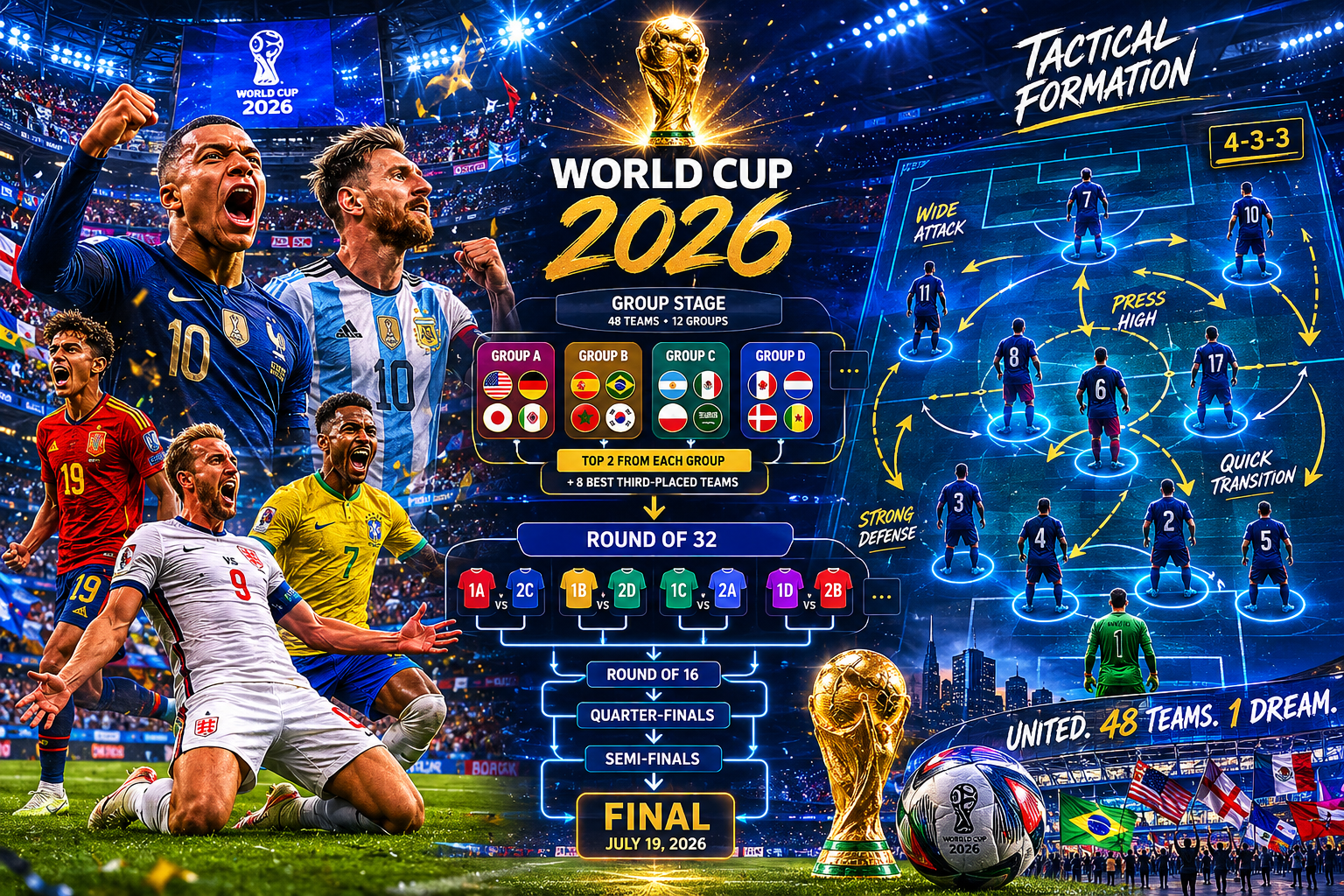
The Round of 32 bracket is pre-determined based on group finishing positions. FIFA publishes the official bracket key showing which group winners play which runners-up. This means the potential quarterfinal and semifinal paths can be mapped out before the tournament even starts.
General bracket logic:
- Group A winner typically plays Group B runner-up
- Third-place teams are slotted into specific bracket positions based on which groups they came from
- The bracket is designed so host nations can potentially meet only in later rounds
For fans planning viewing schedules, the FIFA website and major sports broadcasters publish the full knockout bracket map alongside the group draw results.
Can I See the Full Group Stage Schedule?
Yes. The full match schedule for the World Cup 2026 group stage is available on FIFA’s official website (fifa.com) and through broadcast partners including FOX Sports (USA), BBC and ITV (UK), and TSN (Canada).
Key group stage dates:
- Opening match: June 11, 2026
- Group stage concludes: July 2, 2026
- Round of 32 begins: July 4, 2026
Matches are spread across 16 cities, including New York/New Jersey, Los Angeles, Dallas, Miami, Atlanta, Seattle, San Francisco, Kansas City, Houston, Philadelphia, Boston, Vancouver, Toronto, Guadalajara, Mexico City, and Monterrey.
FAQ: World Cup 2026 Groups
Q: How many groups are there in World Cup 2026? There are 12 groups (A through L), each containing 4 teams, for a total of 48 participating nations.
Q: How many teams advance from each group? The top 2 teams from each group advance automatically. Additionally, the 4 best third-place finishers across all 12 groups also advance, for a total of 28 teams reaching the Round of 32.
Q: When was the World Cup 2026 group draw held? The official group draw was held in Miami, Florida, in December 2025, hosted by FIFA at a ceremony broadcast globally.
Q: Can a team qualify from third place? Yes. Four of the 12 third-place teams advance based on their points and goal difference compared to all other third-place finishers.
Q: Are host nations seeded in the draw? Yes. The USA, Canada, and Mexico were all placed in Pot 1 as automatic seeds and were guaranteed to be in separate groups.
Q: What happens if a match ends in a draw during the group stage? Both teams receive 1 point each. There is no extra time or penalty shootout during the group stage — draws are a valid result.
Q: Which confederation has the most teams in the 2026 World Cup? UEFA (Europe) has the largest allocation with 16 teams, reflecting European football’s depth and FIFA ranking strength.
Q: How is the “best third-place team” determined? By comparing all 12 third-place teams on points first, then goal difference, then goals scored, then fair play record, and finally drawing of lots if still level.
Q: Where can I watch World Cup 2026 group stage matches? In the USA: FOX Sports and Telemundo. In the UK: BBC and ITV. In Canada: TSN and CTV. Check your local broadcaster for regional rights.
Q: How many matches are played in the group stage total? Each group plays 6 matches (every team plays the other 3 once). With 12 groups, that’s 72 total group stage matches.
Conclusion
The World Cup 2026 groups represent the most ambitious group stage in FIFA history, with 48 nations, 12 groups, and a new advancement format that keeps more teams alive longer. For football fans, this means more meaningful matches, more potential upsets, and a broader global representation than any previous tournament.
Actionable next steps for fans:
- Bookmark the official FIFA website (fifa.com) for live standings, confirmed lineups, and real-time group table updates.
- Map your viewing schedule using the group stage dates (June 11 to July 2, 2026) and your local broadcaster’s match listings.
- Understand the tiebreaker rules before the final matchday in each group — goal difference, not head-to-head, is the first separator.
- Watch the third-place race across all 12 groups on the final matchday, as 4 additional spots are still up for grabs.
- Follow CONCACAF teams closely — with three host nations and additional qualifiers, North American football has its biggest World Cup stage yet.
The 2026 group stage is where legends are made and giants fall. Knowing how the system works gives every fan a sharper lens for what’s at stake in every single match.
References
- FIFA. (2023). 2026 FIFA World Cup format and qualification. Retrieved from https://www.fifa.com/worldcup/2026
- FIFA. (2025). Official group draw results — 2026 FIFA World Cup. Retrieved from https://www.fifa.com
- The Athletic. (2025). World Cup 2026 group draw analysis and reaction. The Athletic.
- BBC Sport. (2025). FIFA World Cup 2026: Everything you need to know. Retrieved from https://www.bbc.com/sport/football