Last updated: May 21, 2026
Quick Answer: World Cup football is FIFA’s flagship international tournament, held every four years, where national teams from across the globe compete for the sport’s most coveted prize. It’s the most-watched sporting event on the planet, drawing billions of viewers per cycle and featuring 48 teams (as of the 2026 format). Qualification, group stages, and knockout rounds determine the champion over roughly a month of intense competition.
Key Takeaways 🏆
- The FIFA World Cup runs every four years and now features 48 national teams starting with the 2026 edition
- Teams must qualify through continental competitions — no team gets an automatic spot except the host nation(s)
- Brazil leads all nations with five World Cup titles; Germany and Italy each have four
- Ticket prices for World Cup matches range from roughly $100 to $1,000+ depending on the round and seat category
- Injuries during the tournament are managed by team medical staff; FIFA sets strict squad replacement rules
- Referees use VAR (Video Assistant Referee) technology to review controversial calls
- Weather and climate can significantly affect team performance, especially for nations unused to heat or altitude
- Smaller nations have reached the semi-finals but no team outside the traditional powerhouses has ever won the title
- Common team mistakes include over-relying on one star player and poor squad depth management
- The World Cup is strictly for professional international players — amateur players do not compete
What Exactly Is the World Cup and How Does It Work?
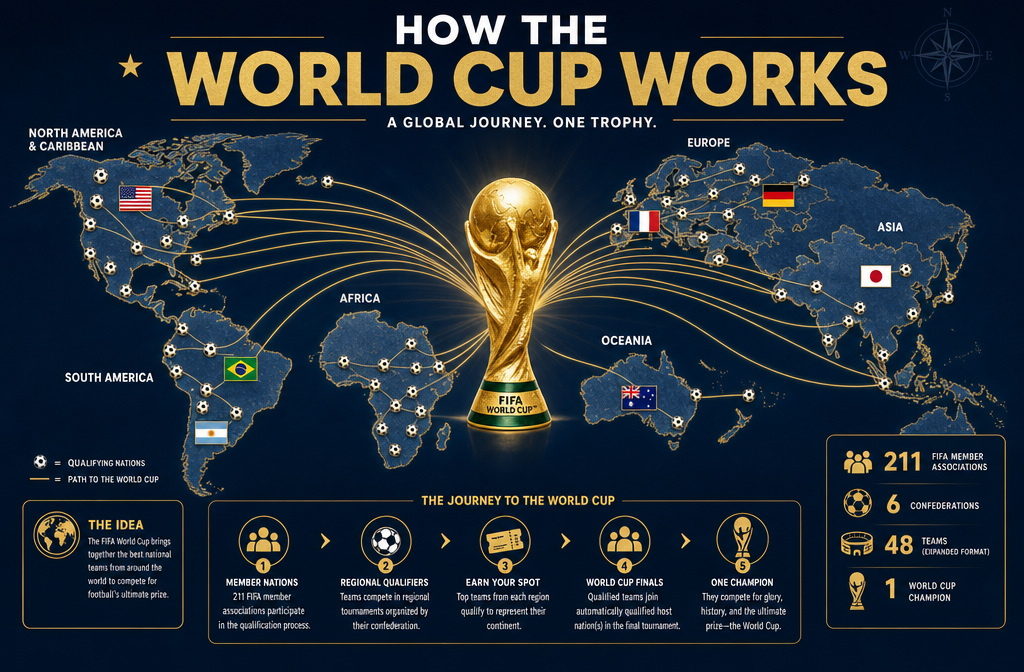
World Cup football is FIFA’s premier international competition, where men’s national teams battle across a structured tournament to be crowned world champions. The format includes a group stage followed by knockout rounds, culminating in a single final match.
Here’s how the 2026 format breaks down:
- 48 teams divided into 12 groups of four
- Top two teams from each group, plus eight best third-place finishers, advance to a 32-team knockout round
- From there: Round of 32, Round of 16, Quarter-finals, Semi-finals, Third-place playoff, and the Final
- The entire tournament spans approximately 39 days
The host nation qualifies automatically. All other spots are earned through regional qualifying campaigns that can last two years or more.
How Is World Cup Football Different from Other Soccer Tournaments?
The World Cup stands apart from club tournaments like the UEFA Champions League or regional competitions like the Copa América because it pits national teams against each other — not clubs. Players who are rivals at club level become teammates for their country.
Key differences at a glance:
| Feature | World Cup | Champions League | Copa América |
|---|---|---|---|
| Teams | National sides | Club teams | South American nations |
| Frequency | Every 4 years | Annual | Every 4 years |
| Global reach | All confederations | Mainly Europe | South America |
| Prize | Jules Rimet Trophy | UEFA trophy | Copa América trophy |
| Viewership | Billions globally | Hundreds of millions | Regional focus |
The prestige gap is enormous. Winning the World Cup is widely considered the peak achievement in football, above any club trophy.
How Much Does It Cost to Attend a World Cup Match?
Attending World Cup football in person is expensive but not impossible for dedicated fans. FIFA releases tickets in tiered categories based on seat location and match importance.
Rough price ranges (estimates based on historical tournament data):
- Group stage matches: $100–$400 per ticket
- Round of 16 / Quarter-finals: $250–$600
- Semi-finals: $400–$800
- Final: $600–$1,500+ (official price); resale market can exceed $5,000
Beyond tickets, fans also need to budget for:
- Flights and accommodation (prices spike significantly in host cities during the tournament)
- Fan ID or tournament passes required in some host nations
- Local transport between venues if attending multiple games
💡 Tip: Buy directly from FIFA’s official ticketing portal. Third-party resellers carry a high risk of fraud and inflated prices.
Which Countries Are Best at Winning World Cup Tournaments?
A handful of nations dominate the World Cup trophy cabinet. Brazil is the most successful nation in World Cup football history, with five titles. The full winners list by title count:
- 🇧🇷 Brazil — 5 titles
- 🇩🇪 Germany — 4 titles
- 🇮🇹 Italy — 4 titles
- 🇦🇷 Argentina — 3 titles
- 🇫🇷 France — 2 titles
- 🏴 England, 🇺🇾 Uruguay, 🇪🇸 Spain — 1 title each
South American and European nations have shared every single title in World Cup history. No team from Africa, Asia, or North America has ever won.
How Do Countries Qualify to Play in the World Cup?
Every nation except the host(s) must earn their place through FIFA’s continental qualifying system. Qualification for World Cup football is a grueling, multi-year process.
The six FIFA confederations each receive a set number of spots:
- UEFA (Europe): ~16 spots
- CONMEBOL (South America): ~6 spots
- CAF (Africa): ~9 spots
- AFC (Asia): ~8 spots
- CONCACAF (North/Central America & Caribbean): ~6 spots
- OFC (Oceania): ~1 spot (often via playoff)
Some confederations use league-style qualifying rounds; others use knockout formats. The final spots are often decided by inter-confederation playoffs, where teams from different regions face off in single-leg or two-leg ties.
Why Do Some Teams Always Seem to Struggle in World Cup Football?
Some nations consistently underperform at the World Cup despite strong domestic leagues. The main reasons come down to squad depth, tactical preparation, and tournament experience.
Common structural issues:
- Small talent pool: Smaller nations have fewer elite players to rotate, so injuries hit harder
- Weak qualifying competition: Some regions have weaker opponents in qualifying, leaving teams underprepared for the World Cup’s intensity
- Mental pressure: Players who thrive at club level sometimes freeze in the high-stakes international environment
- Coaching continuity: Nations that frequently change managers struggle to build a consistent system
Choose this explanation if… a team has strong individual players but keeps exiting early — it’s usually a squad depth or tactical system problem, not a talent shortage.
What Are Common Mistakes Teams Make in World Cup Strategy?
World Cup football punishes poor planning quickly. Teams that go deep in the tournament tend to avoid these recurring errors:
- Over-relying on one star player: If that player gets injured or marked out of the game, the team has no plan B
- Ignoring squad rotation: Playing the same XI every game leads to fatigue by the knockout rounds
- Defensive naivety in knockout games: Teams that play open football without a solid defensive structure get exposed
- Underestimating group stage opponents: Upsets happen constantly in the group stage when favorites don’t take weaker teams seriously
- Poor set-piece preparation: A significant portion of World Cup goals come from set pieces; teams that neglect this lose cheap goals
What Are the Biggest Upsets in World Cup History?
World Cup football has produced some genuinely shocking results over the decades. These aren’t flukes — they reveal how any well-organized team can beat a bigger nation on a given day.
Notable upsets include:
- USA 1–0 England (1950): One of the biggest shocks ever, with the Americans defeating the inventors of the game
- Senegal 1–0 France (2002): Defending champions France knocked out by a Senegal side in their first World Cup
- Germany 0–2 South Korea (2018): The defending champions eliminated in the group stage
- Saudi Arabia 2–1 Argentina (2022): Argentina, eventual champions, lost their opening group game
These results prove that the World Cup’s single-game knockout format is a great equalizer.
Can Smaller Countries Actually Win the World Cup Championship?
No smaller nation has ever won the World Cup, but several have come remarkably close. Croatia reached the final in 2018 with a population of under 4 million. Morocco reached the semi-finals in 2022, becoming the first African nation to do so.
What smaller nations need to compete deep in the tournament:
- A generational talent (or group of talents) peaking at the right time
- A tactically disciplined coach with a clear defensive structure
- Tournament experience built over multiple World Cup cycles
- Some favorable bracket luck in the knockout rounds
The gap is closing, but the financial and infrastructure advantages of traditional powerhouses remain significant.
What Happens If a Player Gets Injured During World Cup Play?
FIFA allows teams to replace injured players under specific conditions. Since the 2022 tournament, squads have been expanded to 26 players, giving coaches more depth to manage injuries.
Key rules:
- Before the tournament starts: Injured players can be replaced if a doctor certifies the injury before the team’s first match
- During the tournament: Once the tournament begins, injured players generally cannot be replaced in the squad
- On the pitch: Standard substitution rules apply (up to five per game in regular time)
- Concussion protocols: FIFA has introduced concussion substitutes that don’t count against the team’s regular substitution allowance
Serious injuries during the knockout rounds are devastating because squad replacements are not permitted mid-tournament.
How Do World Cup Referees Handle Controversial Calls?
Referees in World Cup football now have access to VAR (Video Assistant Referee) technology, which allows officials to review key decisions. VAR was introduced at the 2018 World Cup and has been used in every tournament since.
VAR can be used to review:
- Goals (offside, handball, foul in the build-up)
- Penalty decisions
- Direct red card incidents
- Mistaken identity (wrong player carded)
The on-field referee makes the final call after consulting the VAR team. Controversial decisions still happen — VAR doesn’t eliminate human judgment, it just adds a review layer. Offside calls in particular remain contentious because millimeter margins can rule out legitimate-looking goals.
How Does Weather Impact World Cup Tournament Performance?
Weather is a genuine competitive factor in World Cup football, particularly when tournaments are held in extreme climates. The 2022 Qatar World Cup was moved to November–December specifically to avoid summer heat that could endanger players.
Key weather effects:
- Heat and humidity: Increases fatigue, raises injury risk, and favors teams from warm-climate nations
- Altitude: High-altitude venues (common in South American qualifiers) reduce oxygen availability, slowing players from sea-level nations
- Cold and rain: Affects pitch conditions and can neutralize technically superior teams by turning games into physical battles
- Wind: Impacts long-range shooting and set-piece delivery
Teams that prepare by training in similar conditions weeks before the tournament tend to adapt better. Acclimatization camps are now standard practice for well-funded football federations.
Is the World Cup for Amateur or Professional Players?
The World Cup is exclusively for professional international players. There is no amateur pathway to the FIFA World Cup. Players must hold citizenship or eligibility for a national team and be selected by their national federation’s coaching staff.
For amateur players who love the game:
- FIFA World Cup — professional international only
- FIFA Futsal World Cup — professional futsal players
- FIFA Beach Soccer World Cup — semi-professional/professional
- Amateur and grassroots competitions exist at national and regional levels, but are entirely separate from the FIFA World Cup ecosystem
Frequently Asked Questions
How often is the World Cup held? The FIFA World Cup is held every four years. The next men’s edition after 2026 is scheduled for 2030.
How many teams play in the 2026 World Cup? 48 teams compete in the 2026 FIFA World Cup, up from 32 in previous editions.
Who has won the most World Cups? Brazil holds the record with five World Cup titles, followed by Germany and Italy with four each.
Can a player play for two different countries at the World Cup? No. Once a player represents a nation at a senior competitive level, they cannot switch international allegiance for World Cup purposes (with limited exceptions under FIFA eligibility rules).
What is VAR in World Cup football? VAR stands for Video Assistant Referee. It’s a technology system that allows match officials to review key decisions — goals, penalties, red cards, and mistaken identity — using video footage.
How long is a World Cup match? A standard match is 90 minutes (two 45-minute halves). Knockout games that are level after 90 minutes go to 30 minutes of extra time, then a penalty shootout if still tied.
What happens to the host country if they lose early? The host nation is eliminated like any other team. They do not receive special treatment beyond automatic qualification.
How are World Cup referees selected? FIFA appoints referees through its Referees Committee, selecting officials from a global pool based on performance in their domestic leagues and international experience.
What is the FIFA World Cup trophy made of? The current FIFA World Cup trophy is made of 18-carat gold with a malachite base. It weighs approximately 6.1 kilograms.
Do players get paid for playing in the World Cup? Players don’t receive direct payment from FIFA, but FIFA distributes prize money to the national football associations, which may pass bonuses on to players according to their own agreements.
Conclusion
World Cup football is the sport at its most intense, most unpredictable, and most globally connected. Whether you’re tracking qualification campaigns, planning to attend a match, or just trying to understand why your favorite nation keeps bowing out in the group stage, knowing how the tournament works makes every game more meaningful.
Actionable next steps for football fans in 2026:
- Check FIFA’s official site for the 2026 tournament schedule, host cities, and ticketing information
- Follow your nation’s qualifying journey through their continental confederation
- Learn the VAR rules so controversial calls make sense in real time
- Budget early if you’re planning to attend — accommodation and flights sell out fast in host cities
- Watch the group stage closely — that’s where the biggest upsets and surprises almost always happen
The World Cup only comes around every four years. Don’t just watch it — understand it.
Meta Title: World Cup Football: The Complete Fan Guide (2026)
Meta Description: Everything football fans need to know about World Cup football in 2026 — how it works, which nations dominate, costs to attend, upsets, VAR rules, and more.