Last updated: May 25, 2026
Quick Answer: Iraq has qualified for the FIFA World Cup just once, in 1986, where they lost all three group-stage matches. Despite that single appearance, Iraqi football has a passionate fanbase and a team that competes seriously in Asian football. As of 2026, Iraq has not returned to the World Cup but remains one of the more competitive sides in the AFC.
Key Takeaways
- 🏆 Iraq qualified for the 1986 FIFA World Cup in Mexico — their only appearance to date.
- 🌍 Iraq is ranked among the top football nations in the Middle East, regularly competing with Saudi Arabia, Iran, and Qatar.
- ⚽ Football is by far the most popular sport in Iraq, cutting across age groups and regions.
- 🏟️ Political instability and infrastructure damage have significantly slowed the development of Iraqi football.
- 💰 Most Iraqi national team players earn modest wages compared to European counterparts, though some play in well-paying Gulf leagues.
- 🎯 Iraq has won the AFC Asian Cup once, in 2007, which remains their biggest international achievement.
- 📉 Tactical inconsistency and player development gaps are the biggest on-field challenges for the national team.
- 🧒 Youth interest in football is extremely high in Iraq, with kids playing in streets and informal pitches across the country.
Has Iraq Ever Qualified for the World Cup?
Yes — Iraq has qualified for the FIFA World Cup exactly once. That was the 1986 World Cup in Mexico, making Iraq one of only a handful of Arab nations to reach the tournament at that time. Qualifying was a massive achievement for Iraqi football, coming during a period when the country was also dealing with the Iran-Iraq War.
At the tournament, Iraq was placed in Group B alongside Belgium, Paraguay, and Mexico (the host nation). They lost all three matches and were eliminated in the group stage. The results were tough, but just being there was historic.
Common mistake: Many fans assume Iraq has never been to a World Cup. That’s wrong. The 1986 qualification is a real and celebrated milestone in Iraqi football history.
How Many Times Has Iraq Played in World Cup Tournaments?
Iraq has played in one World Cup tournament — the 1986 edition in Mexico. They played three group-stage matches and lost all three.
| Match | Opponent | Score |
|---|---|---|
| Group Stage | Paraguay | 1–0 loss |
| Group Stage | Belgium | 2–1 loss |
| Group Stage | Mexico | 1–0 loss |
That’s three World Cup matches total, with zero wins and zero draws. It’s a short record, but it’s real history. Since 1986, Iraq has come close in qualifying rounds several times but has not made it back to the main tournament.
What Are Iraq’s Best World Cup and International Performances?
Iraq’s best international achievement isn’t actually at the World Cup — it’s the 2007 AFC Asian Cup, which they won on home soil (the tournament was held across four Asian nations). That title remains the high point of Iraqi football and came during an incredibly difficult period for the country.
Top Iraqi football achievements:
- 🥇 AFC Asian Cup winners: 2007
- 🌍 FIFA World Cup appearance: 1986
- 🏅 Multiple Gulf Cup of Nations titles
- 🔄 Consistent top-four finishes in AFC qualifying rounds
The 2007 Asian Cup win was especially emotional. Iraq beat Saudi Arabia in the final, and celebrations broke out across the country despite ongoing conflict. It showed just how much football means to the Iraqi people.
How Good Is Iraq’s National Soccer Team Compared to Other Middle Eastern Teams?
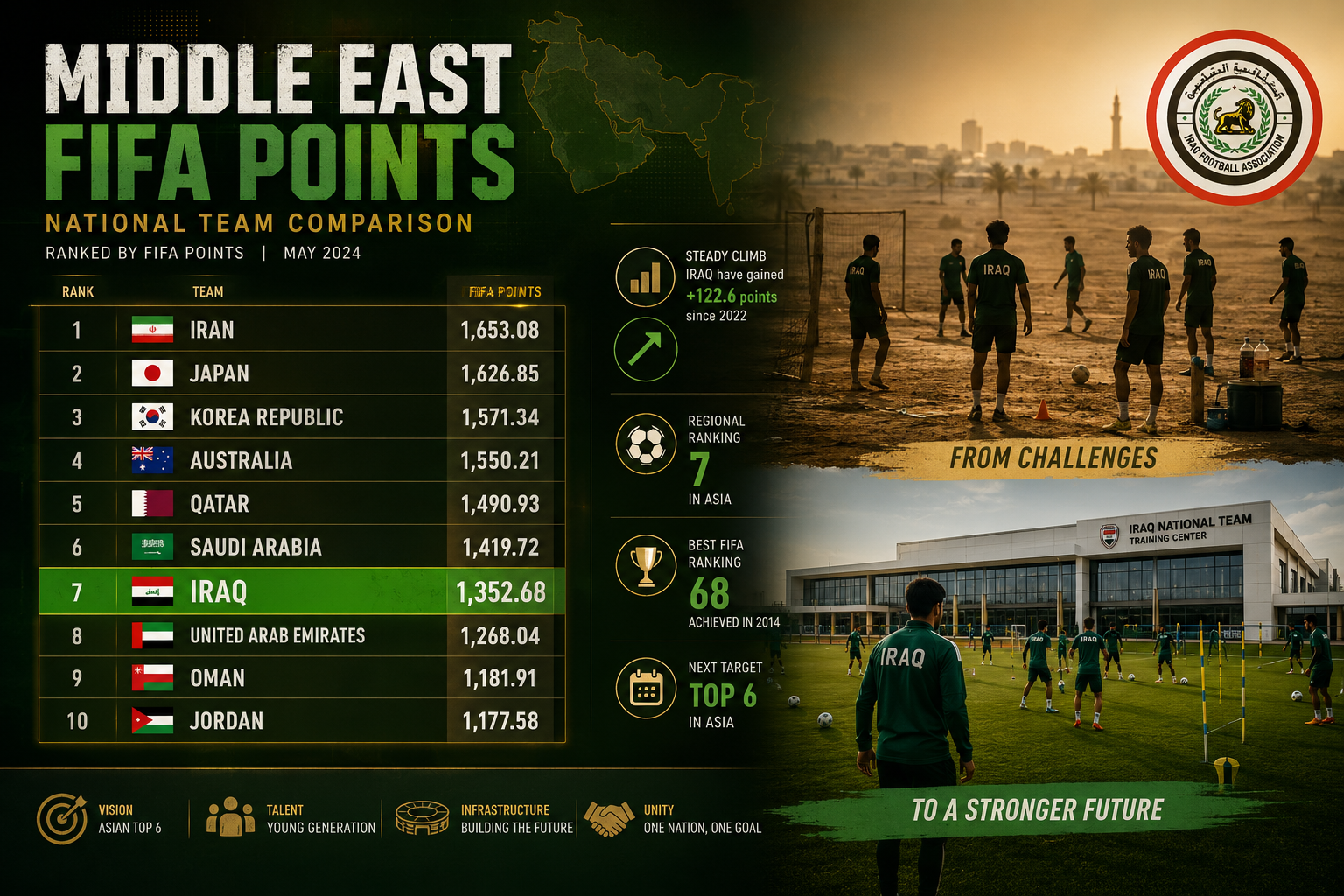
Iraq is consistently one of the top three or four football nations in the Middle East, competing closely with Iran, Saudi Arabia, and Qatar. In AFC rankings, Iraq typically sits in the upper tier of Asian football.
How Iraq compares regionally (general tier grouping):
- Tier 1 (strongest): Iran, Japan, South Korea, Australia
- Tier 2 (competitive): Saudi Arabia, Iraq, Qatar, UAE
- Tier 3: Jordan, Bahrain, Oman
Iraq tends to punch above its weight given the structural challenges it faces. The national team has beaten Saudi Arabia and Iran in competitive matches, which is no small feat. The biggest gap between Iraq and the top Asian teams is in squad depth and professional development pathways.
Which Players from Iraq Have Played in Major International Leagues?
A small but growing number of Iraqi players have made it to professional leagues outside the Middle East. Most Iraqi players compete in the Iraqi Premier League or Gulf leagues (Saudi Arabia, UAE, Qatar), which are well-funded but not considered top-five global leagues.
Notable Iraqi players with international experience:
- Younis Mahmoud — Iraq’s 2007 Asian Cup hero, played in Qatar and Thailand
- Nashat Akram — Competed in the Austrian Bundesliga with Austria Wien
- Ahmed Yasin — Has played in Belgium and the UAE
- Amjad Attwan — Active in Gulf club football
The path to European football remains difficult for Iraqi players. Visa issues, lack of agent connections, and limited scouting infrastructure all play a role. A few players of Iraqi descent have represented other nations (like Germany or Sweden), which also reduces the talent pool available to the Iraqi national team.
How Much Money Do Iraq National Team Players Earn?
Most Iraqi national team players earn significantly less than their counterparts in top European leagues. Players in the Iraqi Premier League earn an estimated $1,000–$5,000 per month on average (these are general estimates based on regional football salary reporting, not verified official figures). Players who move to Gulf leagues can earn considerably more — sometimes $10,000–$30,000 per month depending on the club and their profile.
Salary tiers for Iraqi footballers (estimated ranges):
- Iraqi Premier League: Low to moderate wages, often supplemented by bonuses
- Gulf leagues (Saudi, UAE, Qatar): Moderate to high wages
- European leagues: Rare, but those who make it earn significantly more
The national team itself pays appearance fees and bonuses for qualifying matches, but these are not public figures. Compared to players from Saudi Arabia or Qatar — where domestic leagues are heavily funded — Iraqi players generally earn less.
What Are the Challenges for Iraq’s Soccer Program?
Iraq’s football program faces a combination of political, infrastructural, and financial challenges that have held it back for decades. These aren’t excuses — they’re real, documented barriers that any serious football fan should understand.
Key challenges:
- Infrastructure damage: Decades of conflict have left many stadiums and training facilities in poor condition.
- Political interference: FIFA has previously suspended Iraq’s football federation due to government interference in football administration.
- Brain drain: Players of Iraqi descent often choose to represent other nations where they’ve grown up.
- Funding gaps: The Iraqi Football Association has limited resources compared to Gulf rivals.
- Safety concerns: Hosting international matches in Iraq has been complicated by security situations, forcing some “home” games to be played in neutral countries.
How Do Political Conflicts Impact Iraq’s Soccer Development?
Political instability has directly disrupted Iraqi football at nearly every level. FIFA actually suspended Iraq from international competition in 2009 due to government interference in the football federation — a serious sanction that cost the team valuable competitive matches.
Beyond federation politics, the broader conflict environment has:
- Forced players to train in substandard or makeshift facilities
- Made it harder to attract foreign coaches and scouts
- Disrupted youth academies and school football programs
- Created an unpredictable environment for long-term planning
Despite all of this, Iraqi football has shown remarkable resilience. The 2007 Asian Cup win happened during one of the most violent periods in modern Iraqi history, which makes it even more extraordinary.
What Are the Typical Training Conditions for Iraq’s National Soccer Team?
Training conditions for Iraq’s national team are improving but still inconsistent. The team often trains at facilities in Baghdad, but the quality of pitches, equipment, and sports science support lags behind what top Asian teams have access to.
For major tournaments, Iraq’s federation sometimes arranges training camps in countries with better infrastructure — Jordan, UAE, or Turkey — to give players access to higher-quality preparation environments. This is a practical workaround but adds logistical complexity and cost.
What’s improving:
- New stadium projects have been announced and partially completed
- Gulf-based Iraqi players bring back professional training habits
- Foreign coaching appointments have introduced more structured methods
Why Doesn’t Iraq Win More World Cup Matches (or Qualify More Often)?
Iraq hasn’t returned to the World Cup since 1986 for a mix of reasons: squad depth, political disruptions, and the sheer competitiveness of Asian qualifying. The AFC qualification process is genuinely tough — Asia gets a limited number of World Cup spots, and Iraq competes against powerhouses like Japan, South Korea, Iran, and Australia.
Biggest on-field mistakes and patterns:
- Defensive lapses in high-pressure qualifying matches
- Over-reliance on a small core of experienced players
- Inconsistent performances at home vs. away
- Tactical rigidity against technically superior opponents
The team has come close in qualifying. In recent cycles, Iraq has reached the final or penultimate qualifying rounds before falling short. The gap isn’t enormous — it’s often a handful of points or a single bad result.
Is Soccer Popular in Iraq, and Which Age Groups Are Most Interested?
Football is the dominant sport in Iraq by a wide margin. It’s played in streets, on dirt pitches, in schools, and watched obsessively on television. The sport cuts across ethnic and religious lines in a way few other things do in Iraqi society.
Who’s most into it:
- Youth (ages 8–18): Extremely high participation in informal football. Many kids grow up idolizing both Iraqi players and European stars.
- Young adults (18–35): The core fanbase for the national team and European club football. Iraqi fans follow the Premier League, La Liga, and Champions League closely.
- Older fans (35+): Often deeply connected to the 1986 World Cup era and the 2007 Asian Cup triumph.
Social media has supercharged football culture among younger Iraqis. Clips of national team matches, debates about tactics, and fan content are all over Iraqi social platforms.
FAQ: World Cup Iraq
Has Iraq ever won a World Cup match? No. Iraq played three matches at the 1986 World Cup and lost all three. They have not returned to the tournament since.
When did Iraq qualify for the World Cup? Iraq qualified for the 1986 FIFA World Cup in Mexico. It remains their only World Cup appearance.
What is Iraq’s biggest football achievement? Winning the 2007 AFC Asian Cup. Iraq beat Saudi Arabia in the final, and it’s considered one of the most emotional moments in the country’s sporting history.
Is Iraq in FIFA? Yes, Iraq is a full FIFA member and competes in AFC (Asian Football Confederation) qualifying.
Has FIFA ever banned Iraq? Yes. FIFA suspended Iraq in 2009 due to government interference in the national football federation. The ban was eventually lifted.
Who is Iraq’s most famous footballer? Younis Mahmoud is widely considered Iraq’s most iconic modern player, famous for scoring the winning goal in the 2007 Asian Cup final.
Can Iraq qualify for the 2026 World Cup? Iraq competed in the AFC qualifying rounds for the 2026 World Cup but did not secure a direct qualification spot. The 2026 tournament (USA, Canada, Mexico) expanded to 48 teams, giving Asia more spots — but Iraq ultimately fell short.
Why do some Iraqi players represent other countries? Players born in Iraq but raised abroad (Germany, Sweden, Denmark, etc.) sometimes choose to represent their country of residence. This is legal under FIFA rules and reduces the talent available to Iraq.
How many times has Iraq reached the AFC Asian Cup final? Iraq has won the Asian Cup once (2007) and reached the final on that occasion. They’ve also been competitive in other editions without winning.
What league do most Iraqi players play in? Most Iraqi national team players compete in the Iraqi Premier League or Gulf leagues (Saudi Arabia, UAE, Qatar).
Conclusion
The story of World Cup Iraq is one of resilience, passion, and unrealized potential. One World Cup appearance, one Asian Cup title, and decades of football culture that has survived wars, sanctions, and political chaos — that’s a remarkable record for any football nation.
For fans watching Iraqi football in 2026, here’s what to focus on:
- Follow the Iraqi Premier League to spot emerging talent before they hit the national team radar.
- Watch AFC qualifying matches — Iraq is always competitive and games against Iran, Saudi Arabia, and South Korea are must-watch.
- Learn the 2007 Asian Cup story if you haven’t already. It’s one of football’s most moving underdog tales.
- Support calls for better football infrastructure in Iraq — more investment in youth academies and stadiums directly translates to World Cup chances.
Iraqi football has the passion. It has the history. What it needs now is consistency, investment, and a bit of luck in qualifying. The next World Cup appearance may be closer than many people think. ⚽🇮🇶
Meta Title: World Cup Iraq: History, Performances & Future Hopes 2026
Meta Description: Iraq’s only World Cup was in 1986. Discover Iraq’s football history, best performances, player salaries, challenges, and World Cup qualifying chances in 2026.