Last updated: May 25, 2026
Quick Answer: Croatia is one of Europe’s most consistent World Cup nations, having reached the final in 2018 and finished third in both 1998 and 2022. Despite a population of just over four million, Croatia punches well above its weight on the global football stage, producing elite midfielders and technically gifted players generation after generation.
Key Takeaways
- Croatia has appeared in six FIFA World Cups (1998, 2002, 2006, 2014, 2018, 2022) since gaining independence.
- Their best result is runners-up in 2018, when they lost to France in the final.
- Croatia has never won the World Cup, but has finished in the top four twice.
- The iconic red-and-white checkered kit comes from Croatia’s national coat of arms.
- Luka Modrić remains the most decorated Croatian player in history, winning the 2018 Ballon d’Or.
- Croatia consistently excels in central midfield, producing technically elite players.
- Young talents like Joško Gvardiol and Martin Baturina are the next wave to watch.
- Croatia’s squad depth is a known weakness — injuries to key players can significantly affect performance.
- Ticket prices for Croatia World Cup matches vary widely by stage and host nation.
- For new football fans, Croatia is an excellent team to follow because of their attacking style and dramatic tournament runs.
How Many World Cups Has Croatia Played In?
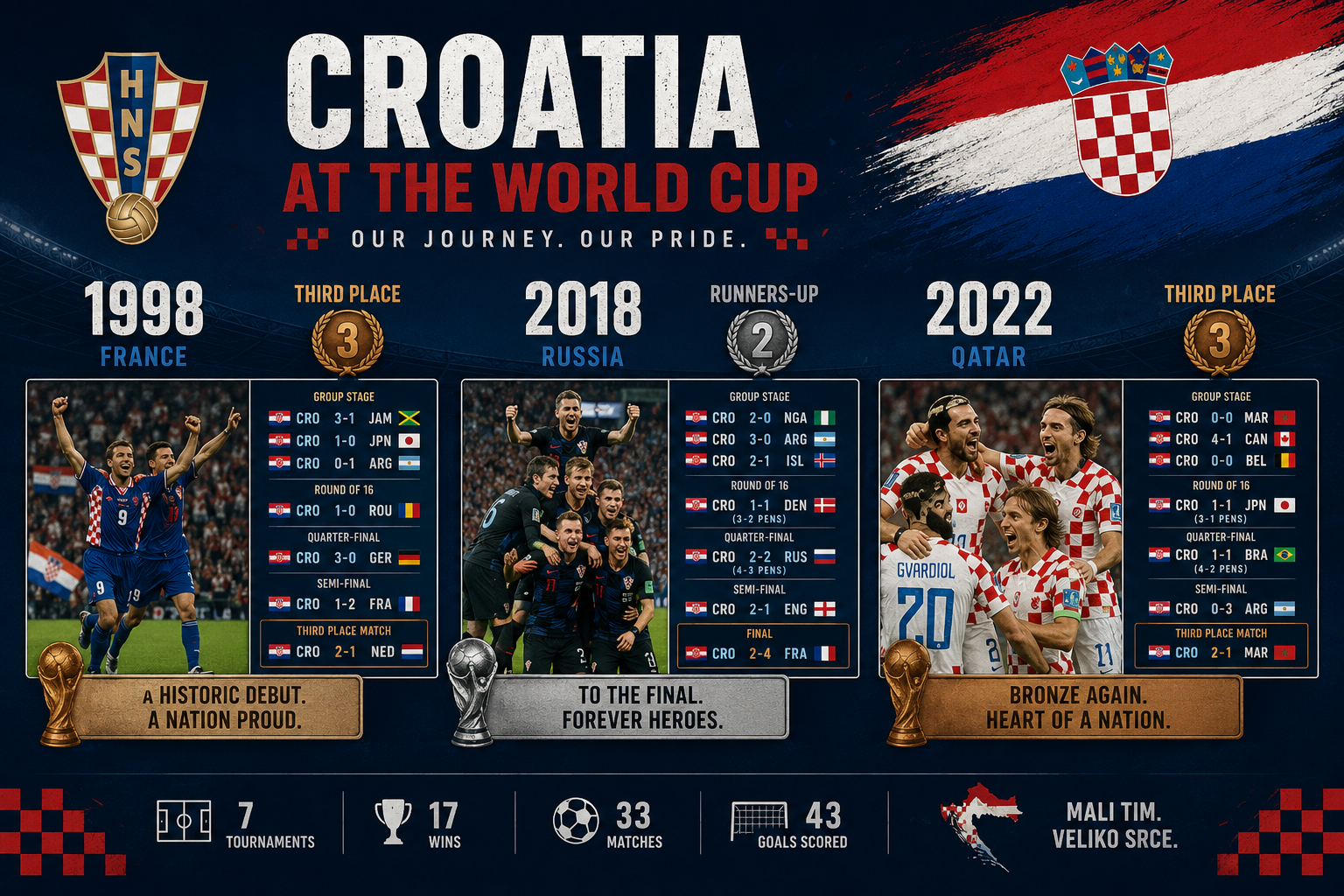
Croatia has competed in six World Cups since first qualifying in 1998. Before that, Croatian players appeared under the Yugoslav national team banner.
Here’s a quick breakdown of every World Cup Croatia has entered:
| Year | Host | Result |
|---|---|---|
| 1998 | France | 3rd Place |
| 2002 | South Korea/Japan | Round of 16 |
| 2006 | Germany | Round of 16 |
| 2014 | Brazil | Group Stage |
| 2018 | Russia | Runners-Up (2nd) |
| 2022 | Qatar | 3rd Place |
Croatia’s record of reaching the knockout rounds in five of six tournaments is genuinely impressive for a nation of its size.
Did Croatia Ever Win the World Cup?
No, Croatia has never won the World Cup. Their closest moment came in 2018 in Russia, where they defeated England in the semi-final before losing 4-2 to France in the final. They did, however, win bronze medals in 1998 and 2022, making them one of only a handful of nations to finish third more than once.
🏆 “Two bronze medals and a silver — Croatia’s World Cup record would be the envy of countries ten times its size.”
What Makes the Croatian National Soccer Team So Good?
Croatia’s success comes down to a combination of a strong football culture, excellent youth development, and an almost freakish ability to produce elite central midfielders.
Key reasons Croatia consistently performs well:
- Football is deeply embedded in Croatian culture. Kids grow up playing the game seriously, and club academies like Dinamo Zagreb have strong development programs.
- Midfield excellence. Croatia has produced Luka Modrić, Ivan Rakitić, and Mateo Kovačić — three world-class central midfielders active in the same era. That’s statistically unusual for any nation.
- Tournament mentality. Croatia has a reputation for performing better as tournaments progress. They won three consecutive extra-time matches at the 2018 World Cup.
- Strong club experience. Most Croatian players compete in top European leagues (La Liga, Premier League, Serie A), giving them elite-level preparation.
Why Are Croatia’s Uniforms Checkered? 🔴⬜
Croatia’s famous red-and-white checkered kit is directly tied to the Croatian coat of arms, which features a traditional checkerboard shield known as the šahovnica. This symbol has represented Croatian identity for centuries, long before the modern nation existed.
The pattern was adopted on the national football jersey when Croatia began competing as an independent nation in the early 1990s. It’s now one of the most recognizable kits in world football — and one of the most popular among collectors.
Who Are the Top Croatian Soccer Players Right Now?
As of 2026, Croatia’s squad blends experienced veterans with exciting younger players.
Current standouts:
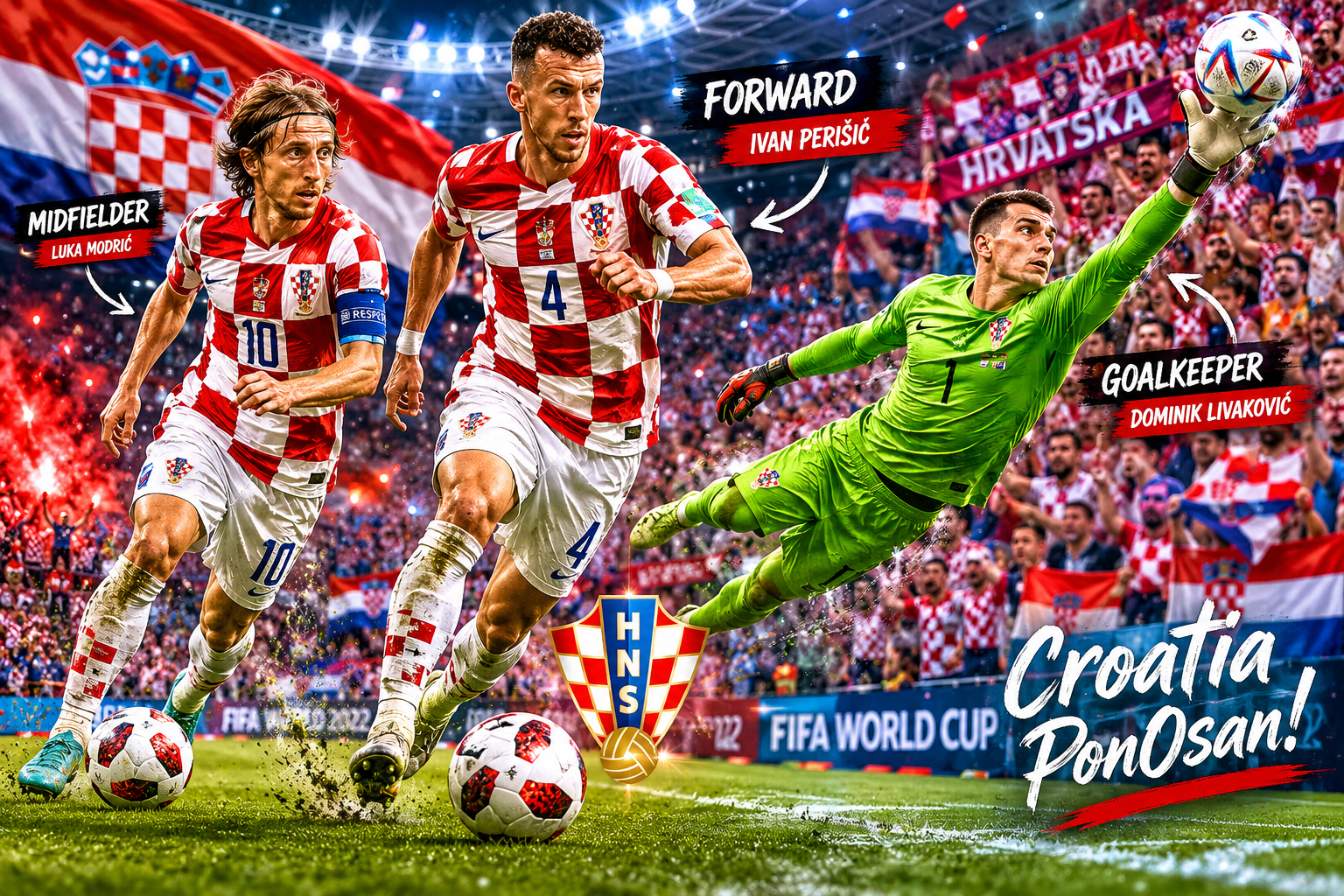
- Luka Modrić — Still the heartbeat of the team, though his international future is uncertain at 40. One of the greatest midfielders ever.
- Joško Gvardiol — The Manchester City centre-back is arguably the best defender in the world under 25.
- Mateo Kovačić — A reliable, technically gifted midfielder who performs consistently at the highest level.
- Bruno Petković — A physical striker who delivers in big moments.
- Martin Baturina — The most exciting young talent in the current squad, a creative midfielder with elite vision.
Are There Any Young Croatian Soccer Talents to Watch?
Yes, and this is genuinely exciting for the future of World Cup Croatia campaigns.
Young players to keep an eye on:
- Martin Baturina (born 2003) — Dinamo Zagreb product with exceptional passing and movement. Already attracting interest from top European clubs.
- Joško Gvardiol (born 2002) — Already established at Manchester City, he’s arguably already a star rather than just a prospect.
- Luka Sučić (born 2002) — A creative midfielder who plays in Austria and has shown strong potential at international level.
Croatia’s pipeline looks healthy, which matters because the post-Modrić transition is the biggest question facing the team right now.
How Does Croatia Compare to Other European Soccer Teams?
Croatia sits comfortably in the second tier of European football, just below the traditional giants (Germany, France, Spain, England, Italy) but consistently above most other nations.
Quick comparison:
| Team | World Cup Wins | Best Result | Population |
|---|---|---|---|
| France | 2 | Champions (2018) | ~68 million |
| Croatia | 0 | Runners-Up (2018) | ~4 million |
| Belgium | 0 | 3rd Place (2018) | ~11 million |
| Denmark | 0 | Semi-Final (1992 Euros) | ~6 million |
Croatia’s output relative to population size is arguably the best in Europe. No other nation with fewer than five million people has reached a World Cup final in the modern era.
What Are the Biggest Challenges for Croatia in the World Cup?
Croatia’s main challenges are squad depth and the post-Modrić transition.
Specific pressure points:
- Replacing Modrić’s creativity. No single player can replicate what he does. Croatia will need a system change, not just a personnel swap.
- Scoring goals. Croatia has historically been stronger in midfield than attack. Finding a reliable striker remains a recurring issue.
- Squad depth. When key players get injured, Croatia’s quality drops noticeably compared to larger nations.
- Tournament fatigue. Their 2018 run of three straight extra-time matches was physically brutal. Managing player fitness over a long tournament is a real concern.
What Positions Do Croatian Players Typically Excel In?
Croatia’s greatest strength is central midfield, and that’s been consistent across generations.
- Central midfielders — Modrić, Rakitić, Kovačić, Baturina. This is Croatia’s golden position.
- Centre-backs — Gvardiol represents a new wave of elite Croatian defenders.
- Goalkeepers — Danijel Subašić was world-class in 2018; the position has historically been solid.
- Weakest area — Pure strikers. Croatia rarely produces a dominant number nine, which is why they rely heavily on midfield creativity to generate goals.
Is Croatia a Good Team for Soccer Beginners to Watch?
Absolutely — Croatia is one of the best teams for new football fans to follow. Here’s why:
- They play attacking, technical football that’s easy to appreciate even without deep tactical knowledge.
- They’re always competitive in tournaments, so you won’t be watching a team that exits in the group stage.
- Their story is compelling — a small nation consistently beating bigger, richer countries.
- Luka Modrić is one of the most watchable players in football history, combining elegance with intensity.
Choose Croatia if you want: drama, technical skill, and a genuine underdog narrative without actually watching a weak team.
How Expensive Are Tickets to Watch Croatia Play?
Ticket prices for World Cup Croatia matches depend heavily on the host nation, the stage of the tournament, and demand.
General estimates (based on recent World Cup pricing trends):
- Group stage matches: Roughly $100–$300 USD for standard category tickets.
- Knockout rounds: $200–$600+ USD depending on the opponent and venue.
- Semi-finals/Final: Prices can reach $1,000–$3,000+ USD on the secondary market.
For friendly matches and UEFA Nations League games in Croatia, tickets are significantly cheaper — often €20–€80 depending on the opponent and venue.
Tip: Always buy through official FIFA or UEFA channels to avoid scams. Secondary market prices can be three to five times face value for high-demand fixtures.
What Are Common Mistakes Croatian Soccer Fans Make?
Even passionate fans can fall into a few traps:
- Overestimating squad depth. Croatia’s starting eleven is excellent, but the bench is noticeably thinner than top nations. Fans sometimes expect the same performance when key players are rested or injured.
- Assuming Modrić will always be there. Planning emotionally around one player’s presence is risky. The post-Modrić era is coming, and it’s worth embracing the transition rather than dreading it.
- Ignoring qualifying campaigns. Croatia has had some uncomfortable qualifying runs. Assuming automatic World Cup qualification isn’t wise.
- Underestimating opponents. Croatia’s dramatic comeback wins can create a false sense that the team will always find a way through.
How Much Do Croatian Soccer Players Earn?
Croatian players at the top level earn salaries comparable to other European players at their clubs — the nationality doesn’t set the wage, the club does.
General ballpark figures (estimates based on publicly reported data):
- Luka Modrić at Real Madrid reportedly earned in the range of €10–12 million per year at his peak.
- Joško Gvardiol at Manchester City is estimated to earn around €5–8 million annually.
- Mateo Kovačić at Manchester City earns in a similar range to Gvardiol.
Players in Croatia’s domestic league (HNL) earn far less — top earners at Dinamo Zagreb might make €500,000–€1 million per year, with many earning significantly less.
FAQ: World Cup Croatia
Q: When did Croatia first play in the World Cup? Croatia’s first World Cup appearance was in 1998 in France, where they finished third.
Q: Has Croatia ever beaten France in the World Cup? No. France beat Croatia 4-2 in the 2018 World Cup final. Croatia has not defeated France in a World Cup match.
Q: Who is Croatia’s all-time top scorer? Davor Šuker is Croatia’s all-time leading scorer, with 45 international goals. He won the Golden Boot at the 1998 World Cup.
Q: Is Luka Modrić still playing for Croatia? As of 2026, Modrić’s international status is uncertain given his age. He has repeatedly extended his international career but retirement is expected soon.
Q: What is Croatia’s FIFA ranking? Croatia has consistently ranked in the top 10–15 globally in recent years. Check FIFA’s official website for the current ranking.
Q: What league do most Croatian players play in? Most top Croatian players compete in major European leagues — primarily the Premier League, La Liga, Serie A, and Bundesliga.
Q: Why is Croatia so successful despite being a small country? Strong football culture, excellent youth academies (especially Dinamo Zagreb), and a tradition of producing elite midfielders explain most of it.
Q: What is Croatia’s nickname? Croatia’s national team is nicknamed the Vatreni, which means “The Blazers” or “The Fiery Ones” in Croatian.
Q: Did Croatia qualify for the 2026 World Cup? Check UEFA’s official qualification results for confirmed 2026 World Cup squads and qualifying outcomes.
Q: Who coaches Croatia’s national team? Zlatko Dalić has been Croatia’s head coach since 2017 and guided them to their best-ever World Cup results.
Conclusion
World Cup Croatia is one of football’s great stories — a small Adriatic nation that turned independence into a football identity almost overnight. From Davor Šuker’s Golden Boot in 1998 to Luka Modrić lifting the Ballon d’Or in 2018, Croatia has consistently produced moments that belong in any highlight reel of the sport.
What to do next:
- Watch the 2018 World Cup highlights if you haven’t already — Croatia’s run to the final is one of the most dramatic in tournament history.
- Follow Joško Gvardiol and Martin Baturina at club level to track the next generation before they dominate at international tournaments.
- Check FIFA’s official site for Croatia’s upcoming fixtures, squad announcements, and World Cup qualification status.
- Grab a checkered jersey — it’s genuinely one of the most iconic kits in world football, and wearing it means something.
Croatia may never have the resources of Germany or the population of Brazil, but they’ve proven that football genius doesn’t need a big country to thrive. 🔴⬜