Last updated: May 26, 2026
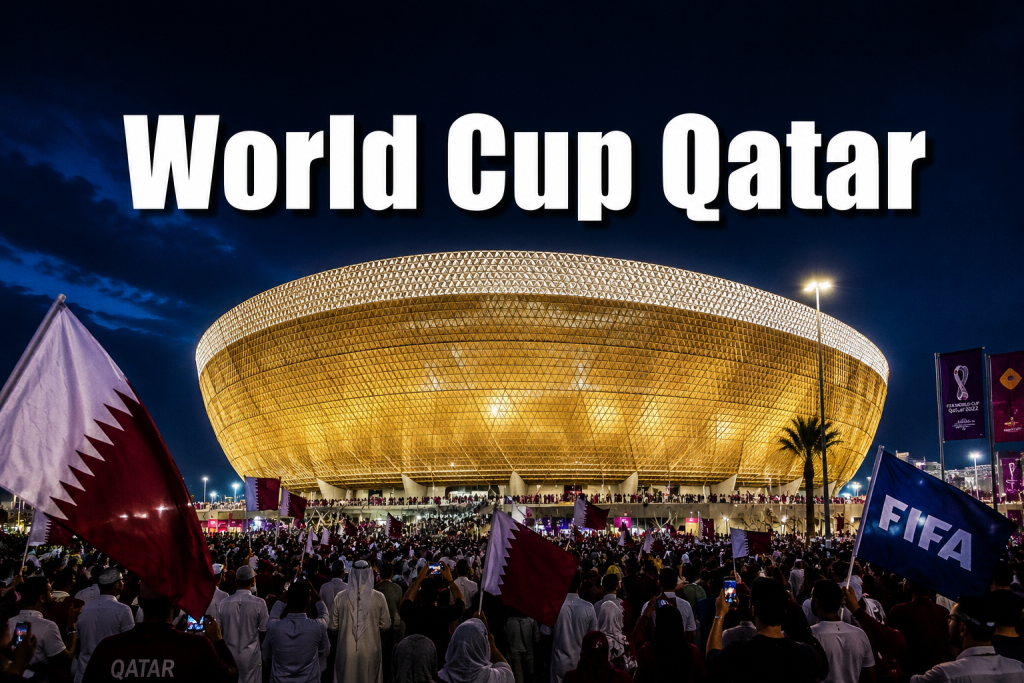
Quick Answer: The 2022 FIFA World Cup Qatar was the first World Cup held in the Middle East, played from November 20 to December 18, 2022, across eight purpose-built or renovated stadiums in and around Doha. Argentina won the tournament, defeating France in a penalty shootout in one of the greatest finals in football history. The event drew global attention both for its football and for serious human rights concerns surrounding its preparation.
Key Takeaways
- 🏆 Argentina won the 2022 World Cup Qatar, beating France 4–2 on penalties after a 3–3 draw
- 🌍 Qatar was the first Middle Eastern country to host a FIFA World Cup
- 💰 Qatar spent an estimated $200–$300 billion on infrastructure (including roads, metro, and hotels), making it the most expensive World Cup in history
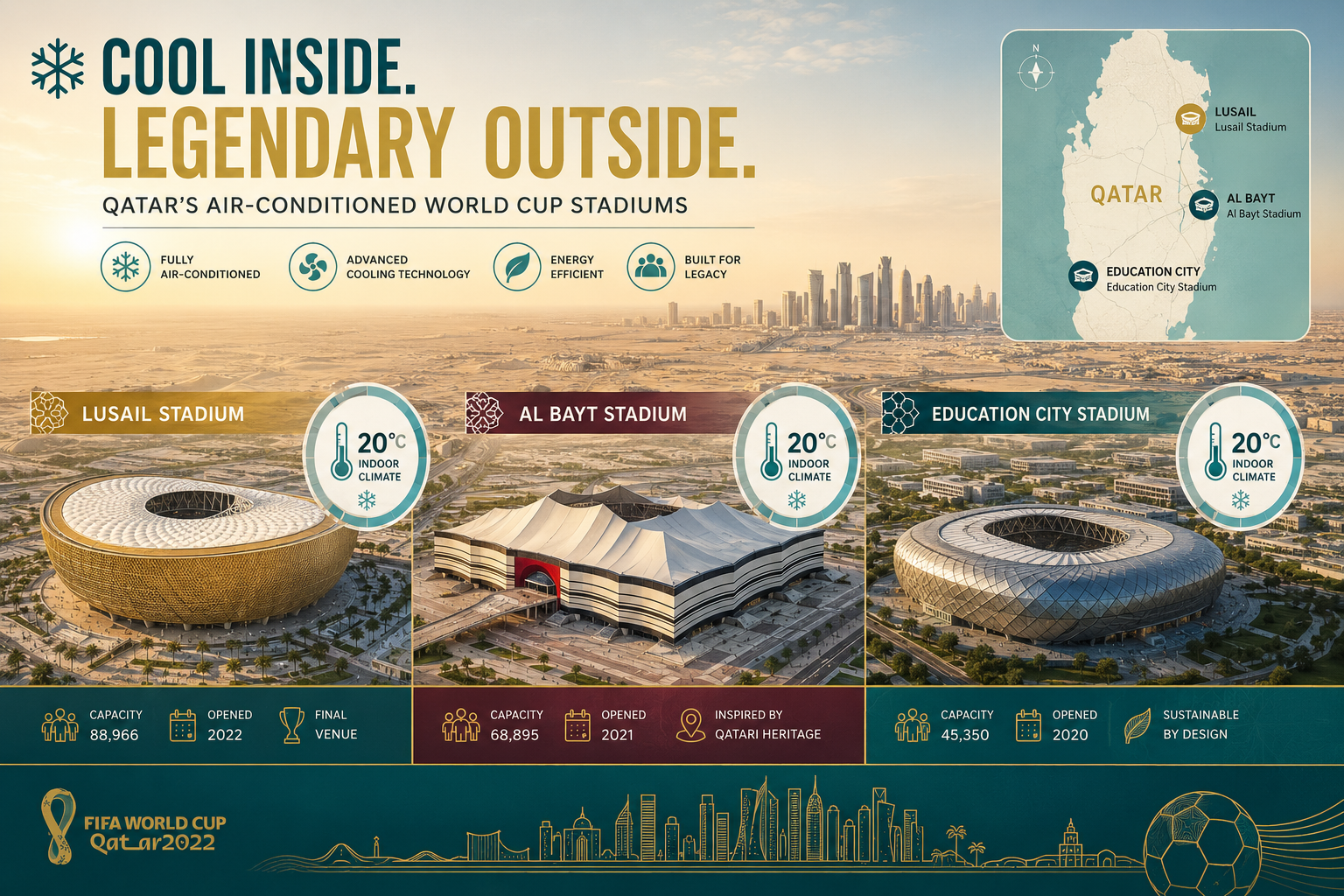
- 🌡️ All stadiums were air-conditioned to manage Qatar’s extreme desert heat
- ⚠️ Significant controversy surrounded migrant worker deaths and LGBTQ+ rights restrictions
- ⚽ Lionel Messi won the Golden Ball, finally claiming the one trophy missing from his career
- 📅 The tournament was moved to November–December to avoid Qatar’s summer temperatures exceeding 40°C
- 🇶🇦 Qatar qualified for the 2026 FIFA World Cup on merit, targeting its first-ever knockout stage berth [2][3]
- 🏟️ Qatar will also host the FIFA U-17 World Cup 2026 from November 19 to December 13, 2026 [4][5]
- 🌐 32 teams competed in Qatar; the 2026 World Cup expands to 48 teams
What Exactly Happened at the 2022 World Cup in Qatar?
The 2022 FIFA World Cup Qatar ran from November 20 to December 18, 2022, with 32 national teams competing across eight stadiums. It was the last World Cup to feature 32 teams before the format expanded to 48 for the 2026 edition in the United States, Canada, and Mexico.
Key tournament facts:
| Detail | Info |
|---|---|
| Host country | Qatar |
| Dates | Nov 20 – Dec 18, 2022 |
| Teams | 32 |
| Stadiums | 8 |
| Total matches | 64 |
| Total goals scored | 172 |
| Winner | Argentina 🇦🇷 |
The group stage produced several upsets. Saudi Arabia defeated Argentina 2–1 in one of the biggest shocks in World Cup history. Japan beat both Germany and Spain to top their group. Morocco became the first African nation to reach the semi-finals, defeating Portugal, Spain, and Belgium along the way.
Who Won the 2022 World Cup Final?
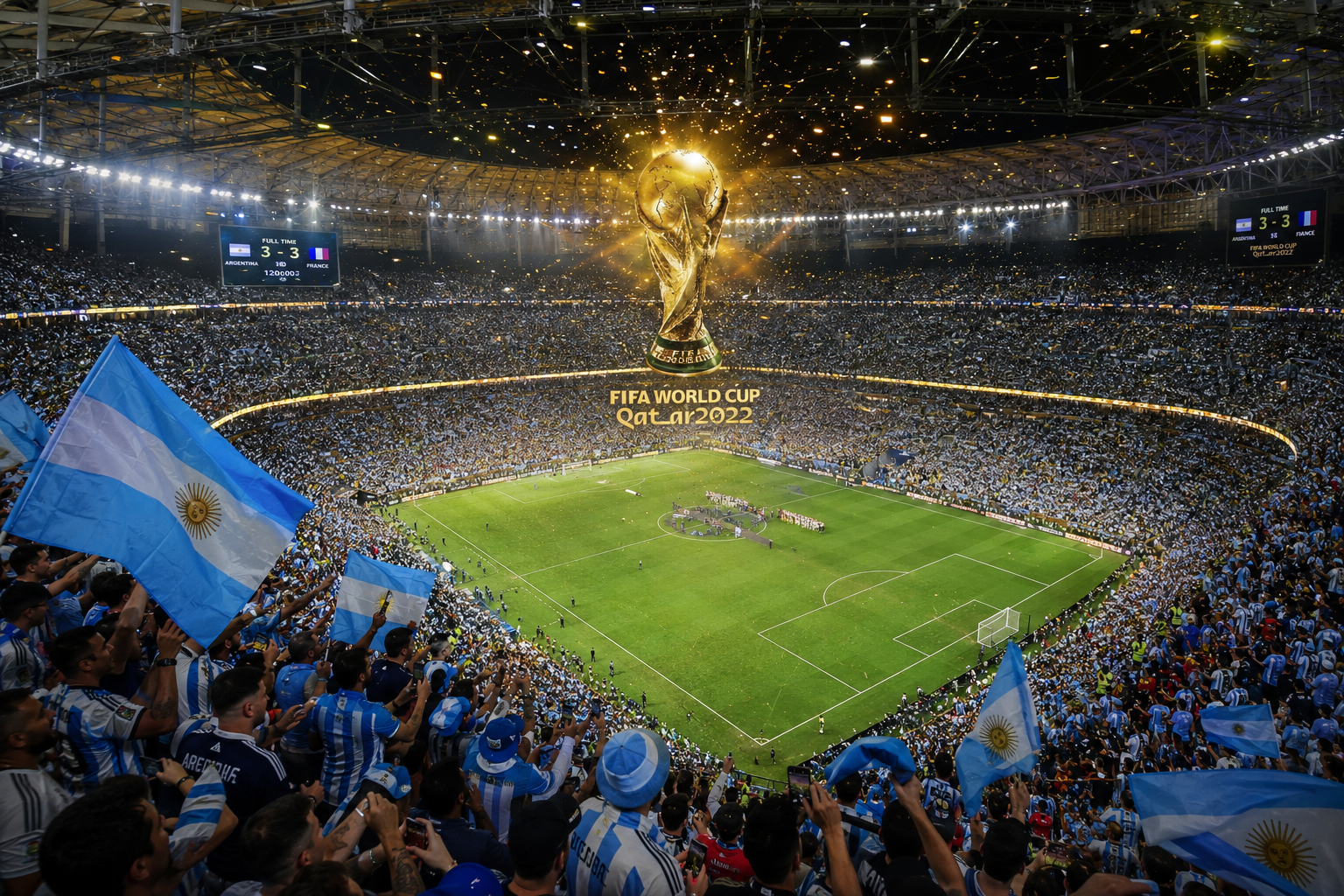
Argentina won the 2022 World Cup Qatar, defeating France 4–2 on penalties after the match finished 3–3 after extra time. It is widely considered the greatest World Cup final ever played.
Kylian Mbappé scored a hat-trick for France, including two goals in the final minutes of normal time to level at 2–2. Angel Di María and two goals from Messi gave Argentina the lead twice before Mbappé’s heroics forced extra time. Gonzalo Montiel scored the winning penalty for Argentina.
Why it matters: It was Lionel Messi’s sixth and final World Cup appearance. He won the Golden Ball (best player), scored seven goals, and at age 35, finally added a World Cup winner’s medal to his career.
How Much Did Qatar Spend to Host the World Cup?
Qatar spent an estimated $200–$300 billion on total infrastructure related to hosting the tournament, according to widely reported figures from outlets including The Guardian and BBC Sport. For context, Russia spent roughly $11.6 billion on the 2018 World Cup.
The bulk of Qatar’s spending went beyond football:
- New metro system connecting stadiums across Doha
- New roads and highways across the country
- Lusail City — an entirely new city built from scratch to host the final
- Eight stadiums built or significantly renovated
- New hotels to accommodate hundreds of thousands of visitors
The direct cost of the stadiums alone was estimated at around $6.8 billion. The broader figure reflects Qatar’s ambition to use the World Cup as a catalyst for national development.
Why Was Qatar Controversial as a World Cup Host?
Qatar’s selection as host in 2010 was controversial from the start, and the controversy deepened over the following 12 years. Three main issues dominated the debate.
1. Alleged corruption in the bidding process FIFA officials faced bribery allegations related to the 2018 and 2022 bidding rounds. Several officials were later banned or faced legal proceedings, though Qatar has consistently denied wrongdoing.
2. Human rights and migrant worker deaths Qatar relied heavily on migrant workers — primarily from South Asia — to build its stadiums and infrastructure. A 2021 investigation by The Guardian estimated that over 6,500 workers from India, Pakistan, Nepal, Bangladesh, and Sri Lanka had died in Qatar since the country won the hosting rights in 2010. Qatar disputed the methodology, arguing that not all deaths were work-related. Regardless, the kafala sponsorship system, which tied workers to employers and restricted their movement, drew widespread condemnation from human rights organisations including Amnesty International and Human Rights Watch.
3. LGBTQ+ rights Same-sex relationships are illegal in Qatar. FIFA and several national football associations issued statements urging tolerance, and Qatar’s government promised safety for all visitors. However, LGBTQ+ fans faced genuine uncertainty about their legal status, and several European captains planned to wear “OneLove” armbands before FIFA threatened sporting sanctions.
“The concerns raised about Qatar were not abstract — they reflected real conditions for real people. Football fans deserve to know that context.” — Human rights advocates consistently made this point throughout the lead-up to the tournament.
What Were the Human Rights Concerns With Qatar Hosting?
The core human rights concern was the treatment of migrant workers under Qatar’s kafala system. Workers often paid recruitment fees of thousands of dollars to agents in their home countries, then found themselves in debt with limited ability to change jobs or leave Qatar without employer permission.
Qatar did introduce labour reforms between 2020 and 2022, including abolishing the requirement for an exit visa and introducing a minimum wage. Human rights groups acknowledged these steps but noted enforcement remained inconsistent.
For LGBTQ+ visitors, Qatar’s authorities stated they would be welcome and safe during the tournament. No widely reported incidents of arrests occurred during the event itself, but the underlying legal situation did not change.
How Did the Climate and Stadiums Work in Qatar?
Qatar’s summer temperatures regularly exceed 40°C, which made a traditional June–July World Cup impossible. FIFA moved the tournament to November–December, when temperatures in Doha average around 24–28°C during the day.
All eight stadiums were equipped with large-scale cooling systems that maintained indoor temperatures at approximately 20°C. The technology used a combination of insulated stadium designs and chilled air delivered through vents near seating areas and the pitch surface.
The eight stadiums:
- Lusail Iconic Stadium (capacity: 89,000) — hosted the final
- Al Bayt Stadium (60,000) — hosted the opening match
- Khalifa International Stadium (45,416)
- Al Janoub Stadium (40,000)
- Education City Stadium (45,350)
- Ahmad Bin Ali Stadium (44,740)
- Al Thumama Stadium (44,400)
- Stadium 974 (44,089) — built from shipping containers and later dismantled
Which Teams Performed Best in Qatar?
Argentina, France, and Morocco were the standout teams of the 2022 World Cup Qatar.
- Argentina — Won the tournament, unbeaten from the quarter-finals onwards after their shock early loss to Saudi Arabia
- France — Runners-up, with Mbappé finishing as top scorer with eight goals
- Morocco — Fourth place; the tournament’s biggest overachievers, becoming Africa’s best-ever World Cup performers
- Croatia — Third place for the second consecutive World Cup
- Brazil — Favourites who were eliminated on penalties by Croatia in the quarter-finals
Common mistake: Many fans assumed Brazil or France would win comfortably. The tournament showed that squad depth and tactical discipline matter more than individual star power — until Argentina proved that having both Messi and a strong collective is the winning formula.
How Did Messi and Argentina Win the World Cup?
Argentina’s path to the title was anything but smooth. They lost their opening match to Saudi Arabia 2–1, which sent shockwaves through the tournament. From that point, coach Lionel Scaloni tightened Argentina’s defensive structure while giving Messi the freedom to dictate play from a deeper position.
Messi scored in every knockout round. He was decisive against the Netherlands (quarter-final, won on penalties), Croatia (semi-final, 3–0 win), and France in the final. His ability to perform under pressure at age 35 — converting his penalty in the shootout — made the victory feel like the conclusion of a 20-year story.
Key factors in Argentina’s win:
- Messi’s leadership and form throughout the knockout stages
- Emiliano Martínez’s outstanding goalkeeping, including crucial saves in two penalty shootouts
- A disciplined defensive unit that conceded rarely until the final itself
- Strong team cohesion built over Scaloni’s four-year tenure
What Was Different About This World Cup Compared to Previous Tournaments?
Several features made the 2022 World Cup Qatar genuinely unique in the tournament’s history.
- First in the Middle East — a new region for the sport’s biggest event
- Compact geography — all stadiums within 55km of Doha, meaning teams and fans stayed in one city
- No alcohol in stadiums — FIFA reversed its original stance two days before the tournament began, banning beer sales inside stadiums (though alcohol remained available in licensed venues)
- November–December schedule — disrupted European domestic leagues for the first time
- Stadium 974 — the first World Cup venue designed to be fully dismantled after the tournament
What Were the Most Memorable Moments From the 2022 World Cup?
Beyond the final, several moments defined the Qatar World Cup:
- Saudi Arabia 2–1 Argentina — arguably the biggest upset in World Cup history
- Japan’s comeback wins against Germany and Spain
- Morocco’s run to the semi-finals, with emotional scenes of players celebrating with their mothers on the pitch
- Mbappé’s hat-trick in the final — the first in a World Cup final since Geoff Hurst in 1966
- Messi lifting the trophy — a moment millions of football fans had waited decades to see
How Did Other Middle Eastern Countries React to Qatar Hosting?
Reaction across the Middle East was largely positive, with many Arab fans viewing Qatar’s hosting as a source of regional pride. Fans from Saudi Arabia, Egypt, Morocco, and other Arab nations travelled in large numbers and were vocal in their support.
Morocco’s run to the semi-finals became a focal point for pan-Arab celebration. Their victories over Spain and Portugal drew enormous crowds in Moroccan cities and across the Arab world.
The geopolitical context was complex — Qatar had been under a diplomatic blockade by Saudi Arabia, the UAE, Bahrain, and Egypt from 2017 to 2021. The blockade ended before the World Cup, and the tournament proceeded without major diplomatic incidents between Gulf states.
Is It Safe to Travel to Qatar for a Sporting Event?
Qatar is considered safe for most visitors attending sporting events. Crime rates are low, security at venues is thorough, and the country has significant experience hosting large international events.
Practical considerations for visitors:
- LGBTQ+ travellers face legal risk under Qatari law; public displays of affection are not advisable
- Alcohol is available in licensed hotels and some fan zones, but not universally
- Dress codes are conservative outside tourist areas
- The climate in November–December is pleasant (20–28°C), making outdoor activities comfortable
Qatar continues to host major international events in 2026, including the FIFA U-17 World Cup from November 19 to December 13, 2026 [4][5]. The country’s infrastructure — built largely for the 2022 World Cup — remains in place and is actively used.
Qatar’s Football Journey After 2022: What Comes Next?
Qatar’s national team had a difficult 2022 World Cup as hosts, becoming the first host nation to be eliminated in the group stage without winning a match. However, the team has rebuilt significantly since then.
Qatar qualified for the 2026 FIFA World Cup on merit after a decisive home win over the UAE in Asian qualifying in October 2025 [1][3]. They have been drawn into Group B at the 2026 World Cup and are explicitly targeting a first-ever knockout-stage berth as their primary goal [2].
Analysts credit Qatar’s improvement to a stronger domestic league, better player development pathways, and the experience gained from competing in the Copa América and other international tournaments [3].
FAQ
Q: When was the 2022 FIFA World Cup held in Qatar? The 2022 FIFA World Cup Qatar ran from November 20 to December 18, 2022. It was moved from the traditional June–July window because of Qatar’s extreme summer heat.
Q: How many teams played in the Qatar World Cup? 32 teams competed. The 2026 World Cup expands to 48 teams.
Q: Did Qatar win any matches at their own World Cup? No. Qatar lost all three group stage matches, becoming the first host nation eliminated without a win.
Q: How many stadiums were used for the 2022 World Cup? Eight stadiums were used, all within 55km of Doha. Stadium 974 was later dismantled.
Q: What happened to the Qatar World Cup stadiums after 2022? Most remain in use for domestic football, concerts, and other events. Stadium 974 was dismantled as planned. Lusail Stadium has been repurposed for community and sporting use.
Q: Who was the top scorer at the 2022 World Cup? Kylian Mbappé of France finished as top scorer with eight goals, including a hat-trick in the final.
Q: Will Qatar host any more FIFA events? Yes. Qatar is hosting the FIFA U-17 World Cup 2026 from November 19 to December 13, 2026, the second of five consecutive editions of this youth tournament awarded to the country [4][5].
Q: Has Qatar qualified for the 2026 FIFA World Cup? Yes. Qatar qualified for the 2026 FIFA World Cup on merit after beating the UAE in Asian qualifying in October 2025 [1][3].
Q: What is Qatar’s goal for the 2026 World Cup? Qatar’s stated target is to reach the knockout stage for the first time in their World Cup history [2].
Q: Was the 2022 World Cup the most expensive ever? By most estimates, yes. Total spending on infrastructure connected to the event reached an estimated $200–$300 billion, far exceeding any previous World Cup.
Conclusion
The 2022 World Cup Qatar was a tournament of extremes: extraordinary football, a historic final, and legitimate questions about human rights that the sport cannot ignore. Argentina’s victory gave Messi the ending his career deserved. Morocco’s run inspired a continent. And the compact, air-conditioned format proved that football can work in genuinely new environments.
Actionable next steps for football fans in 2026:
- Follow Qatar’s 2026 World Cup campaign — they’re in Group B and targeting their first knockout stage appearance [2]
- Watch the FIFA U-17 World Cup Qatar 2026 (November 19 – December 13) to see the next generation of global talent [4][5]
- Revisit the 2022 highlights — the Messi-Mbappé final remains one of the best 90 minutes in football history
- Stay informed on Qatar’s labour reforms — human rights organisations continue to monitor progress on worker protections
- Plan ahead for the 2026 World Cup in the USA, Canada, and Mexico — the expanded 48-team format means more matches and more nations
References
[1] Qatar Qualifies For Fifa World Cup Final After Home Win Over The United Arab Emirates – https://www.euronews.com/video/2025/10/15/qatar-qualifies-for-fifa-world-cup-final-after-home-win-over-the-united-arab-emirates
[2] Qatar Target Knockout Berth As First World Cup 2026 Milestone – https://thepeninsulaqatar.com/article/25/05/2026/qatar-target-knockout-berth-as-first-world-cup-2026-milestone
[3] 19 Days To The World Cup How Qatar Earned Its Spot In The 2026 Field – https://sports.yahoo.com/soccer/article/19-days-to-the-world-cup-how-qatar-earned-its-spot-in-the-2026-field-120000955.html
[4] Qatar To Host Fifa Under 17 World Cup 2026 In November – https://www.aljazeera.com/sports/2026/4/29/qatar-to-host-fifa-under-17-world-cup-2026-in-november
[5] Fifa U 17 World Cup Qatar 2026 Draw Made As Road To Doha Begins – https://www.euronews.com/2026/05/22/fifa-u-17-world-cup-qatar-2026-draw-made-as-road-to-doha-begins